
In the UK, the cost to develop a mobile app typically runs from a low five-figure sum for a simple MVP to a high six-figure sum for a feature-rich consumer or enterprise product. Compliance-heavy or deeply integrated enterprise apps can be significantly more expensive. Timelines vary widely: a focused MVP typically takes a few months, mid-market apps require several months, and complex enterprise builds often span a year or more. Budget an additional portion of your build cost annually for maintenance after launch.
Two factors account for most of the variance you will see in quotes:
- Feature complexity and backend requirements — real-time functionality, payment processing, third-party API integrations, and offline capability each add significant engineering hours.
- Compliance and security obligations — healthcare, fintech, and regulated-data apps carry audit, penetration testing, and legal review costs that can add 20–30% above the headline build figure.
Pro Tip: Start with a structured discovery phase before committing to a full build. A well-scoped discovery (typically £3,000–£8,000) produces a feature list, technical architecture, and a reliable estimate — cutting the risk of expensive scope changes mid-project without introducing technical debt.
Table of Contents
- What does it cost to develop a mobile app in the UK?
- What actually moves the price on a development quote?
- How does the budget split across development stages?
- How do platform and technology choices affect your budget?
- What do UK agencies and contractors charge per hour?
- Sample budgets for common app types
- How can you reduce development cost without creating problems later?
- What does it cost to own an app after launch?
- How Pocketapp estimates cost: our quoting methodology
- Key takeaways
- What experienced UK buyers often get wrong about app costs
- Pocketapp's discovery and MVP service for UK businesses
- Useful sources and further reading
- FAQ
What does it cost to develop a mobile app in the UK?
The table below maps the four main complexity brackets to realistic GBP ranges, typical timelines, and representative feature sets.
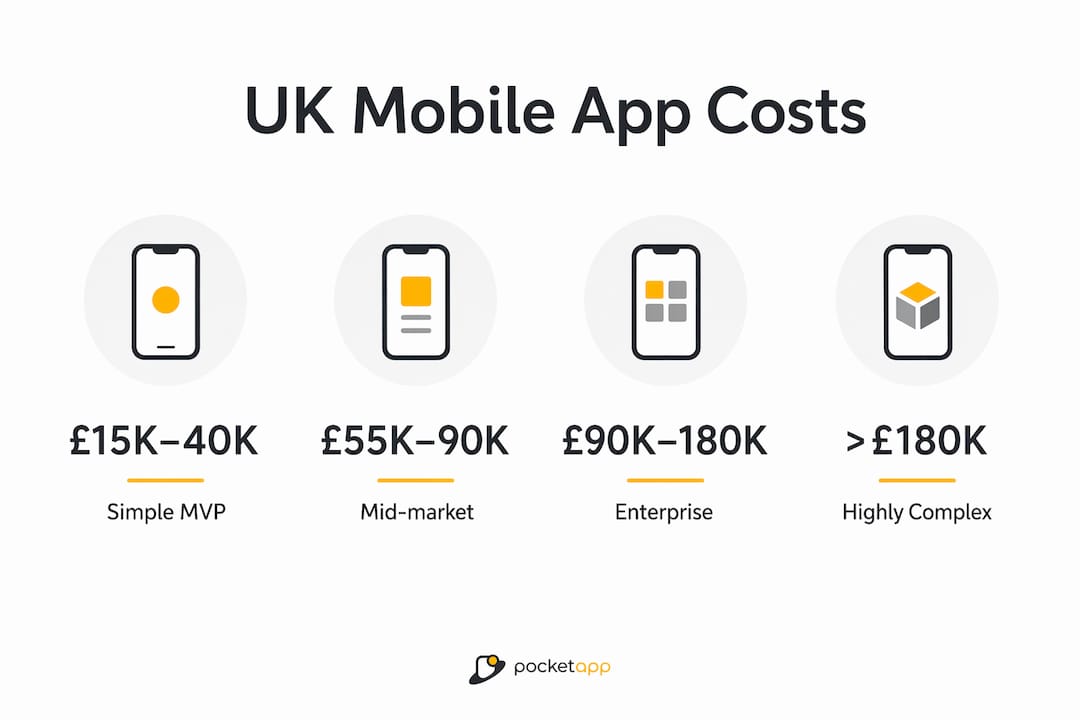
| Complexity | Typical UK cost | Timeline | Example features |
|---|---|---|---|
| Simple / MVP | lower to mid-five figures | a few months | Login, 3–5 screens, basic API, push notifications |
| Standard consumer or business app | mid-five to lower six figures | several months | Multi-screen, user profiles, payments, CMS, analytics |
| Feature-rich / marketplace | £95,000–£200,000 | half a year or more | Two-sided marketplace, real-time chat, maps, media upload |
| Compliance / enterprise | £180,000 and above | extended timelines | Role-based access, audit trails, EHR/CRM integration, pen testing |
Globally, production projects in 2026 typically sit between $30,000 and $500,000+, with a median around $80,000–$150,000. UK projects land at the higher end of comparable international ranges because of local agency rates and, often, stricter compliance requirements.
A few points worth noting at each level:
- Simple MVPs at £15,000–£40,000 are achievable only with a tightly scoped feature list and a cross-platform framework. Scope creep is the most common reason a £20,000 brief becomes a £55,000 project.
- Standard apps in the £40,000–£90,000 bracket usually include a backend, a content management layer, and at least one payment or mapping integration — all of which add meaningful hours.
- Marketplace and feature-rich apps require two-sided logic, real-time infrastructure, and extensive QA across devices, which is why the range climbs quickly.
- Enterprise builds carry costs that go well beyond engineering: security audits, regulatory compliance reviews, and integration with legacy systems all add to the final figure.
What actually moves the price on a development quote?
Feature choices are the single biggest lever. A simple login flow takes roughly 40–80 developer hours; a real-time chat feature requires 150–250 hours because it touches WebSocket infrastructure, media handling, push notifications, and moderation logic simultaneously. Payments, maps, and media streaming each carry their own distinct hour ranges, and stacking several of them compounds the cost non-linearly.

Backend complexity is the second major driver. An app that reads from a single REST API is very different from one that must handle offline sync, high-concurrency data writes, or GDPR-compliant data residency. The backend can represent 40–55% of total development spend on a data-intensive product.
Design investment also shifts the number meaningfully:
- Template or component-library UI (e.g. Material Design, Apple Human Interface Guidelines) typically costs 15–20% of the total build budget.
- Custom illustration, micro-animations, and bespoke design systems push that share to 25–30% and require a dedicated UI/UX designer rather than a developer doing double duty.
Pro Tip: If budget is tight, invest in UX research and wireframing first, then use a component library for the visual layer. You get a well-structured product without the cost of a fully bespoke design system — and you can refine the visual identity in a later phase.
Compliance and security requirements add a predictable uplift. Healthcare apps (NHS integrations, IG Toolkit alignment), fintech products (FCA considerations), and any app handling children's data (UK GDPR, Age Appropriate Design Code) typically add 20–30% above the base build cost. This covers penetration testing, legal review, and additional QA cycles.
Geography and team seniority shape the hourly rate, which then multiplies across every hour in the project. Representative mid-level rates run at £70–£90 per hour for Western European agencies, $35–$80 for Eastern European teams, and $20–$55 for South Asian suppliers — all at agency/mid-level. A UK-based senior developer commands more than those mid-level figures, which is why blended team models (senior lead, mid-level engineers, offshore QA) are common on mid-market projects.
Statistic callout: Hidden costs typically add 15–30% above the headline build quote; the first-year total often equals the build cost plus 40–60% when hosting, third-party APIs, store fees, and maintenance are included.
How does the budget split across development stages?
Understanding where the money goes at each stage helps you spot thin or missing line items in a supplier quote. The percentages below reflect industry-standard budget splits across a typical mid-market project.
| Stage | % of total budget | GBP range (£70K mid-market example) | Key deliverables |
|---|---|---|---|
| Discovery | 10–15% | £8,000–£10,500 | Feature spec, technical architecture, wireframes, risk log |
| Design (UX/UI) | 20–25% | £14,000–£17,000 | User flows, high-fidelity screens, design system, prototype |
| Front-end development | 20–25% | £14,000–£17,000 | All client-side screens, navigation, animations |
| Back-end development | 20–30% | £14,000–£20,000 | API, database, auth, integrations, admin panel |
| QA and testing | 15–20% | £10,500–£14,000 | Test plans, regression, device testing, performance |
| Deployment and launch | 5–10% | £4,000–£7,000 | Store submissions, CI/CD pipeline, monitoring setup |
| Year-1 maintenance | 15–20% of build/year | £10,500–£14,000 p.a. | Bug fixes, OS updates, minor feature additions |
Worked example — £70,000 mid-market app:
A standard consumer app with user authentication, a product catalogue, push notifications, Stripe payments, and an admin dashboard might break down as follows:
- Discovery and scoping: £8,000
- UX/UI design (custom component library): £15,000
- Front-end (React Native, iOS + Android): £16,000
- Back-end (Node.js API, PostgreSQL, AWS): £18,000
- QA (manual + automated, 3 device sets): £10,000
- Deployment and store submission: £3,000
- Total build: £70,000
- Year-1 maintenance budget: £12,000–£14,000
The QA and project management uplifts are often underestimated. Industry standard practice applies QA at roughly 20% of development cost and project management at around 15% — both of which should appear as explicit line items in any credible quote.
How do platform and technology choices affect your budget?
The platform decision is one of the earliest and most consequential cost choices you will make. Building a single native iOS app is the baseline. Adding a native Android build is effectively a second project, pushing total hours to roughly 1.8–1.9× the single-platform figure. Cross-platform frameworks like Flutter and React Native typically increase total hours to only about 1.2× a single native build, because 70–85% of the codebase is shared.
That translates to a saving of approximately 30–45% versus commissioning two separate native apps — a meaningful difference on a £80,000 project.
Cross-platform is not a universal answer, though. There are areas where platform-specific work remains necessary regardless of the framework:
- Payment integrations (Apple Pay, Google Pay) require platform-specific configuration and testing.
- Camera and media pipelines for advanced use cases (AR, video processing) often need native modules.
- Deep OS integrations — health data (HealthKit/Health Connect), NFC, background location — frequently require native bridging code.
- Android QA overhead is real: the fragmentation of Android devices and OS versions means QA cycles are typically 20–30% longer than on iOS, regardless of framework.
Pro Tip: Choose cross-platform development when your feature set is primarily UI-driven and your integrations are standard (auth, payments, push, analytics). Opt for native when your core value proposition depends on deep hardware access or performance-critical rendering — the cost saving from cross-platform disappears quickly if you end up writing native modules for half the feature set.
What do UK agencies and contractors charge per hour?
UK development rates vary considerably by seniority, specialism, and whether you are engaging a freelancer, a boutique agency, or a larger studio. The table below gives working GBP ranges for the roles you will encounter on a typical project.

| Role | Freelancer day rate | Agency hourly rate |
|---|---|---|
| Junior developer | £200–£300/day | £45–£60/hr |
| Mid-level developer | £350–£500/day | £70–£85/hr |
| Senior developer / tech lead | £600–£800/day | £85–£110/hr |
| UX/UI designer | £300–£500/day | £55–£90/hr |
| Project manager / delivery lead | £350–£500/day | £60–£85/hr |
| QA engineer | £250–£400/day | £45–£70/hr |
Common agency pricing models:
- Time and materials (T&M): You pay for hours worked at an agreed rate. Flexible for evolving scope, but requires active budget management. Most appropriate for complex or discovery-led projects.
- Fixed price: A defined scope is costed upfront. Reduces financial risk for the client, but requires a detailed specification before work begins. Changes to scope trigger formal change requests.
- Retainer / phased delivery: A monthly commitment for ongoing development, maintenance, or product iteration. Suits businesses that want a continuous development relationship rather than a single project.
Sample team composition — 6-month mid-market project:
A realistic team for a £70,000–£90,000 app might include: one senior developer (tech lead, 3 days/week), two mid-level developers (full time), one UX/UI designer (full time for months 1–3, then part time), one QA engineer (part time throughout, full time in months 5–6), and a part-time project manager. At a blended agency rate of approximately £75/hour, 1,000 hours of development effort produces a £75,000 build cost before QA and PM uplifts.
Pro Tip: When comparing quotes, ask each supplier for their blended hourly rate and total estimated hours separately. A quote that bundles everything into a single fixed price makes it impossible to assess whether the hours are realistic — and that is usually where scope disputes originate.
Sample budgets for common app types
The scenarios below use a UK agency team model at a blended rate of £75/hour unless stated otherwise. All figures are indicative; your actual quote will depend on the specific feature list agreed during discovery.
| App type | Estimated cost | Timeline | Key assumptions |
|---|---|---|---|
| MVP / proof of concept | £15,000–£40,000 | 8–12 weeks | 3–5 screens, single platform, no custom backend, third-party auth |
| Consumer app (iOS + Android) | £55,000–£90,000 | 4–6 months | Cross-platform, user profiles, push, payments, basic analytics |
| Two-sided marketplace | — | 6–9 months | Buyer/seller flows, real-time messaging, escrow payments, ratings |
| SaaS companion / B2B tool | £70,000–£90,000 | 5–8 months | CRM/ERP integration, role-based access, offline sync, reporting |
| Enterprise / regulated | £180,000 and above | 9–18 months | Compliance, pen testing, legacy integration, multi-tenant architecture |
Worked example — consumer marketplace app:
Assumptions: React Native (iOS + Android), user registration and profiles, product listings with search and filters, in-app messaging (real-time), Stripe Connect payments, seller dashboard, push notifications, basic admin panel.
- Discovery: £9,000
- Design: £18,000
- Front-end (React Native): £22,000
- Back-end (Node.js, PostgreSQL, Redis for real-time): £28,000
- QA (manual + automated): £14,000
- Deployment: £4,000
- Build total: £95,000
- Year-1 maintenance and hosting: £16,000–£19,000
For apps that include payment integrations, factor in Stripe's transaction fees and the additional QA time required to test payment flows across both platforms — this is a line item that frequently appears only after the initial quote is agreed.
How can you reduce development cost without creating problems later?
The most reliable way to reduce mobile app development cost is to reduce scope — but scope reduction only works if it is done deliberately, not arbitrarily. Cutting the wrong features creates a product that cannot validate your core hypothesis, which wastes the entire budget.
MVP scoping rules:
- Define the single user action that proves your product's core value. Build only what is needed to enable that action.
- Defer everything that is "nice to have" to phase 2. If a feature does not directly support the core user journey, it does not belong in the MVP.
- Use third-party services (Stripe for payments, Twilio for SMS, Firebase for auth and push) rather than building custom infrastructure. This can save 30–50 hours per integration.
- Choose cross-platform from the start if your feature set allows it. The 30–45% saving versus two native builds is the single largest structural cost reduction available.
Procurement dos and don'ts:
- Do run a structured discovery phase before signing a build contract. It costs £3,000–£8,000 and saves multiples of that in avoided scope changes.
- Do ask for a detailed breakdown of hours by feature, not just a total price.
- Do check that QA and project management are explicit line items, not absorbed into a vague "development" figure.
- Don't select a supplier purely on lowest price. Choosing the cheapest option frequently leads to technical debt, poorer UX, and a forced rebuild within 12–18 months — at a cost that exceeds the saving.
- Don't skip the discovery phase to save money. Undefined scope is the primary cause of budget overruns.
- Don't assume offshore is always cheaper when total cost of ownership is considered. Communication overhead, QA rework, and timezone friction add hidden hours.
Pro Tip: Ask any prospective supplier for two or three examples of projects where the final cost exceeded the original estimate, and how they handled it. A supplier who cannot answer this question clearly has not built a mature change-control process — and you will pay for that gap.
For a broader view of how app strategy affects long-term cost efficiency, it is worth thinking about procurement and product decisions together from day one.
What does it cost to own an app after launch?
The build cost is only part of the picture. Annual maintenance should be budgeted at 15–20% of the original build cost per year. On a £70,000 app, that is £10,500–£14,000 annually — covering OS updates (Apple and Google each release major platform versions annually), bug fixes, security patches, and minor feature additions.
Beyond maintenance, recurring infrastructure and third-party costs add up:
- Cloud hosting (AWS, Azure, Google Cloud): £50–£500/month depending on traffic and data volume. Cloud-based infrastructure scales with usage, so a low-traffic MVP might cost £50–£100/month while a high-traffic consumer app could run £300–£800/month.
- Payment processing (Stripe, Braintree): typically 1.4–2.9% per transaction plus a fixed fee, plus monthly platform fees if using Stripe Connect for marketplaces.
- SMS and push notifications (Twilio, Firebase): low-volume apps often stay within free tiers; high-volume messaging can cost £200–£800/month.
- Mapping (Google Maps Platform, Mapbox): free tier covers modest usage; commercial-scale mapping costs £100–£500/month.
- App store fees: Apple Developer Programme costs $99/year (
£80); Google Play Developer account is a one-time $25 (£20) fee. - Analytics and monitoring (Mixpanel, Datadog, Sentry): free tiers exist, but production-grade monitoring for a mid-market app typically costs £100–£400/month.
Statistic callout: Hidden costs add a significant percentage above the headline build quote; across the first year, total ownership cost often substantially exceeds the build cost when including hosting, APIs, and store fees.
Pro Tip: Set up cost alerting on your cloud provider from day one. AWS, Azure, and Google Cloud all offer budget alerts that fire before you hit a threshold — a simple step that prevents the "surprise £3,000 hosting bill" that catches many first-time app owners off guard.
For a detailed look at keeping your product in good shape over time, Pocketapp's guidance on app maintenance covers what a well-structured support arrangement should include.
How Pocketapp estimates cost: our quoting methodology
Pocketapp's estimating process starts before a single line of code is written. With over 300 projects delivered for clients including WWF, Dechra, and Crocus, the team has built a structured approach to producing estimates that hold up through delivery.
The Pocketapp estimating method:
- Discovery workshop — a structured session (typically half a day to two days) to define user journeys, technical constraints, and integration requirements. This produces a feature list ranked by priority and a first-pass technical architecture.
- Hours modelling — each feature is estimated in developer hours using historical data from comparable delivered projects. QA is added at approximately 20% of development hours; project management at approximately 15%.
- Platform and team blend — the team model (senior lead, mid-level engineers, designer, QA) is selected based on the project's complexity, and a blended rate is applied to produce a GBP total.
- Buffer for unknowns — a contingency of 10–15% is applied to the hours estimate for integration unknowns and third-party API variability. This is disclosed transparently in the quote, not hidden in inflated line items.
- Change control — any scope change after sign-off is assessed against the hours model and presented as a formal change request with cost and timeline impact before work proceeds.
Example project outline:
A retail client needed a cross-platform loyalty and rewards app with barcode scanning, a points ledger, push notifications, and a CMS-driven content feed. Discovery produced a 47-feature specification. The hours model estimated 920 development hours, 184 QA hours, and 138 PM hours — a total of 1,242 hours at a blended rate of £78/hour, producing a build estimate of approximately £97,000. The project delivered within 3% of that figure.
To get a fast, accurate quote from Pocketapp, send a brief that includes: your target user and their core job to be done, the platforms you need (iOS, Android, or both), any integrations you know about (payments, CRM, mapping), your target launch date, and your indicative budget range. The more specific the brief, the more precise the estimate.
Key takeaways
The cost to develop a mobile app in the UK ranges from £15,000 for a tightly scoped MVP to £180,000 and above for a compliance-heavy enterprise product, with mid-market consumer apps typically landing between £55,000 and £90,000.
| Point | Details |
|---|---|
| UK cost ranges | Simple MVPs cost £15,000–£40,000; mid-market apps £55,000–£90,000; enterprise builds £180,000 and above. |
| Maintenance budget | Plan 15–20% of your build cost per year for OS updates, bug fixes, and minor features. |
| Hidden costs | First-year ownership typically adds 40–60% on top of the build cost when hosting, APIs, and store fees are included. |
| Cross-platform saving | Flutter or React Native saves approximately 30–45% versus two separate native builds. |
| Pocketapp next step | Pocketapp offers structured discovery workshops and fixed-scope MVPs; contact the team with your brief for a transparent, hours-based quote. |
What experienced UK buyers often get wrong about app costs
Most budget conversations focus on the build cost. That is the wrong frame. The build is a one-time event; the product is a long-term asset that will require ongoing investment to remain functional, secure, and competitive. A £70,000 app that costs £8,000 per year to maintain is a very different financial proposition from a £50,000 app built on fragile foundations that requires a £40,000 rebuild in year two.
The red flags in a vendor proposal are usually not about price — they are about what is missing. A quote with no explicit QA line item means QA is either not planned or absorbed into a vague "development" figure that will be squeezed when the project runs long. A proposal with no discovery phase means the scope has not been properly defined, and the fixed price is therefore a fiction. Vague deliverable descriptions ("we will build the app") with no feature-level breakdown make it impossible to hold a supplier accountable when the product does not match expectations.
The procurement step that most buyers skip is asking for a change-control process before signing. Every project encounters unknowns. The question is not whether scope will change, but whether you will know about it and approve it before the cost is incurred. A supplier who cannot describe their change-control process clearly is a supplier who will present you with a surprise invoice.
One more thing: the cheapest quote is almost never the cheapest project. Technical debt compounds. A codebase written by the most affordable team available often costs more to maintain, extend, and eventually replace than a well-architected product would have cost to build correctly the first time.
Pocketapp's discovery and MVP service for UK businesses
For UK businesses working through their first app budget, the most common problem is not a lack of ambition — it is a lack of a precise brief. Pocketapp's mobile app development service is built around solving that problem first.
The process starts with a discovery workshop that turns your idea into a costed, prioritised feature specification. From there, Pocketapp can deliver a fixed-scope MVP, a full consumer or enterprise product, or a phased build that lets you validate early and invest further based on real user data. With cross-platform expertise in Flutter and React Native, the team builds for iOS and Android simultaneously without doubling the budget. Every quote includes a transparent hours breakdown, a blended rate, and a clear change-control process.
To get started, send Pocketapp a brief describing your users, your platforms, your key integrations, and your target budget. The team will respond with a structured estimate and a recommended next step — whether that is a discovery workshop, a fixed-scope MVP, or a full project proposal.
Request a quote or book a discovery session with Pocketapp today.
Useful sources and further reading
The following sources informed the cost figures and methodology in this guide:
- Upwork: How Much Does It Cost to Build a Mobile App? — covers stage-by-stage budget splits and the maintenance percentage rule of thumb.
- TECHSY Mobile App Cost Calculator — feature-level hour estimates and cross-platform cost multipliers.
- Yudiz: Mobile App Development Cost 2026 — UK-oriented ranges and hidden cost analysis.
- TeamSeven: Real Numbers by App Type — regional hourly rate benchmarks by seniority.
- Inoxoft App Cost Calculator — interactive tool for estimating project cost by feature set.
- Microsoft Azure Pricing Calculator — useful for modelling cloud hosting and infrastructure costs.
- Pocketapp: Measuring ROI from your business mobile app — practical guidance on linking build cost to business outcomes.
- Pocketapp: App maintenance guide — what a well-structured post-launch support arrangement should cover.
FAQ
Is it expensive to create a mobile app in the UK?
A simple MVP starts at around £15,000–£40,000 with a UK agency; mid-market consumer apps typically cost £55,000–£90,000. Complexity, compliance requirements, and platform choice are the main factors that push costs higher.
How much does it cost to own a mobile app each year?
Budget 15–20% of your original build cost annually for maintenance, covering OS updates, bug fixes, and minor features. On top of that, hosting, third-party APIs, and store fees typically add 40–60% to the build cost across the first year.
Is an app with 10,000 users worth a lot?
User numbers alone do not determine value. An app with 10,000 users is valuable only if those users generate revenue, reduce operational costs, or enable a measurable business outcome — the business model matters far more than the download count.
Is owning an app profitable?
It can be, but profitability depends on the monetisation model, user retention, and whether the app replaces a more expensive manual or outsourced process. Treating app development as an infrastructure investment and modelling ROI against the processes it replaces gives a more accurate picture than focusing on headline build cost alone.
How do I get an accurate quote for my app idea?
Prepare a brief that covers your target users, the platforms you need, your key integrations, and your indicative budget. A structured discovery phase (£3,000–£8,000) before the main build is the most reliable way to produce an estimate that holds through delivery.