
TL;DR:
- Investing in user experience yields an average return of £100 for every £1 spent, driven by higher conversions and cost savings.
- Early UX investment significantly reduces development costs by fixing issues in prototyping and improves long-term competitive advantage through continuous testing and iteration.
User experience (UX) is defined as every interaction a person has with your product, service, or brand, and every £1 invested in it returns an average of £100. That figure, drawn from multiple industry studies, is not a marketing claim. It reflects the compounding effect of higher conversions, lower support costs, and stronger retention that well-designed products generate. Adobe and IBM have both documented the financial case for UX at scale, yet most organisations still treat it as a design task rather than a board-level priority. This article sets out the quantifiable business reasons to invest in user experience and explains precisely where those returns come from.
What measurable returns can businesses expect from investing in UX?
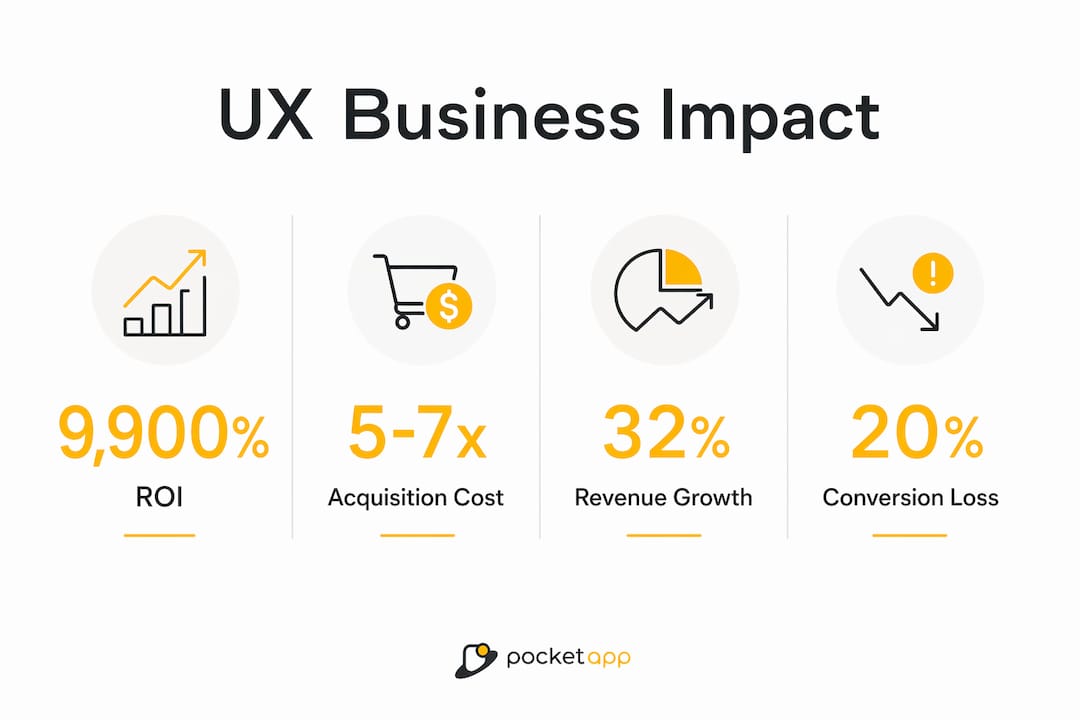
The user experience ROI case is built on hard numbers, not sentiment. Studies consistently show a 9,900% average return on UX investment, driven primarily by conversion rate improvements, reduced engineering rework, and lower customer support volumes. A well-designed checkout flow, for instance, can lift conversion rates by up to 400%. That is not a marginal gain. It is the difference between a product that pays for itself and one that does not.

The financial impact extends beyond conversion. Organisations that invest in UX report measurable reductions in inbound support queries, because intuitive design answers questions before users need to ask them. Each avoided support call has a direct cost saving attached to it. When multiplied across thousands of users, the aggregate saving frequently exceeds the original design budget within the first year.
Design maturity also correlates with shareholder value. Companies with mature UX practices see 32% higher revenue growth and 56% greater shareholder returns compared to competitors. This tells you that UX is not a one-off project cost. It is a compounding asset that appreciates as the organisation's design capability matures.
| Metric | Business outcome |
|---|---|
| £1 invested in UX | Average £100 return (9,900% ROI) |
| Conversion rate improvement | Up to 400% uplift with well-designed flows |
| Revenue growth | 32% higher for UX-mature companies |
| Shareholder returns | 56% greater for design-led organisations |
| Support cost reduction | Fewer inbound queries from intuitive design |
How does UX impact customer acquisition and retention?
Acquiring a new customer costs five to seven times more than retaining an existing one. That ratio makes retention through usability one of the highest-leverage investments available to any business. When your product is easy to use, customers return without prompting, recommend it to others, and require less hand-holding from your support team. Each of those outcomes reduces your effective customer acquisition cost (CAC).
UX reduces friction at every stage of the customer journey. Friction is the technical term for anything that slows, confuses, or frustrates a user. A confusing navigation structure, a form with too many fields, or a slow-loading page all constitute friction. Removing these barriers does not just improve satisfaction scores. It directly increases the proportion of users who complete a desired action, whether that is a purchase, a sign-up, or a renewal.
Behavioural segmentation is the practice of grouping users by how they actually interact with your product, rather than by demographic assumptions. Organisations that align their user journeys to real behavioural data see significantly higher engagement because the experience feels relevant rather than generic. This is the mechanism behind enhancing user engagement at scale.
UX features that directly improve retention include:
- Onboarding flows that guide new users to their first success within minutes, reducing early drop-off
- Progressive disclosure that presents information in layers, preventing cognitive overload on first use
- Error prevention and recovery that catches mistakes before they frustrate users and provides clear recovery paths
- Personalisation triggers based on past behaviour that make returning users feel the product understands them
- Performance consistency across devices and connection speeds, so the experience does not degrade on mobile
Pro Tip: Map your top three user drop-off points before commissioning any new design work. Fixing existing friction is almost always more cost-effective than adding new features.
Why is early UX investment critical for controlling development costs?
The cost of fixing a design flaw scales dramatically with how late it is discovered. Fixing issues in prototyping costs up to 100 times less than addressing the same problem after product launch. This ratio is not theoretical. It reflects the engineering hours, QA cycles, and deployment overhead required to change code that is already in production, compared to adjusting a wireframe in a design tool like Figma or Sketch.
Most organisations underestimate this cost multiplier because they account for design and development separately. The design budget looks small relative to engineering, so it is the first line to be cut when timelines tighten. The result is products that ship with usability problems baked in, requiring expensive post-launch patches and generating support costs that dwarf the original design saving.
Early UX investment also accelerates release cycles. When developers receive well-tested, clearly specified designs, they spend less time interpreting ambiguous requirements and less time in back-and-forth with product managers. The downstream effect is faster delivery, fewer defects, and more predictable sprint velocity.
| Development stage | Relative cost to fix a UX issue |
|---|---|
| Design and prototyping | 1x (baseline) |
| Development (pre-launch) | 10x |
| Post-launch (live product) | 100x |
Pro Tip: Run at least one moderated usability test with five representative users before any feature moves from design into development. Five users typically surface 85% of critical usability problems.
What role does performance and design play in UX outcomes?
Technical performance is a UX decision, not just an engineering one. Slow page load times decrease conversion rates by approximately 20% for every additional second of delay, and retailers lose an estimated £2.6 billion annually due to slow page speeds. Improving load time by just 0.1 seconds increases retail conversions by 8.4%. These are not rounding errors. They are material revenue differences that sit entirely within the control of your product and engineering teams.
Visual design shapes perception before a user has read a single word. Users form their first impression of a website within 50 milliseconds, and 94% of those first impressions relate to design quality. A product that looks untrustworthy or cluttered loses users before they have evaluated its actual value. This is why the importance of UX design extends well beyond aesthetics. It is the mechanism by which trust is established or destroyed in under a second.
Cognitive load theory and Hick's Law both support the case for simplicity in interface design. Hick's Law states that the time taken to make a decision increases with the number of options presented. Fewer, clearer choices produce faster decisions and higher completion rates. Practical design principles that reduce cognitive load include:
- Whitespace that separates content into digestible sections and reduces visual noise
- Typography hierarchy that signals which information is most important without requiring the user to read everything
- Consistent iconography that allows users to build a mental model of the interface quickly
- Colour contrast that meets WCAG accessibility standards, broadening your usable audience
- Chunking of complex forms or processes into clearly labelled steps that feel manageable
How does mature UX practice drive long-term competitive advantage?
The gap between how companies perceive their own UX and how customers actually experience it is striking. 80% of companies believe their UX is superior, but only 8% of customers agree. This perception gap is not a communication problem. It is a measurement problem. Organisations that do not continuously test with real users are operating on assumptions, and those assumptions are almost always more favourable than reality.
Continuous testing and data-driven iteration are what separate UX-mature organisations from those that treat design as a one-time deliverable. Mature UX organisations also improve internal workflows, reclaiming hundreds of thousands in annual productivity by shaving time from repetitive tasks for large teams. Internal ROI from UX improvements frequently equals or exceeds the gains on the customer-facing side, yet it is rarely included in the business case.
Embedding UX as a continuous improvement loop produces compounding returns. Each iteration surfaces new insights, each insight informs a better decision, and each better decision closes the gap between what your product does and what your users actually need. Organisations that build this capability into their culture, rather than outsourcing it as a project, consistently outperform competitors on both growth and retention metrics.
The long-term benefits of prioritising UX at a strategic level include:
- Higher net promoter scores that reduce paid acquisition dependency
- Lower churn rates that improve the accuracy of revenue forecasting
- Stronger brand equity that commands premium pricing in competitive markets
- Faster product iteration cycles driven by a clear understanding of user needs
Key takeaways
Investing in user experience delivers compounding financial returns across conversion, retention, development cost control, and competitive positioning, making it one of the highest-ROI decisions available to business leaders.
| Point | Details |
|---|---|
| UX ROI is quantifiable | Every £1 invested returns an average of £100 through conversion gains and cost reductions. |
| Early investment saves money | Fixing UX issues in prototyping costs up to 100 times less than post-launch corrections. |
| Retention beats acquisition | UX reduces friction and churn, cutting the cost of retaining customers versus acquiring new ones. |
| Performance is a UX lever | A 0.1-second load time improvement lifts retail conversions by 8.4%, making speed a revenue decision. |
| Maturity compounds returns | UX-mature companies achieve 32% higher revenue growth and 56% greater shareholder returns. |
UX belongs in the boardroom, not the design department
I have worked with enough product teams to know that the most expensive UX mistakes are not made by designers. They are made by executives who approve a product roadmap without a single user in the room. The conversation about why invest in user experience should not be happening in design reviews. It should be happening at budget allocation, at strategic planning, and at every point where a decision about your product's direction is made.
The uncomfortable truth is that most organisations treat UX as cosmetic. They commission a redesign when the numbers drop, spend three months on visual polish, and then wonder why retention has not improved. Visual polish is not UX. UX is the systematic reduction of friction between what a user wants to do and what your product allows them to do. When you treat it as a continuous discipline rather than a periodic project, the returns are not incremental. They are structural.
Adobe's research on UX as a strategic priority makes the case clearly: UX tied to customer lifetime value and brand equity drives decisions that compound over years, not quarters. The organisations I have seen extract the most value from design investment are those where the product, commercial, and design functions share the same success metrics. When the designer's goal is the same as the CFO's goal, the work gets better and the business gets stronger.
If you are a business leader reading this and UX still sits three levels below the product director in your org chart, that structure is costing you money every single day.
— Paul
How Pocketapp can help you capitalise on UX investment
Pocketapp has delivered over 300 mobile projects for clients including WWF, Dechra, and Crocus, with UX design at the centre of every build. The team combines expert app design with rigorous user testing to produce products that convert, retain, and grow. Whether you are building from scratch or improving an existing product, Pocketapp's approach to mobile app development is grounded in measurable outcomes rather than aesthetic preference. If you want to understand what a properly scoped UX investment could return for your specific business, speaking with the Pocketapp team is the most direct route to a credible answer.
FAQ
What is the average ROI of investing in user experience?
Studies show that every £1 invested in UX returns an average of £100, representing a 9,900% ROI. This return comes from higher conversion rates, reduced support costs, and improved customer retention.
How does UX design reduce development costs?
Fixing a UX problem during prototyping costs up to 100 times less than correcting the same issue after launch. Early usability testing eliminates costly rework and reduces technical debt before it accumulates.
Why does page load speed matter for user experience?
Each additional second of load time reduces conversions by approximately 20%. Improving load time by just 0.1 seconds increases retail conversions by 8.4%, making performance a direct revenue variable.
How does UX investment affect customer retention?
Acquiring a new customer costs five to seven times more than retaining an existing one. UX reduces friction and churn, making retention through usability one of the most cost-efficient growth strategies available.
What separates UX-mature companies from their competitors?
UX-mature organisations achieve 32% higher revenue growth and 56% greater shareholder returns. They close the gap between company perception and customer reality through continuous testing, rather than relying on assumptions about their own product quality.