
TL;DR:
- Digital transformation involves the ongoing integration of digital technology across every part of an organization to fundamentally change operations and create new value. It requires a focus on technology, processes, people, and culture, aiming for domain-level changes that deliver lasting benefits. Leaders must drive cultural change and stakeholder engagement to ensure successful and sustained transformation efforts.
Digital transformation is the continuous integration of digital technology across every part of an organisation, fundamentally changing how it operates, delivers value, and competes. According to McKinsey, it involves the fundamental rewiring of organisations to deploy technology at scale, focusing on entire business domains rather than isolated projects. It is not a one-off IT upgrade. It is an ongoing commitment to reshaping how your business thinks, works, and grows.
The core elements of digital transformation span four interconnected dimensions:
- Technology: adopting cloud computing, AI, IoT, big data, and mobile platforms to replace or augment legacy systems
- Processes: redesigning workflows and operational models so they are faster, more data-driven, and less dependent on manual effort
- People: equipping employees with new skills, tools, and ways of working that match a digital-first environment
- Culture: building an organisation that welcomes experimentation, learns from failure, and treats continuous improvement as standard practice
A common misconception is that buying new software constitutes transformation. It does not. Deploying a CRM system or migrating to the cloud is digitisation. True transformation rewires the entire customer journey, the business model, and the organisational culture around digital capability.
Which strategic domains does digital transformation reshape?
Digital transformation does not touch every part of a business equally. It tends to concentrate in four domains, each of which drives a distinct type of value.
- Business models: organisations move from product-based revenue to subscription, platform, or data-driven models. A manufacturer that historically sold hardware might shift to selling outcomes as a service, bundling connected devices with ongoing analytics.
- Operational processes: back-office functions such as finance, procurement, and supply chain are automated and integrated. The result is faster cycle times, fewer errors, and real-time visibility across the operation.
- Products and services: digital features are embedded directly into offerings. A retailer adds a personalised app experience; a healthcare provider offers remote monitoring alongside in-person care.
- Employee and customer experience: internal tools improve how staff collaborate and access information, while customer-facing channels become faster, more personalised, and available across every device.
The McKinsey domain-focused approach makes the case clearly: transformations that address interconnected activities within a whole domain achieve far greater and more durable value than those that fix one process step at a time. Addressing the full customer journey, for instance, produces compounding gains that a single chatbot deployment never could.
Why digital transformation matters for your business
The business case for transformation goes well beyond cost reduction, though that is often where organisations start. TEKsystems research identifies the primary drivers executives cite: improved customer experience at 40%, operational efficiency at 38%, and business process transformation at 38%. IT modernisation, increased innovation, and cybersecurity improvements follow closely behind.
A significant portion of executives pursuing digital transformation name improved customer experience as their primary driver, according to the 2023 TEKsystems State of Digital Transformation report.
Focusing only on cost savings, however, misses the longer-term gains. TEKsystems' executive summary notes that organisations fixated on cost reduction often overlook speed to market and the opportunity to build entirely new business models. The organisations that treat transformation as a growth strategy, rather than a cost-cutting exercise, tend to pull ahead of competitors who do not.
The benefits of digital transformation include improved customer engagement, greater operational responsiveness, faster time to market, and the ability to grow digital capabilities over time. These are not abstract gains. A retailer with a well-designed mobile app can personalise promotions in real time; a charity with a digital engagement platform can reach donors it would never have found through traditional channels.
How leadership and culture drive transformation success
Leadership is the single biggest determinant of whether a digital transformation succeeds or stalls. Technology can be purchased; the will to change how an organisation thinks and behaves cannot. Senior leaders must do three things well: set a clear vision for what the transformed organisation looks like, resource the programme properly, and actively engage stakeholders at every level.

Cultural change is equally demanding. Transformation requires building an environment where experimentation is encouraged and failure is treated as a source of learning rather than a reason for blame. That shift does not happen by announcing it in a town hall. It happens through consistent behaviour from leaders, through how performance is measured, and through the stories an organisation chooses to celebrate.
Common pitfalls in this area include:
- Treating transformation as an IT project: when the CIO owns the programme alone, the business never fully commits
- Underinvesting in change management: technology rollouts without training and communication plans consistently underperform
- Ignoring middle management: this layer either accelerates or blocks adoption; leaving them uninformed is a reliable way to create resistance
- Measuring only technology milestones: go-live dates matter less than whether people are actually using the new tools and changing their behaviour
Managing digital transformation as a long-term commitment rather than a finite project is what separates organisations that sustain gains from those that see early momentum fade.
Pro Tip: Build a coalition of "digital champions" across departments before you launch any major transformation initiative. These are credible peers who can translate the vision into practical terms for their colleagues, answer day-to-day questions, and surface resistance before it becomes a blocker.
Frameworks and strategies for implementing digital transformation
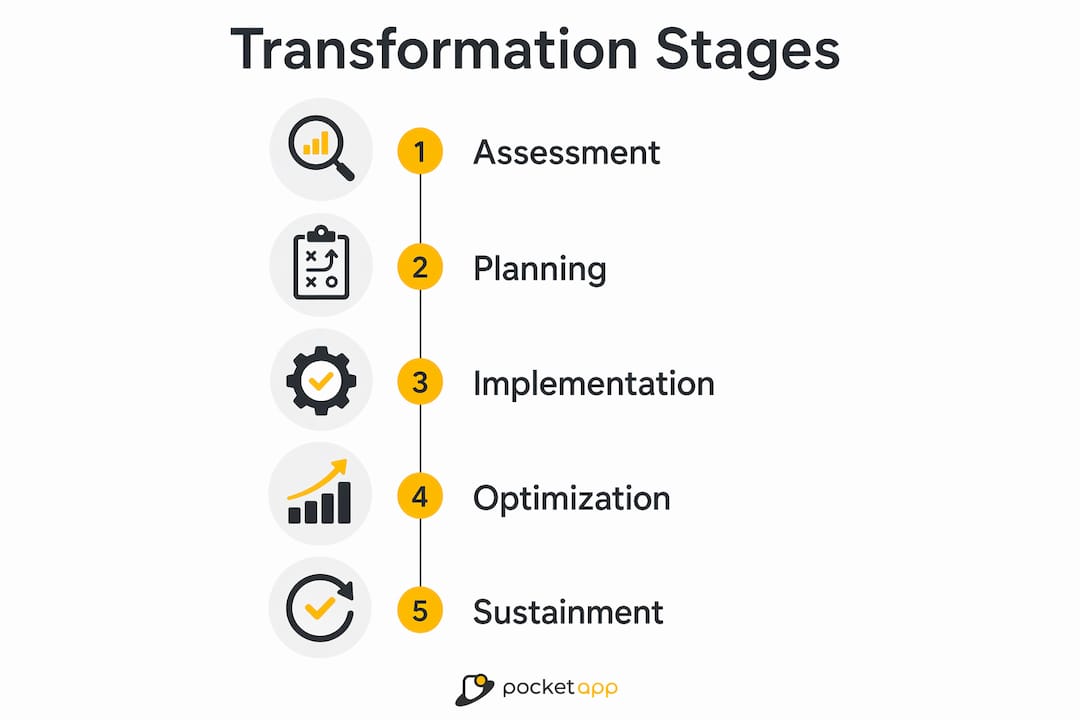
A clear framework prevents transformation from becoming a collection of disconnected technology projects. The most effective approaches share a common structure, even if the labels differ.
The core steps in any credible digital transformation strategy are:
- Assess your current state: audit existing technology, processes, and capabilities honestly. Identify where the biggest gaps and the biggest opportunities lie.
- Define domain-level goals: rather than setting vague targets like "become more digital," specify what a transformed customer journey or supply chain looks like in measurable terms.
- Select technology with purpose: choose platforms and tools that serve the defined goals, not the other way around. Cloud infrastructure, AI, and mobile apps are enablers, not the strategy itself.
- Run a pilot: test the approach in one domain or business unit before scaling. A pilot surfaces integration issues, user adoption barriers, and process gaps at a manageable cost.
- Scale with governance: once the pilot validates the model, scale with clear ownership, funding, and a governance structure that keeps the programme aligned with business priorities.
TechTarget's digital transformation guide reinforces that successful organisations adopt frameworks spanning technology, people, and processes together. Treating any one of these as secondary is where value erodes. The digital product discovery phase, in particular, is where many organisations either sharpen their focus or lose it entirely.
How do you measure digital transformation success?
Measurement is where many transformation programmes struggle. The benefits are real, but they often cut across multiple functions and take time to materialise, making attribution genuinely difficult.
Gartner's guidance identifies the key performance indicators relevant to transformation: customer satisfaction scores, digital adoption rates, operational efficiency metrics, revenue growth, and innovation metrics such as the number of new digital products launched or the speed of iteration.
Practical KPIs to track across a transformation programme:
- Customer satisfaction and Net Promoter Score (NPS): do customers find the new digital experience better than what it replaced?
- Digital adoption rates: what percentage of your target users are actively using the new tools or channels?
- Operational efficiency: cycle times, error rates, and cost per transaction before and after transformation
- Revenue from digital channels: what proportion of revenue now comes through digital touchpoints?
- Time to market: how quickly can the organisation launch new products or features compared to pre-transformation baselines?
- Employee productivity: are staff spending less time on manual tasks and more on higher-value work?
The honest challenge is that some of the most important gains, such as organisational agility and the ability to respond to market shifts, do not show up cleanly in a quarterly dashboard. Build a measurement framework before the programme starts, not after, so you have a baseline to compare against.
How COVID-19 and current trends are shaping digital transformation in 2026
The COVID-19 pandemic compressed years of digital adoption into months. Remote working, cloud migration, and digital customer engagement moved from "planned initiatives" to survival requirements almost overnight. Organisations that had already invested in digital infrastructure adapted quickly; those that had not faced a far steeper climb.
The pandemic did not create the need for digital transformation. It removed every excuse for delaying it.
The trends shaping transformation priorities in 2026 build on that acceleration:
- AI integration: generative AI and machine learning are moving from experimental tools to core operational infrastructure, automating content, decisions, and customer interactions at scale. The role of AI in digital marketing is one of the clearest examples of this shift.
- Cloud-first architecture: most new digital capabilities are built on cloud platforms, enabling faster deployment and greater flexibility than on-premise alternatives.
- Mobile-first customer experience: consumers and employees alike expect to complete tasks on a mobile device. Organisations that have not prioritised mobile operational efficiency are visibly behind.
- Sustainability as a transformation driver: UK organisations face growing pressure from regulators, investors, and customers to demonstrate environmental responsibility. Digital tools that reduce waste, track emissions, and support greener operations are increasingly central to transformation roadmaps.
- Cybersecurity by design: as digital footprints expand, security can no longer be bolted on after deployment. It must be embedded from the start.
Digital transformation in practice: UK industry examples
The most useful way to understand what digital transformation looks like is to see it working in specific sectors. Across UK industries, the pattern is consistent: organisations that commit to domain-level change, rather than point solutions, achieve the most durable results.
Retail: a retailer that replaces a static e-commerce site with a personalised mobile app changes the entire customer relationship. Push notifications, loyalty programmes, and real-time stock visibility are not features; they are a new model for how the brand engages its customers. User experience in retail apps is the difference between an app that drives repeat purchases and one that gets deleted after a week.
Charity and non-profit: charities face a particular challenge: limited budgets, high expectations from donors, and a need to demonstrate impact clearly. Digital transformation in this sector often centres on donor engagement platforms, volunteer coordination tools, and data-driven fundraising. Pocketapp has worked with organisations including WWF to build mobile experiences that deepen engagement and extend reach beyond what traditional channels allow. Practical guidance on digital transformation for charities is increasingly relevant as the sector faces rising competition for attention and funding.
Healthcare: remote monitoring, patient-facing apps, and digital triage tools have moved from pilot projects to mainstream delivery in UK healthcare. The ability to collect and act on patient data outside a clinical setting changes both the cost model and the quality of care.
Manufacturing: IoT sensors on production lines, predictive maintenance algorithms, and digital supply chain visibility are transforming how UK manufacturers operate. The shift from reactive to predictive maintenance alone can reduce unplanned downtime substantially.
Pocketapp has delivered over 300 mobile app projects across these sectors, working with clients in retail, charity, healthcare, and consumer engagement to build tailored digital solutions. The consistent finding across that portfolio is that the most successful projects are those where the client has a clear domain-level goal, not just a feature list.
How to engage stakeholders and communicate through transformation
Transformation programmes fail more often because of people than technology. Stakeholder engagement is not a communications exercise bolted onto the end of a project plan. It is a core discipline that runs from the first day of scoping to the last day of rollout and beyond.
The starting point is mapping your stakeholders by influence and interest. Executives, middle managers, frontline staff, customers, suppliers, and regulators all have different stakes in the outcome and different thresholds for change. A communication approach that works for the board will not work for a warehouse team learning a new inventory system.
Effective engagement during transformation typically involves:
- Early involvement: bring key stakeholders into the design process before decisions are made, not after. People support what they help to build.
- Transparent progress updates: regular, honest communication about what is working, what is not, and what comes next builds trust far more effectively than polished announcements.
- Two-way channels: create mechanisms for feedback, questions, and concerns to surface. Town halls, pulse surveys, and direct manager conversations all serve this purpose.
- Celebrating milestones: recognising progress publicly reinforces the narrative that the transformation is moving forward and that the effort is worthwhile.
Custom web solutions and internal digital tools can support this communication infrastructure, giving teams a single place to track progress, access training materials, and raise issues. The organisations that get this right treat communication as a product in its own right, iterating on it as the programme evolves.
Ready to move from strategy to delivery?
Understanding digital transformation is one thing. Building the digital products that make it real is another. Pocketapp works with UK organisations across retail, charity, healthcare, and beyond to design and build mobile applications that sit at the heart of transformation programmes. With over 300 projects delivered, we know what separates a digital product that changes how a business operates from one that simply adds another icon to a home screen.
If you are ready to turn your transformation strategy into a product your customers and teams will actually use, talk to our team about what we can build together.
Key takeaways
Digital transformation succeeds when technology, people, processes, and culture are developed together, with domain-level goals driving every decision rather than isolated technology deployments.
| Point | Details |
|---|---|
| Definition and scope | Digital transformation is the continuous integration of technology across an entire organisation, not a one-off IT project. |
| Primary business drivers | Improved customer experience (40%), operational efficiency (38%), and business process transformation (38%) are the top executive motivators. |
| Leadership and culture | Cultural change and leadership commitment determine success more reliably than the technology chosen. |
| Measurement from the start | Define KPIs including customer satisfaction, digital adoption rates, and revenue from digital channels before the programme begins. |
| Domain focus over point solutions | Transformations targeting entire business domains, such as the full customer journey, deliver greater and more durable value than isolated fixes. |
FAQ
What is the difference between digitisation and digital transformation?
Digitisation converts analogue information or processes into digital formats, such as scanning paper records. Digital transformation goes further, fundamentally changing how an organisation operates, competes, and delivers value using digital technology.
How long does a digital transformation take?
There is no fixed timeline. Most organisations treat transformation as an ongoing programme rather than a project with an end date, with meaningful domain-level changes typically taking one to three years to embed fully.
What are the most common reasons digital transformation fails?
The most frequent causes are treating it as an IT project rather than a business-wide change, underinvesting in change management and training, and failing to engage middle management who control day-to-day adoption.
Which technologies are central to digital transformation?
Cloud computing, AI and machine learning, IoT, big data analytics, and mobile platforms are the core enabling technologies. Mobile apps, in particular, are often the primary touchpoint through which customers and employees experience transformation directly.
How do you measure the return on investment of digital transformation?
Track KPIs such as customer satisfaction scores, digital adoption rates, operational efficiency metrics, and revenue from digital channels, as identified in Gartner's guidance on measuring transformation success. Establish baselines before the programme starts so you have a meaningful comparison point.