
TL;DR:
- Wearable app development involves designing for constrained interfaces, sensor integration, and multiple platforms.
- Business value includes reducing costs, enhancing safety, increasing engagement, and accelerating decision-making.
- Future growth relies on edge AI, IoT integration, evolving regulations, and passive sensing technologies.
The wearable technology market is projected to reach $826 billion by 2032, yet most businesses still treat wearable apps as a novelty rather than a serious commercial tool. That is a costly oversight. From logistics firms tracking field operatives in real time to healthcare providers monitoring patient vitals remotely, wearable app development is quietly reshaping how organisations operate and engage with their audiences. This guide cuts through the hype to show you what wearable app development actually involves, where it delivers measurable returns, and how to avoid the pitfalls that derail even well-funded projects.
Table of Contents
- What is wearable app development?
- How wearables drive business value
- Core challenges and technical requirements
- Future trends and business opportunities
- A pragmatic perspective: what most guidebooks miss in wearable app development
- Boost your business with expert wearable and mobile app solutions
- Frequently asked questions
Key Takeaways
| Point | Details |
|---|---|
| Wearable apps explained | Wearable app development creates software for devices like smartwatches to improve business outcomes. |
| Proven ROI | Businesses see real gains in efficiency and customer engagement with well-designed wearables. |
| Integration challenges | Success depends on handling platform fragmentation, regulatory compliance, and security effectively. |
| Future-ready frameworks | Edge AI, IoT, and evolving standards are key opportunities for forward-thinking businesses. |
What is wearable app development?
Wearable app development is the process of designing, building, and deploying software specifically for devices worn on the body. Think smartwatches, fitness trackers, augmented reality (AR) glasses, and medical monitoring patches. These are not simply smaller versions of your mobile app. They operate under fundamentally different constraints, and understanding those constraints is the first step to building something genuinely useful.
The key differences from standard mobile development include:
- Constrained interfaces: Screens are tiny, interactions must be glanceable, and complex navigation simply does not work.
- Sensor integration: Wearables rely heavily on accelerometers, heart rate monitors, GPS, and gyroscopes. Your app must interpret this continuous data stream intelligently.
- Continuous connectivity: Wearables often sync with a paired smartphone or cloud backend in real time, which demands careful battery and bandwidth management.
- Platform fragmentation: The main platforms are Apple watchOS, Google's Wear OS, and a range of proprietary fitness band ecosystems, each with distinct development requirements.
Industry relevance spans healthcare, fitness, retail, and logistics. A hospital might deploy a wearable app to alert nurses when a patient's vitals deteriorate. A warehouse operator might use one to guide pickers via haptic feedback. Understanding the future of wearable apps helps you anticipate where investment will deliver the strongest returns.
Smartwatches account for over 35% of the wearable tech market, making them the dominant platform for business-focused wearable app development today.
The app development process for wearables shares DNA with mobile development but demands additional layers of planning around device capability, sensor logic, and user experience design. If you want a practical framework, a solid step by step app development approach helps you avoid costly rework later.
How wearables drive business value
Now that we have defined wearable app development, what business results can you expect in practice? The evidence is compelling across multiple sectors.

| Sector | Use case | Business outcome |
|---|---|---|
| Healthcare | Remote patient monitoring | Reduced readmissions, lower care costs |
| Logistics | Worker safety and location tracking | Fewer incidents, faster response times |
| Fitness | Personalised coaching apps | Higher retention, premium subscriptions |
| Retail | Staff productivity tools | Faster fulfilment, reduced errors |
Here is how wearables generate ROI in practice:
- Reduce operational costs by automating data collection that previously required manual input or separate hardware.
- Improve workforce safety through real-time alerts and incident detection, reducing liability and downtime.
- Increase customer engagement via personalised, contextual nudges delivered at the right moment on a device the user already wears.
- Accelerate decision-making by surfacing actionable insights directly on the wrist, cutting the time between data and action.
The numbers back this up. ArcBest, a logistics company that deployed wearable musculoskeletal (MSK) care, achieved a 3.2:1 ROI and 65% reduction in surgery intent among participants. That is not a marginal improvement. It is a structural change in how the business manages workforce health costs.
Understanding measuring ROI from mobile apps is essential before you commit budget, and a clear framework for measuring ROI in app development will keep your project accountable from day one.
Pro Tip: Do not chase novelty. The wearable apps that generate the strongest ROI solve a specific, painful operational problem rather than launching simply because the technology is available.
Core challenges and technical requirements
While the value is clear, developing effective wearable apps comes with distinct challenges that businesses frequently underestimate.
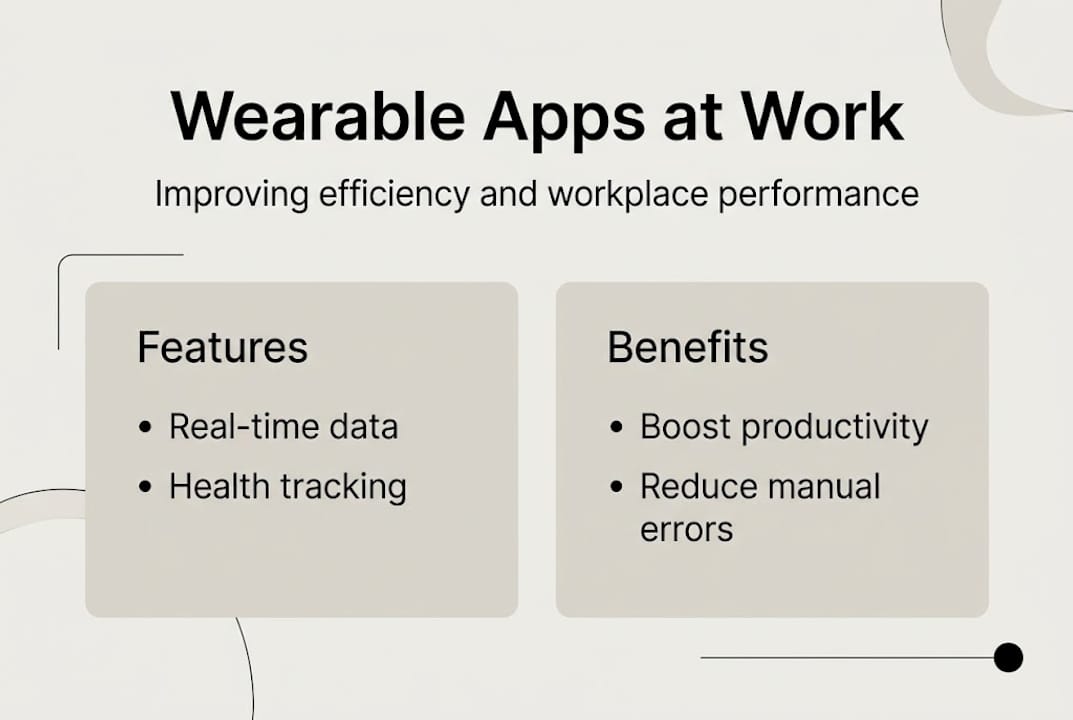
| Challenge | Traditional mobile app | Wearable app |
|---|---|---|
| Screen real estate | Generous, flexible layouts | Severely constrained, glanceable only |
| Battery management | Hours of active use expected | Minutes of active screen time |
| Platform standards | iOS and Android dominate | Multiple fragmented ecosystems |
| Regulatory compliance | GDPR standard | GDPR plus FHIR/HL7 for healthcare |
| Data security | App-level encryption | Device, sync, and cloud-level encryption |
The most common obstacles include:
- Ecosystem fragmentation: Apple watchOS, Wear OS, and proprietary platforms each have different APIs, design guidelines, and update cycles.
- Device capability variance: A premium smartwatch and a basic fitness band have vastly different processing power and sensor sets.
- Regulatory compliance: Healthcare wearables must meet FHIR and HL7 interoperability standards alongside GDPR. Retail and logistics apps still face strict data handling obligations.
- Security: Wearables collect sensitive biometric and location data continuously. Encryption must cover the device, the sync layer, and the cloud backend simultaneously.
Fragmented ecosystems and evolving regulations require standardisation and robust security practices from the very first sprint, not as an afterthought.
Pro Tip: Adopt a unified middleware layer and standardised APIs early in your architecture. This dramatically reduces the cost of supporting multiple wearable platforms and simplifies future updates.
Paying close attention to ethical mobile app considerations and mobile app data privacy best practices is not optional. Regulatory missteps can halt a product launch entirely and expose your business to significant liability.
Future trends and business opportunities
With a grasp of the challenges, it is important to look ahead at the technologies and policies shaping the future of wearables.
The market trajectory is striking. Projections place the global wearable technology market at $826 billion by 2032, up from estimates of $84 to $358 billion in 2025 and 2026. Businesses that build wearable capability now will be positioned to capitalise on that growth rather than scramble to catch up.
Key trends to watch:
- Edge AI: Processing data directly on the device rather than sending it to the cloud enables faster, smarter responses. A wearable that detects a worker's fatigue pattern and adjusts workload recommendations in real time is already technically feasible.
- Deeper IoT integration: Wearables are becoming nodes in broader connected environments. A warehouse operative's smartwatch might communicate directly with conveyor systems, forklifts, and inventory software simultaneously.
- Regulatory evolution: Governments are tightening rules around biometric data, consumer safety, and health claims. Businesses must track these changes proactively rather than reactively.
- Passive sensing: Next-generation devices will monitor blood glucose, stress hormones, and hydration without active user input, opening new possibilities in occupational health and personalised retail.
Future differentiation will rely on edge AI, deeper IoT ecosystems, and keeping pace with regulatory evolution. The businesses that treat these as strategic priorities rather than IT concerns will define the next wave of wearable innovation.
Exploring wearables and mobile app integration alongside IoT smart solutions and building IoT apps will give your team a clear picture of the architectural decisions ahead.
A pragmatic perspective: what most guidebooks miss in wearable app development
Most articles on wearable app development fixate on device features, sensor lists, and market statistics. What they rarely address is the single biggest reason projects fail: businesses build for the device rather than for the problem.
We have seen organisations invest heavily in cutting-edge wearable hardware, only to discover that their underlying data infrastructure cannot support real-time sync, or that their compliance team was not involved until launch week. Both scenarios are entirely avoidable.
The real competitive advantage in wearable app development is not which gadget you support. It is whether your platform layer is unified enough to scale without rebuilding from scratch every time a new device enters the market. Chasing every new wearable form factor is expensive and rarely delivers proportional returns.
ROI comes from solving a specific operational pain point, whether that is reducing injury rates, cutting manual data entry, or improving customer retention through timely personalisation. As highlighted in our thinking on designing next-gen wearable apps, the most durable products are built around human behaviour, not hardware specifications. Regulatory and integration missteps can erase every efficiency gain you have worked to achieve. Build compliance in from day one.
Boost your business with expert wearable and mobile app solutions
Navigating wearable app development requires more than technical skill. It demands strategic clarity about which problems are worth solving, which platforms to prioritise, and how to build for compliance and scale from the outset.
At Pocket App, we have delivered over 300 mobile and wearable projects for clients across healthcare, retail, logistics, and beyond. Our mobile app development services cover everything from initial discovery through to deployment and iteration. Whether you are exploring wearable integration for the first time or scaling an existing solution, our business app development team is ready to help you turn operational challenges into measurable outcomes. Get in touch to discuss your project.
Frequently asked questions
What are common types of wearable apps used in business?
Popular types include health tracking, workforce safety monitoring, remote asset management, and productivity tools for smartwatches and fitness trackers. Smartwatches hold over 35% of the market, making them the primary platform for enterprise wearable solutions.
How do wearable apps improve operational efficiency?
They deliver real-time data from workforce and assets, support health and safety monitoring, and automate processes that previously required manual effort. Organisations like ArcBest have demonstrated measurable cost savings through wearable-enabled workforce health programmes.
Which industries benefit most from wearable app development?
Healthcare, logistics, manufacturing, retail, and fitness sectors see the largest impact and ROI. Exceptional ROI and operational improvements are particularly well documented in healthcare and logistics deployments.
What future trends should businesses watch in wearable apps?
Edge AI, regulatory changes, and tighter IoT integration will shape future business opportunities and requirements. Edge AI and IoT ecosystems are already influencing how development teams architect new wearable solutions.
Are there unique compliance concerns with wearable apps?
Yes. Data privacy, GDPR, and sector-specific protocols such as FHIR and HL7 are essential for regulatory compliance. Healthcare-focused wearables face particularly strict interoperability and privacy requirements that must be addressed at the architecture stage.