
TL;DR:
- In 2026, SEO focuses on earning recognition from AI systems through generative engine optimisation. Content must be well-structured, authoritative, and supported by verifiable credentials to secure AI citations. Despite the rise of AI, foundational SEO and traditional search remain essential for visibility.
SEO trends in 2026 centre on one fundamental shift: earning recognition from AI systems, not just ranking in traditional search results. Generative engine optimisation (GEO) has emerged as the discipline that defines this new era, with search interest in GEO surging 161% year on year to 12,000 monthly searches. At the same time, zero-click search now accounts for 68% of all queries, forcing digital marketers to rethink every metric they rely on. The professionals who adapt fastest will own the most valuable real estate in search: the AI-generated answer itself.
What are the biggest SEO trends in 2026?
The single most important shift in 2026 is the rise of generative engine optimisation. GEO is the practice of structuring content so that AI systems, including Google's AI Overviews, ChatGPT, and Perplexity, cite your brand in their generated answers. Traditional SEO focused on ranking position. GEO focuses on citation frequency and brand recognition within AI responses.

The numbers confirm this shift is real and accelerating. Searches for "AI overview optimization" increased by 625% year on year. That figure tells you where the profession's attention is moving, and where your budget should follow.
GEO does not replace traditional SEO. It builds on top of it. Content that earns AI citations shares three consistent traits: clear authorship with verifiable credentials, structured formatting that AI can parse quickly, and E-E-A-T signals that demonstrate first-hand expertise. A blog post written by a named specialist with a linked author bio, supported by original data or client case studies, outperforms generic content in AI citation rates. That is E-E-A-T 2.0 in practice.
Practical steps to optimise for GEO:
- Write direct, declarative answers in the first paragraph of every page, not buried in the third section
- Use H2 and H3 headings that mirror exact user questions, since AI systems pull from question-formatted content more frequently
- Include named authors with credentials and link to their professional profiles
- Cite primary sources and original research within the content itself
- Structure long-form content with clear topic clusters rather than isolated standalone articles
Pro Tip: Query fan-out is the practice of anticipating the sub-questions a user's main query will trigger. Search volume for "query fan out" grew over 2,500% year on year, signalling that AI systems process queries as clusters of related intents. Build content that answers the parent question and its three to five most common follow-up questions within the same page or cluster.
How does zero-click search change your KPIs?
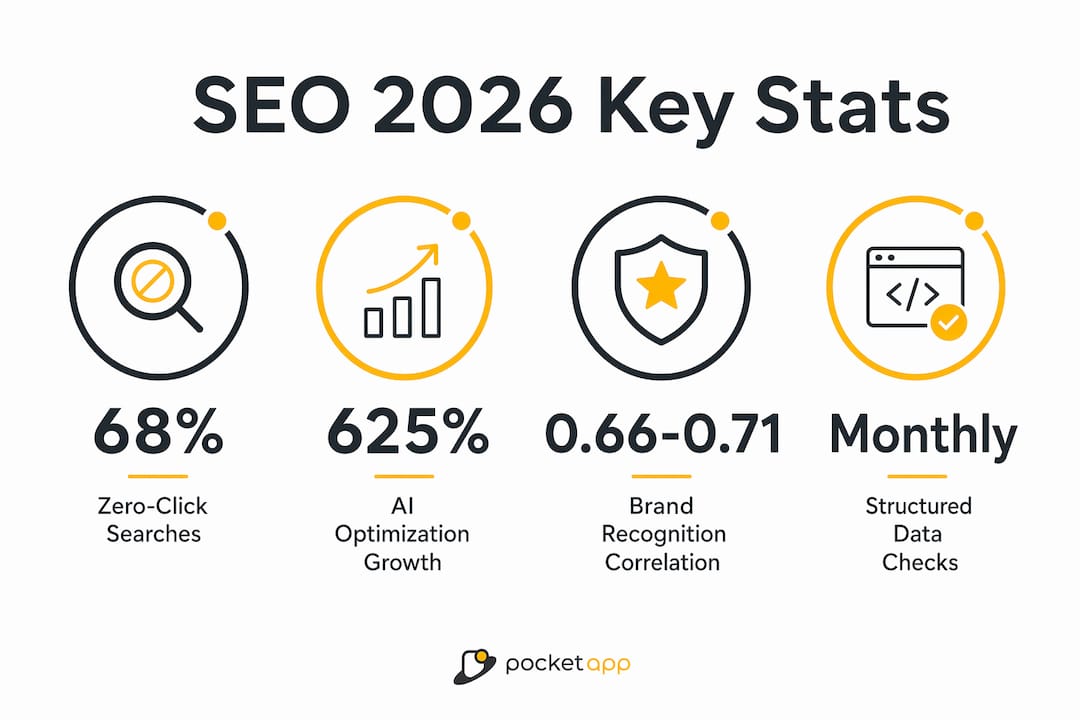
Zero-click search reaching 68% prevalence is the statistic that makes most marketing directors uncomfortable. It means the majority of searches now end without a single visit to any website. Measuring success purely by organic click volume is no longer a reliable indicator of SEO performance.
The replacement metrics are more nuanced but more meaningful. Brands that earn AI citations see a 35% higher click-through rate than uncited competitors on the same queries. That gap proves that being named in an AI answer still drives traffic, even when most users do not click through at all.
Reframe your reporting around these four indicators:
- AI citation frequency: Track how often your brand appears in AI Overviews and LLM-generated answers using tools that monitor generative search results
- Branded search volume: Rising searches for your brand name signal growing recognition, even when organic clicks plateau
- Impression share in AI results: Measure how often your content appears in the AI answer panel versus competitors
- Transactional query performance: Allocate content investment toward queries with clear purchase intent, where users are more likely to click through regardless of AI summaries
The practical implication is clear. Informational queries will increasingly be answered by AI without a click. Transactional and navigational queries still drive meaningful traffic. Shift your content calendar to reflect that reality.
"Search engines are still the primary discovery channel for 32.4% of global internet users aged 16 and over. Traditional search is not dead. It is sharing the stage."
Does foundational SEO still matter in 2026?
Foundational SEO is the prerequisite for AI visibility, not an alternative to it. AI systems cannot cite content they cannot crawl. Core Web Vitals, clean site architecture, and correct canonical tags are the floor, not the ceiling, of any GEO strategy.
No AI-specific schema markup is officially required by Google or any major search engine. Traditional structured data, including Article, FAQ, HowTo, and Product schema, remains the primary technical signal for AI search systems. Implementing these correctly gives AI systems the structured context they need to extract and cite your content accurately.
| Technical factor | Why it matters for AI visibility |
|---|---|
| Core Web Vitals | Slow or unstable pages are deprioritised by crawlers and AI systems alike |
| Structured data (schema) | Provides machine-readable context that AI uses to extract and cite facts |
| Mobile usability | AI Overviews are predominantly served on mobile; poor mobile UX reduces citation likelihood |
| Crawlability and indexation | Content that cannot be crawled cannot be cited, regardless of quality |
Mobile usability deserves particular attention. Mobile-first design is no longer a UX preference. It is a direct ranking and citation signal. AI Overviews appear most frequently on mobile devices, so pages that fail mobile usability tests are systematically excluded from the most visible AI-generated answers.
Pro Tip: Run a monthly crawl audit using Screaming Frog or Sitebulb. Prioritise fixing broken internal links, missing schema, and slow Largest Contentful Paint scores before investing in new content. A technically sound site earns AI citations faster than a content-heavy site with crawl errors.
Why does brand authority determine AI recognition?
The correlation between branded web mentions and AI Overview visibility sits between 0.66 and 0.71. That is a strong positive relationship. Brands that appear consistently across authoritative third-party sources, industry publications, and knowledge graph entries are significantly more likely to be cited in AI-generated answers.
SEO's goal has shifted from ranking to recognition. A brand that ranks third but is mentioned across 50 authoritative domains will outperform a brand that ranks first but exists only on its own website. AI systems weight off-site entity signals heavily when deciding which sources to cite.
Entity clarity is the technical side of brand authority. Your brand must appear consistently, with the same name, description, and category, across Wikipedia, Wikidata, Google's Knowledge Panel, LinkedIn, and major industry directories. Inconsistent entity data confuses AI systems and reduces citation probability.
Tactics to build brand authority for AI recognition:
- Publish original research or proprietary data that other sites will cite and link to
- Secure bylines in industry publications with high domain authority
- Maintain consistent NAP (name, address, phone number) data across all local directories for local SEO
- Build a Wikipedia or Wikidata entry if your brand meets notability criteria
- Monitor AI-generated brand mentions using dedicated tracking tools and respond to inaccuracies promptly
"Effective SEO in the AI era requires non-commodity, verifiable expertise. Author credentials, client case studies, and original data are the signals AI cannot replicate and consistently rewards with citations."
What is agentic SEO and why does it matter now?
Agentic SEO is the practice of structuring content and data so that AI agents can autonomously read, verify, and act on it without human intervention. These agents do not browse websites the way a person does. They extract structured information, verify pricing and availability, and make recommendations or transactions on behalf of users.
Agentic AI search terms have surged significantly in monthly searches, reflecting how quickly this frontier is moving from theory to practice. Brands that prepare their data architecture now will have a measurable advantage as agentic AI becomes mainstream in 2027 and beyond.
The practical requirements for agentic SEO are specific:
- Machine-readable product data: Publish pricing, availability, and specifications in structured JSON-LD format so agents can verify information without scraping unstructured HTML
- Accurate inventory signals: Real-time stock data must be accessible via structured feeds, not buried in JavaScript-rendered pages
- Authenticity markers: Include verifiable trust signals such as certifications, accreditations, and third-party reviews in structured format
- Clear entity relationships: Define relationships between your products, brand, and category using schema vocabulary so agents can place you correctly in their decision models
The real role of AI in business applications extends directly into agentic SEO. Brands with well-structured mobile apps and APIs are better positioned for agentic discovery because their data is already machine-accessible.
Pro Tip: Test your structured data using Google's Rich Results Test and Schema.org's validator monthly. Agentic AI systems rely on the same structured data signals as traditional search engines. Errors in your JSON-LD directly reduce your visibility to both.
Key takeaways
SEO in 2026 rewards brands that invest in AI recognition, technical precision, and verifiable authority rather than those chasing traditional ranking positions alone.
| Point | Details |
|---|---|
| GEO is the new discipline | Structure content with direct answers, named authors, and topic clusters to earn AI citations. |
| Zero-click demands new KPIs | Track AI citation frequency, branded search volume, and impression share rather than click volume alone. |
| Foundational SEO is non-negotiable | Core Web Vitals, schema markup, and mobile usability remain prerequisites for AI visibility. |
| Brand authority drives AI recognition | Consistent entity data and off-site mentions correlate strongly with AI Overview inclusion. |
| Agentic SEO requires structured data | Machine-readable product and pricing data positions brands for autonomous AI agent discovery. |
The uncomfortable truth about SEO in 2026
The professionals I see struggling most in 2026 are not the ones who ignored AI. They are the ones who chased AI at the expense of everything else. They rewrote their entire content strategy for GEO, neglected their technical foundations, and then wondered why their AI citation rates did not improve.
The truth I have learned from working across dozens of digital projects is this: AI systems are extraordinarily good at identifying genuine expertise and extraordinarily bad at being fooled by the appearance of it. A page optimised for GEO but written by someone with no real knowledge of the subject will not earn sustained citations. A page written by a genuine specialist, structured clearly, and supported by original evidence will earn citations consistently, even if it was never explicitly optimised for AI.
The measurement shift is real and necessary. Tracking branded search volume and AI citation frequency alongside traditional organic metrics gives you a far more accurate picture of your actual market presence. But measurement changes should follow strategic clarity, not precede it. Know what you are trying to be recognised for before you start tracking whether you are being recognised.
My strongest advice for 2026 is to invest in one area of genuine expertise and document it obsessively. Original research, client case studies, proprietary data, and named specialist authors are the signals that AI systems cannot replicate and will not stop rewarding. App design trends and emerging technologies are good examples of areas where genuine expertise, documented consistently, builds the kind of entity authority that compounds over time.
— Paul
How Pocketapp's mobile expertise supports your 2026 SEO strategy
Digital visibility in 2026 does not live on websites alone. A well-built mobile app contributes directly to brand authority, entity recognition, and the structured data signals that AI systems reward. Pocketapp has delivered over 300 mobile projects for brands including WWF, Dechra, and Crocus, with a consistent focus on technical quality and measurable outcomes.
For digital marketers building future-proof visibility, mobile app development that integrates structured data, clean APIs, and strong UX creates the machine-readable brand presence that both AI agents and traditional search engines favour. Pocketapp's team works across B2B and B2C sectors, helping brands build cross-platform applications that support discoverability at every layer of the modern search environment. Get in touch to discuss how a mobile-first approach can strengthen your digital presence in 2026.
FAQ
What is generative engine optimisation (GEO)?
Generative engine optimisation is the practice of structuring content so that AI systems cite your brand in their generated answers. It builds on traditional SEO by adding emphasis on named authorship, direct answer formatting, and verifiable expertise signals.
How does zero-click search affect organic traffic in 2026?
Zero-click search accounts for 68% of queries in 2026, meaning most searches end without a website visit. Brands should track AI citation frequency and branded search volume as primary performance indicators alongside traditional click metrics.
Do I need special AI schema markup to rank in AI Overviews?
No AI-specific schema markup is officially required. Traditional structured data including Article, FAQ, and Product schema remains the primary technical signal for AI search visibility.
What is agentic SEO?
Agentic SEO involves structuring content and product data so that AI agents can autonomously verify information and make recommendations without human input. Machine-readable JSON-LD, real-time inventory data, and clear entity relationships are the core requirements.
Does Google still matter more than AI search tools in 2026?
Google sends roughly 190 times more traffic to websites than ChatGPT, confirming that traditional search remains the dominant traffic source. AI search tools are growing rapidly but have not yet displaced Google as the primary discovery channel.