
Digital transformation in retail means integrating digital technologies across every layer of the business, from supply chain and stock management to customer engagement and post-purchase experience. It is not a single project or a technology upgrade. It is a fundamental shift in how retailers operate, compete, and grow. Technologies including Artificial Intelligence, cloud computing, data analytics, and mobile applications are now woven into the fabric of retail, reshaping what customers expect and what retailers can deliver.
The impact is measurable and urgent. Digital leaders generate 3.3 times the total shareholder return of digital laggards in retail, according to McKinsey's Digital Quotient Survey. For UK retail decision-makers, that gap is not a future concern. It is playing out right now.
Key technologies driving this shift include:
- Artificial Intelligence (AI): personalisation, demand forecasting, and automated customer service
- Data analytics: real-time insight into customer behaviour and operational performance
- Cloud computing: flexible, scalable infrastructure that supports rapid deployment
- Mobile applications: direct, always-on channels connecting retailers with their customers
- Automation: reducing manual processes across fulfilment, logistics, and marketing
- Omnichannel platforms: unifying online and offline retail into a single, connected experience
Why digital transformation is essential for retail survival and growth
Retail margins have been shrinking by two to three percentage points per year over the past five years, and in some verticals by as much as five to six points, according to McKinsey's analysis of the sector. That kind of sustained pressure leaves little room for retailers who are still running on legacy systems and disconnected processes. The competitive landscape has shifted permanently, and digital adoption is no longer a differentiator. It is a baseline requirement.

Consumer behaviour has changed just as dramatically. Shoppers now move fluidly between physical stores, websites, apps, and social platforms, often within a single purchase journey. Retailers who cannot meet them across all those touchpoints lose the sale, and often the relationship. The rise of omnichannel retail has made it clear that the question is not whether to transform, but how quickly and how well.
The consequences of inaction are concrete:
- Lost revenue: retailers without digital channels miss the growing share of purchases that begin or complete online
- Operational inefficiency: manual processes in stock management, logistics, and customer service cost more and respond more slowly than automated alternatives
- Talent gaps: organisations that have not modernised their tech infrastructure struggle to attract the digital skills they need
- Competitive exposure: digitally mature competitors can personalise offers, reprice dynamically, and fulfil faster
Technology is no longer merely a cost-saving tool. It is the core driver enabling next-generation growth and shareholder return in retail, a point McKinsey has made consistently across its research into the sector.
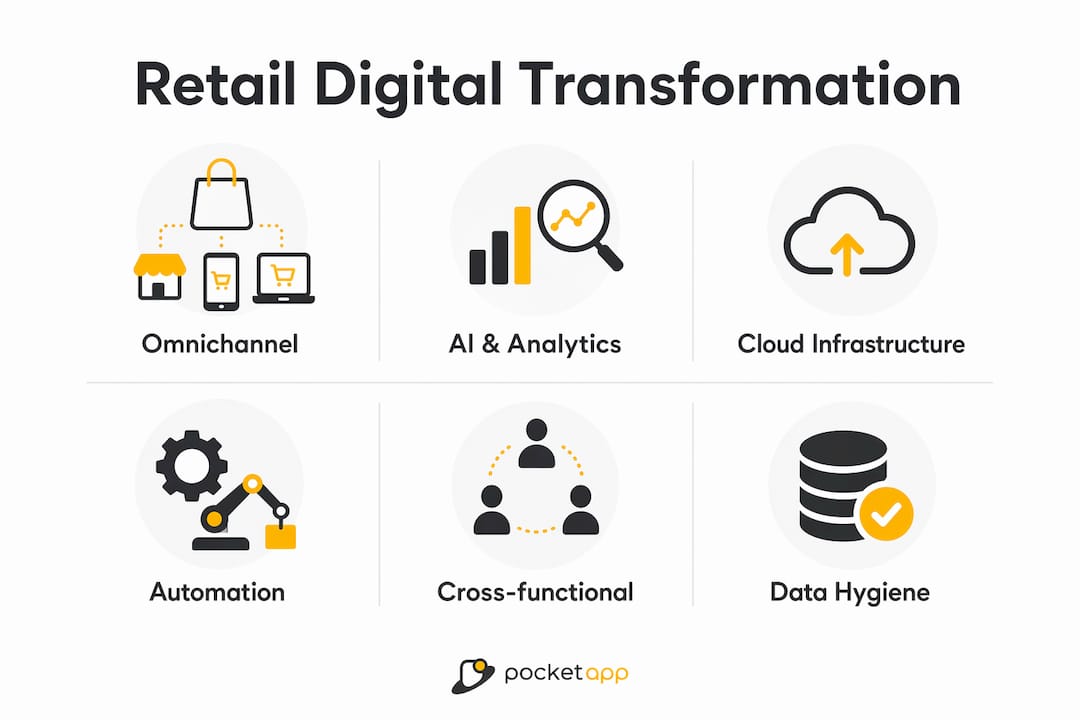
What are the core pillars of retail digital transformation?
Successful digital transformation in retail rests on six interconnected pillars. Retailers who address only one or two tend to stall. Those who work across all six simultaneously build the kind of compounding advantage that is difficult for competitors to replicate.
Omnichannel integration
Customers expect a consistent experience whether they are browsing on a mobile app, visiting a store, or speaking to a customer service agent. Omnichannel integration means connecting all those touchpoints through shared data, unified inventory, and consistent brand experience. Physical stores are also evolving into what analysts describe as "phygital" hubs, blending connectivity technologies like 5G, augmented reality, and smart displays to bridge online and offline retail. Retailers who have built this kind of connected experience space are seeing stronger customer retention and higher basket values.
AI adoption and data analytics
91% of retail IT leaders have identified AI as their top technology priority for implementation by the end of 2026, according to Gartner. That consensus reflects how broadly AI is being applied, from demand forecasting and dynamic pricing to personalised product recommendations and automated customer service. Data analytics underpins all of it. Without clean, well-structured data, AI produces unreliable outputs regardless of how sophisticated the algorithm is.

Cloud computing and tech modernisation
Traditional retail architecture typically relies on monolithic, ageing applications that slow down change and push up costs. Moving to a modular, microservice-based architecture gives retailers the flexibility to update individual components without disrupting the whole system. Cloud-based platforms also support the kind of rapid, automated development pipelines that allow teams to ship new features to customers far more quickly.
Automation
Automation removes friction from repetitive, high-volume processes across the retail value chain. In fulfilment and logistics, it reduces error rates and speeds up throughput. In marketing, it enables personalised communications at a scale no human team could match. In customer service, AI-powered tools handle routine queries instantly, freeing staff to focus on complex or high-value interactions.
Agile delivery and cross-functional working
Many digital transformation failures stem from siloed IT projects rather than enterprise-wide change. Retailers who build cross-functional teams, bringing together engineers, designers, data scientists, and business product owners, move faster and build solutions that actually solve the right problems. McKinsey describes this as "extreme industrialisation": massively automated software delivery pipelines that allow teams to manage end-to-end delivery and get new features to customers at speed.
Data hygiene and unified architecture
This is the pillar most often underestimated. Successful AI implementation depends on robust data hygiene and unified architecture. Fragmented data, inconsistent product information, and disconnected systems produce inaccurate AI outputs, which then drive poor decisions at scale. Retailers gain faster return on investment by ensuring their product and pricing data are accurate, accessible, and machine-readable before investing in bespoke AI models.
Pro Tip: Do not treat digital transformation as an IT project. The retailers who see the strongest results are those who frame it as a business transformation that technology enables, with senior leadership sponsorship and cross-functional accountability from day one.
How does digital transformation benefit retail businesses?
The business case for digital transformation in retail is well evidenced, and the benefits span customer experience, operational performance, and revenue growth.
Personalised customer experience
AI enables retailers to move beyond broad customer segments and deliver genuinely individual experiences. Product recommendations, pricing offers, and marketing messages can all be tailored in real time based on a customer's browsing history, purchase behaviour, and stated preferences. Deloitte's research indicates that 68% of retail executives expect to deploy AI-driven personalisation capabilities in the near future. That kind of tailored engagement drives higher conversion rates and stronger loyalty, particularly when it is consistent across channels. The role of mobile apps in delivering this personalisation is growing rapidly, as the app becomes the primary interface between retailer and customer.
Supply chain efficiency and resilience
A notable share of global retailers currently use AI to enhance supply chain visibility, with this proportion expected to grow significantly in the coming months, according to Deloitte's 2026 Retail Outlook. Walmart offers a well-documented example of what this looks like in practice. The retailer uses AI models, digital twin technology, and predictive analytics to simulate how its logistics network responds to disruptions, from weather events to facility closures, and to take corrective action quickly. The result is a supply chain that is both more efficient and more resilient under pressure.
Faster operations and reduced onboarding friction
Myntra, the Indian fashion e-commerce platform, has significantly reduced seller onboarding times using AI-led automation. That kind of operational acceleration has a direct commercial impact: more sellers onboarded faster means more product range available sooner, which in turn drives more customer choice and revenue. The same principle applies to any high-volume, process-heavy operation in retail.
New revenue streams and business model expansion
Digital transformation opens revenue opportunities that simply did not exist in a purely physical retail model. Digital marketplaces, data monetisation, subscription services, and affiliate commerce all become viable when a retailer has the technology infrastructure to support them. McKinsey notes that a robust tech foundation can extend retail business models beyond the traditional core to generate additional revenues and diversify customer touchpoints.
Marketing effectiveness at scale
AI-enabled marketing tools allow retailers to execute hyper-personalised campaigns, automate creative production, and optimise spend allocation in real time. Deloitte's research highlights that the toolkit retailers need spans hyper-personalisation, creative automation, audience intelligence, content generation, and decision support. Understanding how AI shapes eCommerce outcomes is increasingly central to building a competitive marketing strategy.
Best practices for implementing digital transformation in retail
Getting digital transformation right requires more than selecting the right technologies. The retailers who execute well share a set of common practices that are worth understanding before committing significant investment.
-
Start with use cases, not technology. Identify the specific business problems you need to solve, whether that is reducing stock-outs, improving personalisation, or cutting fulfilment costs, and then select the technology that addresses them. Buying technology in search of a problem is one of the most common and costly mistakes in retail transformation.
-
Prioritise data quality before AI investment. Effective generative AI often uses public and open-source models customised with internal data, rather than building massive proprietary datasets from scratch. That approach only works when the internal data is clean, consistent, and well-structured. Retailers who skip this step find that their AI outputs are unreliable, which erodes trust in the technology across the organisation.
-
Build cross-functional teams. Digital transformation stalls when it is owned entirely by IT. The most effective implementations bring together business leaders, technology teams, data scientists, and frontline staff to define priorities, test solutions, and drive adoption.
-
Invest in employee skills and culture. Technology alone does not change how an organisation operates. Retailers need to invest in training, change management, and new ways of working to ensure that digital tools are actually used effectively. Deloitte's research notes that training will need to be established for commercial teams to work alongside AI tools in real time.
-
Adopt modular architecture. Moving away from monolithic legacy systems to microservice-based, cloud-native architecture gives retailers the flexibility to update and scale individual components without disrupting the whole platform. This is a prerequisite for the kind of rapid iteration that digital transformation demands.
-
Manage tech debt actively. Many retailers are still spending heavily on legacy systems, which crowds out investment in the capabilities that would actually drive growth. A quarterly business review process, where joint business and technology teams assess existing targets and reallocate resources toward future priorities, is a practical way to address this.
-
Align operating model with transformation goals. Architecture changes without operating model changes rarely deliver their full potential. Retailers need to redesign how teams are structured, how decisions are made, and how performance is measured to support the new ways of working that digital transformation requires.
Digital transformation trends shaping UK retail in 2026
The UK retail sector is at an inflection point. Research from Gartner, Deloitte, and McKinsey converges on a consistent picture: AI is moving from pilot to production, physical stores are being reimagined, and the retailers who industrialise their digital capabilities now will be the ones who define the next era of the sector.
AI moves from experimentation to execution
Retailers must industrialise AI adoption and embed it into core business functions to maintain competitiveness, according to Deloitte. The 2026 Retail Outlook found that nearly 68% of retail executives expect to deploy agentic AI for key operational and enterprise activities within 12 to 24 months. Agentic AI, where AI systems take autonomous actions across multiple steps rather than simply responding to a single prompt, represents a significant shift in how retail operations can be run.
Brand loyalty under pressure from AI-driven commerce
A large majority of retail executives believe that generative AI may weaken traditional brand loyalty in the coming years. As AI agents increasingly mediate the discovery and purchase process, they tend to prioritise factors like price and fit over brand recognition. Retailers who want to remain visible in an AI-mediated shopping environment need to ensure their product data is accurate, accessible, and optimised for AI readability. Building a strong brand presence in an AI-driven environment requires a different approach to brand development online than traditional digital marketing.
The phygital store
Physical stores are not disappearing. They are being transformed into connected experience spaces that blend the tactile advantages of in-person shopping with the data richness of digital channels. Technologies including 5G connectivity, augmented reality, and smart displays are enabling retailers to offer in-store shoppers features that were previously only available online, such as personalised recommendations, virtual try-ons, and real-time stock visibility. The AR and VR capabilities now available through mobile platforms are making this kind of immersive in-store experience increasingly accessible for retailers of all sizes.
Supply chain technology as a competitive differentiator
Many retail executives anticipate a positive return on investment from AI-driven supply chain initiatives within the next year, according to Deloitte. Supply chain technology has moved firmly into the strategic investment category. The combination of AI, digital twins, and real-time data is giving retailers the ability to anticipate disruption, optimise fulfilment costs, and improve delivery reliability in ways that were not possible with traditional planning tools.
The Myntra model: AI-driven operational transformation
Myntra's use of AI to cut seller onboarding from up to 15 days to under 2 days is a useful reference point for UK retailers thinking about where AI can deliver the fastest operational impact. The lesson is not that every retailer should replicate Myntra's specific solution. It is that AI applied to high-volume, process-heavy operations can produce dramatic efficiency gains quickly, and that those gains compound over time as the system learns and improves.
How Pocketapp supports retail digital transformation
Pocketapp works with UK retailers to design, develop, and deploy mobile applications that sit at the heart of their digital transformation strategies. With a portfolio of over 300 projects across retail, consumer engagement, and B2B sectors, Pocketapp brings both technical depth and commercial understanding to every engagement. Whether you need a customer-facing app that drives loyalty and personalisation, or an internal tool that connects your operations team with real-time data, Pocketapp has the experience to deliver it.
Retailers who are ready to move from strategy to execution can explore Pocketapp's mobile app development services or speak directly with the team about your specific transformation priorities.
Key takeaways
Digital leaders in retail generate 3.3 times the total shareholder return of digital laggards, making technology investment a direct driver of business value, not a support function.
| Point | Details |
|---|---|
| AI is the top retail technology priority | 91% of retail IT leaders have prioritised AI for implementation by the end of 2026, according to Gartner. |
| Supply chain AI adoption is accelerating | 30% of global retailers currently use AI for supply chain visibility, with 41% projected within 12 months, per Deloitte. |
| Data hygiene determines AI success | Clean, unified data architecture is the prerequisite for reliable AI outputs; poor data quality undermines even sophisticated models. |
| Brand loyalty faces AI-driven disruption | 81% of retail executives expect generative AI to weaken traditional brand loyalty by 2027, requiring retailers to optimise product data for AI readability. |
| Operational transformation delivers fast ROI | Myntra cut seller onboarding from up to 15 days to under 2 days using AI-led automation, demonstrating the speed of operational gains available. |
FAQ
Why is digital transformation important in retail?
Digital transformation allows retailers to meet rising customer expectations, reduce operational costs, and compete effectively in an omnichannel environment. McKinsey's research shows that digital leaders generate 3.3 times the total shareholder return of digital laggards, making the business case clear.
What is the role of digital transformation in retail?
Digital transformation integrates technologies such as AI, data analytics, cloud computing, and mobile applications across retail operations, customer experience, and business models. Its role is to make retailers more responsive, efficient, and competitive in a market where consumer behaviour and competitive dynamics are changing rapidly.
What are the main areas of digital transformation in retail?
The core areas are omnichannel integration, AI adoption, data analytics, automation, cloud infrastructure, and operating model change. Retailers who address all of these together see compounding benefits; those who focus on only one or two tend to stall.
How does digital transformation affect the shopping experience?
Digital transformation enables personalised product recommendations, faster fulfilment, consistent cross-channel service, and immersive in-store experiences using technologies like augmented reality. Deloitte's research indicates that Deloitte's research indicates that 68% of retail executives expect to deploy AI-driven personalisation capabilities in the near future.
What challenges do retailers face when adopting digital transformation?
The most common challenges are legacy system constraints, poor data quality, organisational silos, and skills gaps. Deloitte notes that Legacy system constraints, poor data quality, organisational silos, and skills gaps are common challenges, making modernisation of data architecture a prerequisite for effective transformation.