
TL;DR:
- Most apps lose over 70% of users within the first 30 days, highlighting the importance of retention over acquisition. Effective engagement requires a system that begins with onboarding and adapts based on real user behavior, emphasizing personalization and habit-building. Building trust through valuable experiences and continuous optimization is essential for long-term user retention and app success.
You can spend a fortune acquiring users and still watch your app slowly empty out. Most apps lose over 70% of their users within the first 30 days, which means the real battle is not getting people to download your app. It is getting them to stay. Knowing how to increase app engagement requires more than push notifications and loyalty points. It requires a system: one that starts the moment someone opens your app for the first time and adapts continuously based on how people actually behave.
Table of Contents
- Key takeaways
- How to increase app engagement from day one
- Personalised engagement at scale
- Building habits and community
- Measuring and optimising engagement
- Common engagement mistakes to avoid
- What I have actually learned about app engagement
- Build engagement into your app from the ground up
- FAQ
Key takeaways
| Point | Details |
|---|---|
| Onboarding shapes retention | Gamified and interactive onboarding can nearly triple Day-30 retention rates compared to passive walkthroughs. |
| Personalisation is non-negotiable | Behaviour-triggered notifications outperform generic messages by a significant margin and reduce user frustration. |
| Habits beat features | Streak mechanics, quests, and community tools build long-term usage patterns that isolated features cannot replicate. |
| Measure before you fix | Event tracking and segmentation reveal where users drop off so you prioritise the right improvements first. |
| Trust drives opt-in | Delivering value before asking for permissions increases opt-in rates and reduces early uninstalls. |
How to increase app engagement from day one
The first 24 hours are disproportionately important. Users who experience genuine value in their first session are significantly more likely to return. Those who do not rarely come back. That is why onboarding is not a formality. It is your single biggest lever for retention.
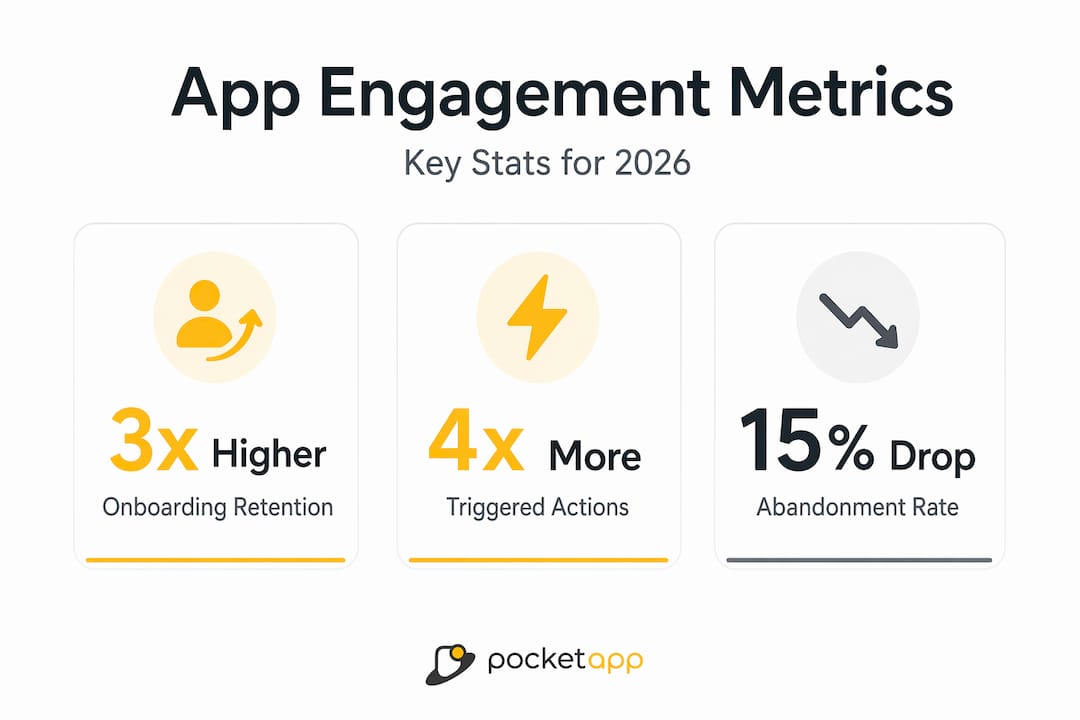
The most effective onboarding flows share a few traits. They are short, they are interactive, and they reward progress. Gamified onboarding nearly triples Day-30 retention rates, and interactive onboarding increases retention by 18% compared to static walkthroughs. That gap is too large to ignore.
Here are the onboarding principles that consistently perform well:
- Get users to an "aha moment" fast. Deep linking to specific content increases Day 1 retention by 15% by cutting the path between download and value delivery.
- Use progressive disclosure. Show users only what they need at each stage. Dumping every feature on them in a single walkthrough causes drop-off, not delight.
- Personalise the onboarding journey. Segment users by goal, experience level, or use case and tailor the first experience accordingly. A beginner and a power user should not see the same flow.
- Delay permission requests. Soft prompts that demonstrate value first raise permission opt-in rates by 35%. Ask for notifications or location access after users have already seen why they would want to grant it.
- Automate a welcome sequence. Automated welcome messages sent within the first 12 hours increase retention by 50%, and early rewards achieve open rates above 60% compared to the 20% industry standard.
Pro Tip: Do not treat onboarding as a one-time linear flow. Build branching paths based on how users actually behave in session one, and use those signals to tailor the messages they receive on days two, three, and seven.
Personalised engagement at scale
Once a user is past onboarding, the question becomes how you stay relevant without becoming annoying. The answer lies in behaviour-triggered communication rather than scheduled broadcasts.
Most teams default to time-based push notifications because they are easy to set up. The problem is that 76% of users are frustrated by messages that have nothing to do with what they are currently doing or interested in. Sending a generic "Come back!" notification to someone who used your app yesterday is noise. Sending a notification triggered by an action they started but did not complete is context.
Follow this sequence when building your personalised engagement system:
- Map your key user actions. Identify the behaviours that correlate with long-term retention, such as completing a profile, making a first purchase, or inviting a friend.
- Set up event tracking. You cannot trigger behaviour-based messages without knowing what users are doing. Instrument your app thoroughly before you build any messaging logic.
- Build trigger rules around intent signals. A user who viewed a product three times but did not buy has shown clear intent. A user who has not opened the app in five days needs a re-engagement angle, not a sales message.
- Layer channels thoughtfully. Omnichannel engagement strategies combining push, email, SMS, and in-app messaging achieve retention rates above 90%. No single channel does the job alone.
- Use AI to optimise send timing. AI-driven timing can boost interaction rates by 40% simply by sending messages when each individual user is most likely to be active.
- Monitor opt-out rates. Rising notification opt-outs are a warning sign, not an acceptable trade-off. They signal message fatigue and need to be addressed immediately.
Pro Tip: Behaviour-triggered notifications achieve interaction rates four times higher than generic blasts. Build your messaging infrastructure around triggers first, then add broadcast campaigns as a secondary layer.
Localisation is worth considering here too. If your app serves users across multiple regions, personalisation paired with localisation meaningfully increases relevance and reduces churn in those markets.
Building habits and community
Getting a user to open your app once is easy. Getting them to open it every day requires a different kind of thinking. This is where mobile app engagement strategies move from communication into product design.

The distinction between extrinsic and intrinsic motivation matters here. Extrinsic rewards like coins, discounts, and badges produce short-term spikes. Intrinsic motivation, driven by progression, social status, and a sense of meaningful play, yields sustained engagement over months and years. Build for the latter while using the former as a hook.
| Mechanic | What it targets | Long-term value |
|---|---|---|
| Streaks | Loss aversion and daily habit formation | High. Streak mechanics increase daily engagement by over 20%. |
| Leaderboards | Social status and competition | Medium. Effective for competitive audiences; risks alienating beginners. |
| Quests and challenges | Goal orientation and progression | High. Creates structured reasons to return and explore features. |
| In-app communities | Belonging and social identity | Very high. Community features reduce churn and increase lifetime value. |
| Live events | Exclusivity and shared experience | High. Interactive live events increase both session frequency and length. |
Social features deserve particular attention. In-app chats, collaborative tools, and shared challenges give users a reason to return that has nothing to do with your product's core function. They come back for the community and stay for the product. This is one of the most underused retail app engagement strategies in commerce specifically, where brands focus on catalogue and checkout and neglect the social layer entirely.
Encouraging social sharing within the app extends your reach too. When a user shares their progress or achievement externally, it acts as organic acquisition and reinforces their own commitment to your product simultaneously.
Measuring and optimising engagement
You cannot improve what you do not measure, and most apps measure the wrong things. Download counts and daily active users are lagging indicators. The metrics that help you actually improve engagement are further down the funnel.
| Metric | What it tells you |
|---|---|
| Day 1, Day 7, Day 30 retention | Where in the early journey you are losing users |
| Session length and frequency | Whether users find ongoing value |
| Feature adoption rate | Which parts of your app go unused |
| Notification opt-out rate | Whether your messaging is annoying rather than useful |
| Churn rate by segment | Which user groups are most at risk |
Event tracking and segmentation are the foundation of any serious engagement improvement programme. Without event-level data, you are making product decisions based on assumptions. With it, you can see exactly where users drop off and prioritise fixes accordingly.
A/B testing compounds your learning. Test onboarding flows against each other, compare notification copy, and trial different trigger conditions before rolling out changes at scale. The goal is not to get it right once. It is to build a cycle of testing, learning, and iterating that never stops.
Pro Tip: Use mobile app analytics to identify the single biggest drop-off point in your onboarding flow, fix only that, then measure again. Teams that try to fix everything at once rarely know which change actually worked.
Common engagement mistakes to avoid
Even well-resourced teams make the same mistakes. Knowing them in advance saves you months of lost momentum.
- Overloading users with notifications. More is not better. Frequency without relevance kills opt-in rates and drives uninstalls faster than almost anything else.
- Building a complex onboarding flow. Long, multi-step walkthroughs cause users to abandon before they have experienced your product's value. Shorter and more interactive always wins.
- Delaying the value delivery. If a user cannot understand why your app is useful within two to three minutes of opening it, they will not stick around to find out.
- Treating all users the same. Ignoring segmentation means your most engaged users get irrelevant messages and your at-risk users get nothing targeted. Neither outcome is acceptable.
- Failing to act on analytics. Collecting data and not acting on it is common. Build a regular review cadence into your product cycle so that insights translate into decisions, not just reports.
- Skipping the user experience optimisation step. Engagement mechanics built on a confusing or slow interface will not save you. Fix the foundation before layering strategies on top.
AI-powered chatbots are worth noting here too. Placed at known friction points, they reduce session abandonment by 15% by answering questions and guiding users forward rather than leaving them stuck.
What I have actually learned about app engagement
What strikes me after working across dozens of mobile products is how rarely teams treat engagement as a continuous system. They ship a feature, run a campaign, and then wonder why retention numbers do not move. The problem is not the tactics. It is the framing.
I have seen apps with genuinely brilliant onboarding fail at week three because nobody thought about what happens after the welcome sequence ends. And I have seen simple apps with mediocre designs retain users for years because they understood human habit psychology and built around it.
The most reliable predictor of long-term engagement I have observed is trust. Users who feel that an app delivers value before it extracts it, whether that means data, money, or attention, stay longer and advocate more. Every time a team asks for permissions too early or bombards users with irrelevant messages, they are spending trust they have not yet earned.
My honest take is this: stop thinking about how to improve app engagement as a marketing problem. It is a product problem. Fix the onboarding, instrument everything, and build a testing culture. The messaging strategy you layer on top will perform far better as a result.
— Paul
Build engagement into your app from the ground up
The strategies in this article work. They work even better when they are designed into the product architecture from the start rather than retrofitted after launch. At Pocketapp, we have built over 300 mobile applications across retail, healthcare, charity, and consumer sectors, and engagement is designed into every layer of what we build, from onboarding flows to analytics instrumentation to gamification systems.
If you are building a new app or rethinking an existing one, our team can help you create mobile app experiences that users actually return to. Whether you need expert app design services or a full development engagement, we build with retention in mind from day one. Get in touch to talk through your project.
FAQ
What is app engagement strategy?
An app engagement strategy is a structured plan for keeping users active, returning, and finding value in your app over time. It covers onboarding, personalised messaging, gamification, analytics, and iterative optimisation working together as a system.
How do I improve app engagement quickly?
The fastest wins come from fixing your onboarding flow and setting up behaviour-triggered notifications. Interactive onboarding increases retention by 18%, and behaviour-triggered messages achieve interaction rates four times higher than generic broadcasts.
How often should I send push notifications?
There is no universal frequency, but relevance matters more than volume. Focus on triggering notifications based on user behaviour rather than scheduling them by time. Monitor opt-out rates closely. Rising opt-outs are a clear signal you are sending too many or sending the wrong ones.
What metrics should I track for app engagement?
Track Day 1, Day 7, and Day 30 retention rates alongside session length, feature adoption rate, notification opt-out rate, and churn by user segment. These give you a picture of where users lose interest and what interventions to prioritise.
Does gamification genuinely improve retention?
Yes, when it is built around intrinsic motivation rather than just badges and coins. Streak mechanics increase daily engagement by over 20%, and apps using gamified onboarding see Day-30 retention rates nearly three times higher than those using standard walkthroughs.