
TL;DR:
- Cloud technology enables scalable, cost-effective mobile app deployment without extensive in-house infrastructure.
- Sector case studies show significant speed, cost savings, and operational improvements using cloud-based solutions.
- Architectural decisions should balance latency, data sensitivity, and regulatory requirements, often benefiting from hybrid approaches.
Many businesses assume that building a scalable, feature-rich mobile app requires a costly, complex server infrastructure managed by a large in-house team. That assumption is wrong, and it is holding organisations back. Cloud technology has fundamentally changed what is possible, allowing retail brands, healthcare providers, and nonprofits to deploy powerful apps without the traditional overhead. This article covers the core mechanics of cloud-powered mobile development, real-world sector results, architecture trade-offs, and security considerations, so you can make informed decisions about your next mobile project.
Table of Contents
- How cloud technology empowers mobile apps
- Sector case studies: Retail, healthcare, and nonprofit transformation
- Balancing performance, scalability, and cost: Cloud vs edge approaches
- Security and compliance in cloud-powered mobile apps
- Why cloud mobile app success demands balanced strategy
- Elevate your mobile app with proven cloud expertise
- Frequently asked questions
Key Takeaways
| Point | Details |
|---|---|
| Elastic scalability | Cloud platforms allow mobile apps to fluidly handle spikes in user traffic and demand. |
| Rapid development | Backend-as-a-Service providers enable businesses to launch apps faster and iterate efficiently. |
| Cost efficiency | Serverless architectures and auto-scaling cut infrastructure costs by up to 90% versus traditional models. |
| Sector adaptation | Retail, healthcare, and nonprofits realise unique benefits from cloud, such as improved productivity and tailored compliance. |
| Security focus | Proper identity management and data protection are critical for safeguarding information in cloud mobile apps. |
How cloud technology empowers mobile apps
The traditional model of mobile app development required businesses to provision, manage, and maintain their own backend servers. This meant significant upfront costs, specialist staff, and slow iteration cycles. Cloud has dismantled that model entirely.
The key enabler is Backend-as-a-Service (BaaS) and its mobile-specific variant, Mobile Backend-as-a-Service (MBaaS). These platforms provide ready-built backend infrastructure that your app connects to via APIs. BaaS and MBaaS platforms like AWS Amplify and Firebase handle scalability, real-time data sync, user authentication, and serverless compute without you ever managing a physical server. You focus entirely on the app experience.
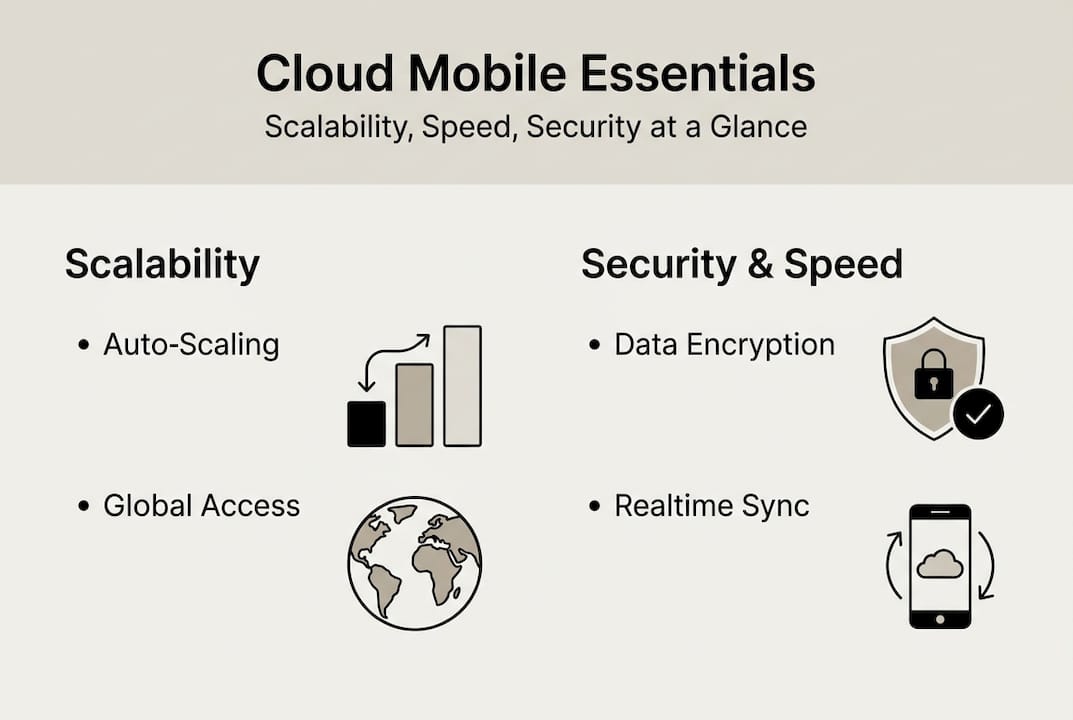
The underlying mechanics are worth understanding. Services such as AWS backend architecture use API Gateway and Lambda for serverless APIs, DynamoDB or Firestore for NoSQL databases, Cognito or Firebase Authentication for user management, and AppSync for GraphQL real-time data. Each component replaces what previously required weeks of custom engineering.
Here is how the main deployment approaches compare:
| Feature | Pure cloud | Hybrid | On-premise |
|---|---|---|---|
| Setup speed | Fast | Moderate | Slow |
| Scalability | Automatic | Partial | Manual |
| Cost model | Pay-as-you-go | Mixed | High upfront |
| Latency | Moderate | Lower | Lowest |
| Maintenance | Provider-managed | Shared | Full in-house |
The benefits of moving to a cloud-first approach include:
- Auto-scaling: Traffic spikes are handled automatically, with no manual intervention required.
- Real-time sync: User data updates instantly across devices, which is critical for collaborative or transactional apps.
- Serverless computing: Functions run only when triggered, dramatically reducing idle costs.
- Faster release cycles: Teams ship features in days rather than months because infrastructure is pre-built.
For businesses exploring whether cloud investment pays off, the evidence on cloud-based app ROI is compelling across multiple sectors.
Pro Tip: If your app experiences unpredictable traffic, such as seasonal retail spikes or campaign-driven charity donations, serverless architecture is your best friend. You only pay for the compute you actually use, and scaling is instant.
Sector case studies: Retail, healthcare, and nonprofit transformation
Understanding the mechanics is one thing. Seeing what those mechanics produce in the real world is another.
Retail: Speed and savings at scale
Neiman Marcus is a standout example. The retailer built its omnichannel app using AWS Amplify, Lambda, and AppSync, and the results were striking. The project achieved 50% faster time-to-market compared to traditional development, alongside a 90% cost reduction versus conventional infrastructure. The app also scaled elastically during high-traffic events like seasonal sales, with zero performance degradation.

Healthcare: Enterprise migration at volume
Tufts Medicine took on one of the more ambitious cloud migrations in healthcare. The organisation deployed Epic EHR on AWS, migrating 42 applications in just 14 months while managing four million patient records. Memorial Healthcare, using Workday mobile, reduced HR case volumes by 10 to 15 per cent and achieved 69% faster expense reimbursements. These are not marginal gains; they represent genuine operational transformation.
Nonprofits: Donor management without compromise
Nonprofits face a unique challenge. They need sophisticated donor management and fundraising tools but rarely have the budget for bespoke infrastructure. Cloud CRM platforms like Salesforce Nonprofit Cloud and StratusLIVE are specifically tailored for this sector, including healthcare philanthropy organisations that need to manage donor relationships without storing protected health information.
Here is a summary of key results across sectors:
| Sector | Organisation | Key result |
|---|---|---|
| Retail | Neiman Marcus | 90% cost reduction, 50% faster delivery |
| Healthcare | Tufts Medicine | 42 apps migrated in 14 months |
| Healthcare | Memorial Healthcare | 69% faster expense reimbursements |
| Nonprofit | Salesforce/StratusLIVE | Scalable donor CRM without PHI risk |
For UK organisations looking to replicate these results, the evidence on mobile app efficiency across domestic sectors reinforces the same pattern: cloud-first apps consistently outperform legacy approaches on cost, speed, and staff productivity.
Balancing performance, scalability, and cost: Cloud vs edge approaches
Cloud is not always the right answer for every part of your architecture. Understanding when to use cloud, edge, or a hybrid of both is one of the most important decisions you will make.
Latency is the critical variable. Cloud processing involves round-trip latency of 200 to 500ms, which is perfectly acceptable for most transactional apps. However, for use cases like real-time AI inference, live health monitoring, or augmented reality, that delay is unacceptable. On-device or edge processing can bring latency below 100ms, which changes the user experience entirely.
Privacy is the second major consideration. Processing data on-device or at the edge means sensitive information never leaves the user's hardware, which is a significant advantage for healthcare and financial apps.
Here is a practical framework for deciding your architecture:
- Define your latency tolerance. If your app requires sub-100ms responses, edge or on-device processing is likely necessary.
- Assess data sensitivity. If users handle highly personal data, consider whether cloud transmission is appropriate or whether on-device processing reduces risk.
- Map your traffic patterns. Unpredictable spikes favour serverless cloud. Consistent, predictable loads may suit reserved cloud instances or hybrid models.
- Calculate total cost of ownership. Edge hardware has upfront costs; hybrid cloud-edge models often provide the best balance of performance and running costs at scale.
- Consider regulatory requirements. Some sectors mandate data residency, which affects whether cloud regions or on-premise components are required.
| App scenario | Recommended approach |
|---|---|
| E-commerce with seasonal spikes | Pure cloud, serverless |
| Real-time health monitoring | Edge or on-device |
| Donor management platform | Cloud CRM |
| AR retail experience | Hybrid (on-device AI, cloud data) |
| EHR mobile access | Hybrid cloud with compliance controls |
The most common mistake we see is businesses treating cloud as a binary choice. The strongest architectures combine cloud for scalability and data management with edge or on-device processing for latency-sensitive or privacy-critical features.
For a deeper look at how architecture choices intersect with risk, the guidance on mobile app security best practices is essential reading before committing to a deployment model.
Pro Tip: Do not lock your entire architecture into one approach at the start. Build modular components that can shift between cloud and edge as your user base and requirements evolve.
Security and compliance in cloud-powered mobile apps
Cloud adoption introduces a specific set of security responsibilities that differ from traditional infrastructure. Understanding these is non-negotiable, particularly for healthcare and nonprofit organisations handling sensitive data.
Identity and Access Management (IAM) is where most cloud security failures originate. IAM refers to the system that controls who can access what within your cloud environment. Poorly configured IAM policies are a leading cause of data breaches in cloud deployments. Healthcare organisations prioritise HIPAA-compliant cloud configurations precisely because the consequences of a breach extend beyond financial penalties to patient safety.
Key security practices for cloud-powered mobile apps include:
- Principle of least privilege: Each service and user account should have only the minimum permissions required.
- Encrypted data in transit and at rest: Use TLS for all API communications and encrypt stored data using provider-managed keys or your own.
- Credential management: Never hard-code API keys or secrets in app code. Use secrets management services like AWS Secrets Manager.
- Multi-factor authentication (MFA): Enforce MFA for all administrative access to cloud consoles.
- Regular security audits: Schedule penetration testing and review IAM policies quarterly.
- Compliance mapping: For healthcare apps, map every data flow to HIPAA requirements before launch.
A misconfigured IAM role is the equivalent of leaving your server room unlocked. The cloud provider secures the infrastructure; you are responsible for securing access to it.
For nonprofits, the good news is that donor management platforms like StratusLIVE are designed to avoid storing protected health information (PHI), which significantly reduces compliance complexity. You still need robust mobile app data protection practices, but the regulatory burden is lighter than in clinical healthcare.
For organisations building apps that handle personal financial or health data, the resources on advanced mobile app security and data privacy best practices provide sector-specific guidance that goes well beyond generic checklists.
Why cloud mobile app success demands balanced strategy
Here is the uncomfortable truth that most cloud guides will not tell you: cloud is not a guaranteed upgrade. We have seen businesses migrate to cloud and end up with higher costs, worse performance, and more security incidents than before, simply because they treated it as a default rather than a deliberate choice.
The organisations that get the most from cloud-powered mobile apps share a few habits. They treat architecture as a living decision, not a one-time choice. They monitor costs continuously as scale grows, because cloud billing can spiral quickly without discipline. They plan for privacy from the start rather than retrofitting compliance.
Hybrid strategies consistently outperform pure-cloud or pure-edge approaches for complex apps. The businesses that thrive are those who match each component of their app to the right infrastructure layer, whether that is serverless cloud for data management, on-device processing for sensitive features, or edge nodes for latency-critical interactions.
The evidence on cloud ROI strategies shows that the returns are real, but they require ongoing architectural review, not a set-and-forget mentality. Build that review into your development cycle from day one.
Elevate your mobile app with proven cloud expertise
At Pocket App, we have spent years helping retail brands, healthcare providers, and nonprofits build cloud-powered mobile apps that genuinely perform under pressure. Our team understands that the right architecture is not the most sophisticated one; it is the one that fits your users, your sector, and your growth plans.
Whether you need professional app development for a consumer-facing retail platform, a compliant healthcare solution, or a donor engagement tool for your charity, we bring the technical depth and sector knowledge to deliver. Explore our business app solutions or find out how our cross-platform cloud apps can reduce your build costs while expanding your reach. Get in touch to discuss your project.
Frequently asked questions
What are the main advantages of using cloud for mobile apps?
Cloud delivers automatic scalability, real-time features, and significant cost savings. Platforms like AWS Amplify enable apps to be deployed 50% faster with 90% cost reduction compared to traditional infrastructure.
How do businesses maintain security for cloud-based mobile apps?
Businesses use strong IAM controls, encryption, sector-specific compliance frameworks, and regular audits. In healthcare, HIPAA-compliant cloud configurations are essential to protect patient data and meet regulatory obligations.
Does cloud support real-time data and high-volume apps?
Yes. Platforms like Firebase and AWS scale to millions of concurrent users. Firebase powers 70 billion app instances per day, with real-time sync delivered via AppSync and Firestore.
When is edge computing better than cloud for mobile apps?
Edge or on-device processing is preferable when your app requires ultra-low latency or handles sensitive data locally. Cloud latency runs 200 to 500ms, while edge solutions can operate well below 100ms, making them suitable for real-time AI and health monitoring.
Can nonprofits use cloud-powered mobile apps without risking sensitive information?
Yes. Platforms like StratusLIVE and Salesforce Nonprofit Cloud are designed for donor management without PHI storage, allowing nonprofits to manage fundraising securely without the compliance burden of clinical healthcare systems.