
TL;DR:
- A brand engagement workflow automates customer interactions through triggers, actions, and decision points to foster loyalty. Proper mapping, ownership, integration, and monitoring ensure it remains reliable and effective over time. Combining AI-driven personalization with authentic communication builds stronger, lasting customer relationships.
A brand engagement workflow is a structured sequence of triggers, actions, and decision points designed to move customers from passive awareness to active loyalty. Automation within these workflows delivers a revenue lift over 30% for 76% of marketers, with conversion lifts of 15–30% and campaign launch times cut by half. That is not a marginal gain. It is the difference between a brand that reacts to customers and one that anticipates them. For brand managers and marketing professionals, building a reliable brand engagement workflow is now the foundation of every effective engagement campaign.
The industry term for this practice is customer engagement automation, though "brand engagement workflow" describes the same discipline from the brand governance perspective. Both terms refer to the same core architecture: defined inputs, conditional logic, and measurable outputs that shape every customer interaction.
What makes a brand engagement workflow effective?
The foundation of any effective brand engagement workflow is visual mapping of triggers, actions, and decision points before a single automation rule is written. Skipping this step is the most common cause of technical failures in live campaigns. A workflow that looks logical in a brief becomes a fault-prone system when triggers fire out of sequence or decision branches are left undefined.
Beyond mapping, five prerequisites determine whether a workflow will hold up under real customer behaviour:
- Clear ownership. Every stage of the workflow needs a named owner, whether that is a CRM manager, a content lead, or a customer success team. Ambiguity in ownership produces gaps in execution.
- Platform integration. Your CRM, marketing platform, analytics stack, and engagement tools must share data in real time. Siloed systems create stale triggers and broken personalisation.
- Event taxonomy. Define and version-control every event your workflow uses, from "product viewed" to "purchase completed." Event taxonomy should be linked to business outcomes and used for accurate attribution, not just tracking.
- Data quality standards. A workflow is only as reliable as the data feeding it. Incomplete customer profiles, duplicate records, and missing consent flags all cause downstream failures.
- Touchpoint mapping. Identify every point at which a customer interacts with your brand, from the first ad impression through to post-purchase support. Each touchpoint is a potential trigger.
Pro Tip: Build your event taxonomy in a shared document before touching your marketing platform. Version-control it like code. When your workflow breaks six months from now, you will know exactly which event definition changed and why.
Successful workflows require clear ownership, simplicity, and visual clarity to avoid breakdowns when real customers behave in unexpected ways. This is not a design preference. It is an operational requirement.

How do you design and automate a brand engagement workflow?
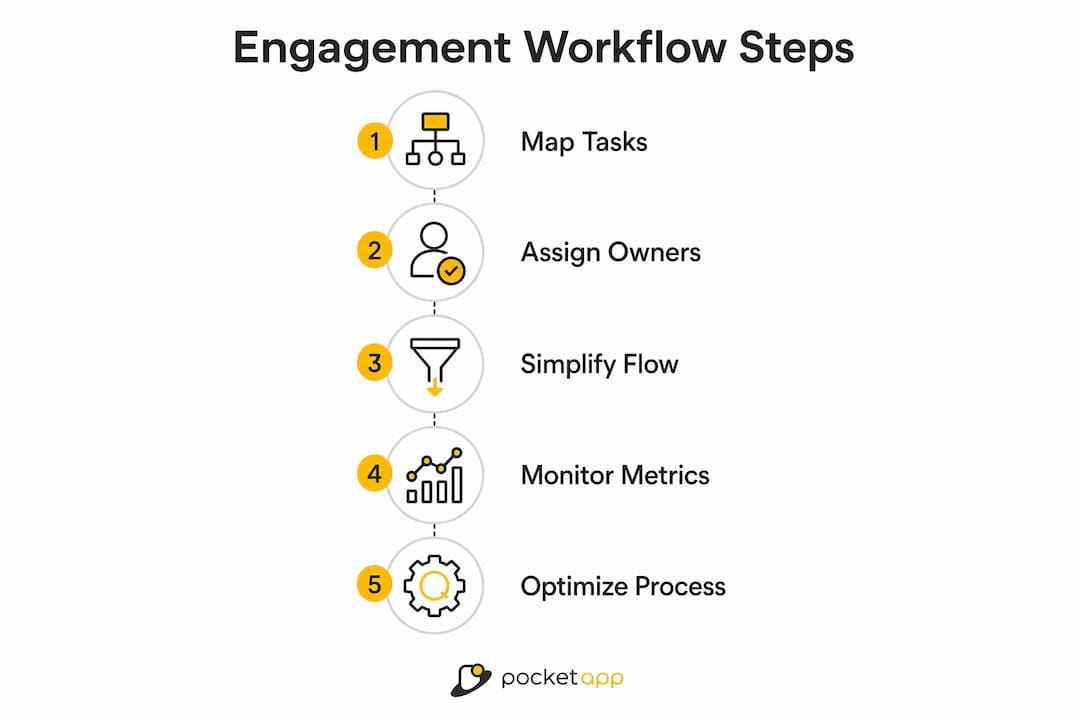
Design starts with the simplest, highest-volume interactions your brand handles. Triggered emails, SMS confirmations, and push notifications are the right starting point. They are low in complexity, high in frequency, and easy to test against real behavioural data. Complex omnichannel sequences come later, once the simpler paths are proven.
Follow these steps to move from concept to live automation:
- Write your if/then logic in plain language first. Before opening any platform, document every condition. "If a customer views a product three times without purchasing, send a reminder email after 24 hours." This sentence becomes your automation rule. Writing it in plain language forces clarity and exposes gaps.
- Connect and sync your data sources. Map every data input your workflow depends on. Confirm that your CRM, analytics platform, and engagement tool are syncing at the frequency your triggers require. A daily sync is insufficient for real-time personalisation.
- Set fallback paths for every failure condition. What happens when a customer's email address is missing? What if a trigger fires but the content asset is unavailable? Every branch needs a fallback, including a human escalation path for high-value interactions.
- Test with real customer behavioural data. Synthetic test data misses edge cases. Use anonymised records from actual customer segments to validate trigger conditions, timing, and content rendering across devices.
- Document every rule and trigger condition. Automation rules that exist only inside a platform become invisible technical debt. A shared document describing every trigger, condition, and action makes the workflow maintainable by anyone on the team.
- Launch incrementally. Start with one customer segment. Monitor delivery rates, engagement rates, and drop-off points before expanding to the full audience.
Pro Tip: A reliable 3-step workflow consistently outperforms complex 12-step sequences that are difficult to maintain. Resist the urge to build everything at once. Complexity is the enemy of longevity.
How do you monitor and troubleshoot engagement workflows?
Monitoring is not a post-launch activity. Continuous monitoring via delivery, engagement, conversion, and drop-off metrics is what separates workflows that improve over time from those that quietly degrade. Customer behaviour changes. Tech stacks evolve. A workflow that performed well in january may be broken by march without anyone noticing.
The five metrics every brand manager should track are:
- Delivery rate. The percentage of triggered messages that reach the intended recipient. A falling delivery rate signals data quality issues or platform configuration problems.
- Engagement rate. Opens, clicks, replies, and app interactions. This tells you whether the content and timing are relevant to the segment receiving it.
- Conversion rate. The percentage of engaged customers who complete the desired action, whether that is a purchase, a sign-up, or a support resolution.
- Drop-off rate. Where customers exit the workflow without completing the intended journey. High drop-off at a specific step identifies a bottleneck or a content failure.
- Cycle time. The total time from trigger to conversion. Long cycle times often indicate unnecessary delays or redundant steps in the sequence.
The most common workflow failures are delayed triggers, missing data tokens in message templates, and unhandled exception states. Each of these is diagnosable with the right monitoring setup.
| Failure type | Likely cause | Fix |
|---|---|---|
| Delayed triggers | Sync frequency too low | Increase data sync cadence |
| Missing data tokens | Incomplete customer profiles | Add data validation before trigger fires |
| Unhandled exceptions | No fallback branch defined | Add human escalation path |
| Low engagement rate | Wrong segment or poor timing | A/B test send time and segment criteria |
| High drop-off | Content mismatch or friction | Audit content relevance at drop-off point |
There is a significant gap between how brands perceive their own attentiveness and how customers experience it. 61% of brand service teams consider themselves proactively engaged, but only 33% of customers agree. Monitoring closes that gap by replacing self-perception with measurable evidence.
What are the best practices for brand engagement workflows in 2026?
The most effective brand interaction strategies in 2026 combine AI-powered decisioning with authentic human communication. Neither works well alone. AI embedded throughout marketing systems enables real-time, context-aware personalisation and dynamic segmentation at scale. That capability is now table stakes for any brand competing on customer experience.
The practices that separate high-performing workflows from average ones are:
- 1:1 personalisation at scale. AI decisioning engines select the next best action for each customer based on real-time behavioural signals, not static segment rules. This shifts the customer engagement process from broadcast to conversation.
- Omnichannel coordination. Email, SMS, push notifications, in-app messages, and social direct messages must fire in a coordinated sequence, not in isolation. A customer who receives the same message across three channels simultaneously experiences the brand as clumsy, not attentive.
- Brand governance and consent management. Every automated message must respect opt-in status, communication preferences, and regulatory requirements. Governance is not optional. It is the condition under which automation is permitted to operate.
- Response SLAs for human touchpoints. Direct message replies should ideally arrive within 4 hours to signal attentiveness and improve platform algorithm visibility. Build this SLA into your workflow as a monitored metric, not an aspiration.
- Transparency as a differentiator. Brands that share imperfections and invite audiences into their stories achieve higher engagement and stronger loyalty than those projecting only polished perfection. Authenticity is a workflow design choice, not just a tone-of-voice guideline.
Blending AI-powered personalisation with human insight and authentic storytelling is the defining challenge of modern brand engagement. Automation handles scale. Humans handle meaning.
"Engagement is now experience-driven. Brands must create valuable moments that foster reach, trust, and retention beyond passive exposure. The workflow is the mechanism. The experience is the outcome."
Messaging platforms that support personalised engagement workflows are increasingly central to this omnichannel approach, particularly for retention-focused sequences where conversational tone matters as much as timing.
Key takeaways
A brand engagement workflow succeeds when it combines clear trigger logic, owned accountability, continuous monitoring, and authentic communication at every customer touchpoint.
| Point | Details |
|---|---|
| Map before you build | Visually document triggers, actions, and decision points before configuring any automation platform. |
| Keep workflows simple | A reliable 3-step workflow outperforms a complex 12-step sequence that nobody can maintain. |
| Monitor five core metrics | Track delivery rate, engagement rate, conversion rate, drop-off rate, and cycle time continuously. |
| Close the perception gap | Only 33% of customers feel proactively engaged; use data, not self-assessment, to measure attentiveness. |
| Blend automation with authenticity | AI handles scale and personalisation; human storytelling and transparency build lasting loyalty. |
Why most brand teams get workflows wrong
Brand teams consistently underestimate the preparation phase. They reach for the platform before they have written a single if/then rule in plain language, and they pay for it six months later when the workflow breaks and nobody can explain why.
The other mistake I see repeatedly is building for completeness rather than reliability. A workflow that covers every conceivable customer scenario but fails on a missing data token is worse than a simple three-step sequence that works every time. Complexity feels like progress. It rarely is.
Cross-functional collaboration is the element most often missing from workflow projects. CRM, content, analytics, and product teams each own a piece of the customer journey. When they do not share a common event taxonomy or a single source of truth for customer data, the workflow reflects their silos. Customers feel that fragmentation directly.
The brands I have seen succeed with user engagement strategies treat their workflows as living systems, not launch projects. They schedule quarterly reviews, prune steps that no longer serve a purpose, and test new trigger conditions against real behavioural data. That discipline is unglamorous. It is also what separates brands with genuine loyalty from those with impressive campaign metrics and poor retention.
Automation for its own sake is the most expensive mistake in this space. Every automated touchpoint should earn its place by improving the customer experience or reducing friction. If you cannot articulate what a workflow step does for the customer, remove it.
— Paul
How Pocketapp supports brand engagement through mobile
Brand managers who want to move from workflow theory to working product need a development partner who understands both the technical and the customer experience side of engagement.
Pocketapp has delivered over 300 mobile app projects for brands including WWF, Dechra, and Crocus, building custom mobile apps that embed engagement workflows directly into the customer experience. Their work spans AI integration, cross-platform app development, and UX design, giving brand teams a single partner for the full build. If your engagement strategy depends on a mobile channel, Pocketapp's team can translate your workflow architecture into a product that performs. Reach out through their website to discuss your project.
FAQ
What is a brand engagement workflow?
A brand engagement workflow is a structured sequence of triggers, actions, and decision points that automates and coordinates customer interactions across channels to build loyalty and drive conversion.
How does automation improve brand engagement?
Automation delivers a revenue lift over 30% for 76% of marketers. It removes manual delays, personalises communication at scale, and ensures consistent follow-up across every customer touchpoint.
What metrics should I track in an engagement workflow?
Track delivery rate, engagement rate, conversion rate, drop-off rate, and cycle time. These five metrics identify where a workflow is performing and where it is losing customers.
How does AI improve a customer engagement process?
AI enables real-time, context-aware personalisation and dynamic segmentation, selecting the next best action for each customer based on live behavioural signals rather than static rules.
How simple should an engagement workflow be?
As simple as it can be while still meeting the customer's need. A reliable 3-step workflow consistently outperforms a complex 12-step sequence that is difficult to maintain and prone to failure.