
For an app that cost £60,000 to build, that means somewhere between £9,000 and £15,000 annually. The right figure depends on how complex the app is, how many users it carries, and how much sensitive data it touches, so maintenance costs vary accordingly.
We recommend a monthly retainer as the default model for most UK SMEs, sized to match risk rather than guesswork. Retainers give you predictable spend and a team that already knows your codebase, which matters the moment something breaks in production.
- Lower end of the range: simple apps with few integrations and low user volumes
- Higher end of the range: apps handling payments, health data, or heavy third-party integration
Industry benchmark: UK app maintenance typically requires budgeting a moderate share of original development cost each year, increasing for apps with strict compliance or security demands.
Underfunding this line item is where most post-launch problems start. Skipped security patches invite breaches, missed OS updates cause crashes on new devices, and an app frozen on an old policy version risks being pulled from the Google Play developer policy and update guidance entirely.
Key Takeaways
| Point | Details |
|---|---|
| Budget the benchmark | Set aside 15 to 25% of your original build cost annually, higher for compliance-heavy apps. |
| Break down line items | Hosting, patching, bug fixes, OS updates, licences, and monitoring each need separate budget lines. |
| Watch usage-scaled costs | Push notifications, SMS, and app-store commissions grow with your user base, not with a flat fee. |
| Choose the right model | Retainers suit most SMEs; ad-hoc suits quiet apps; in-house suits large, complex products. |
| Work with a UK partner | Pocket App offers retainer-based maintenance backed by over 300 delivered projects across regulated and consumer sectors. |
Table of Contents
- What does app maintenance actually cover?
- How much does app maintenance cost in the UK?
- What factors push maintenance costs higher?
- Retainer, ad-hoc, or in-house: which maintenance model fits?
- What hidden costs catch businesses off guard?
- How do you build a realistic maintenance budget?
- Pocket App: UK credentials and what maintenance looks like with us
- Why the standard maintenance advice undersells the risk
- Get a maintenance estimate built around your app
- Sources
- FAQ
What does app maintenance actually cover?
App maintenance cost in the UK breaks down into distinct line items, each with its own budget band and its own reason for existing. Knowing what sits inside each one helps you interrogate a vendor's quote properly, rather than accepting a single lump figure.
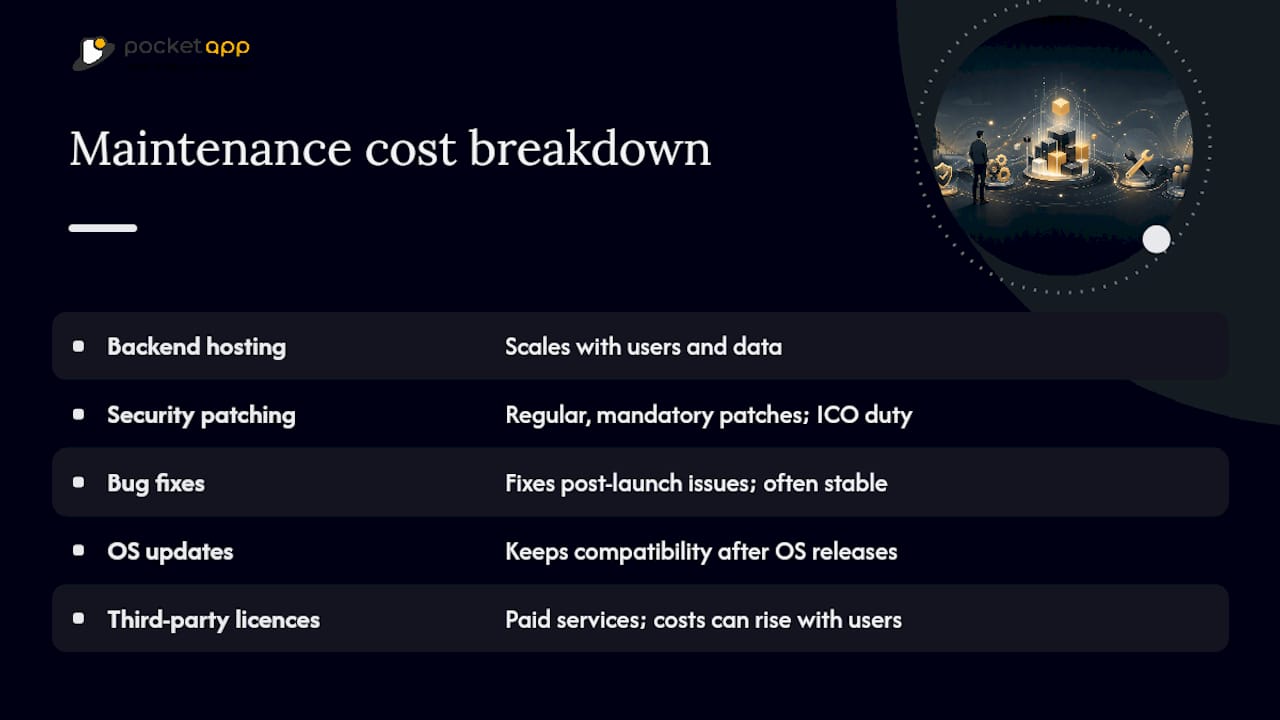
Backend hosting keeps your servers, databases, and APIs running, and its cost scales directly with user numbers and data volume. Security patching closes vulnerabilities as they're discovered, a task the Information Commissioner's Office treats as a core part of an organisation's data protection duty, not an optional extra. Bug fixes address whatever slipped through testing or surfaced once real users got hold of the app. OS updates keep the app working when Apple and Google push new versions of iOS and Android, something that happens on a near-constant cycle. Third-party licences cover the paid tools your app depends on, from mapping services to payment gateways. App-store compliance work keeps you aligned with evolving platform rules. Monitoring watches for crashes, slow load times, and server issues before users complain. Optional feature work covers anything beyond keeping the lights on.
Hosting, licences, and monitoring move with your user base. A retailer app that goes from 5,000 to 50,000 users won't see its bug-fix budget change much, but hosting and third-party licence fees can climb sharply.
How much does app maintenance cost in the UK?
You stop paying for new feature development and start paying to keep existing functionality alive against a moving target: new OS versions, new device models, and new compliance rules that arrive whether you asked for them or not.
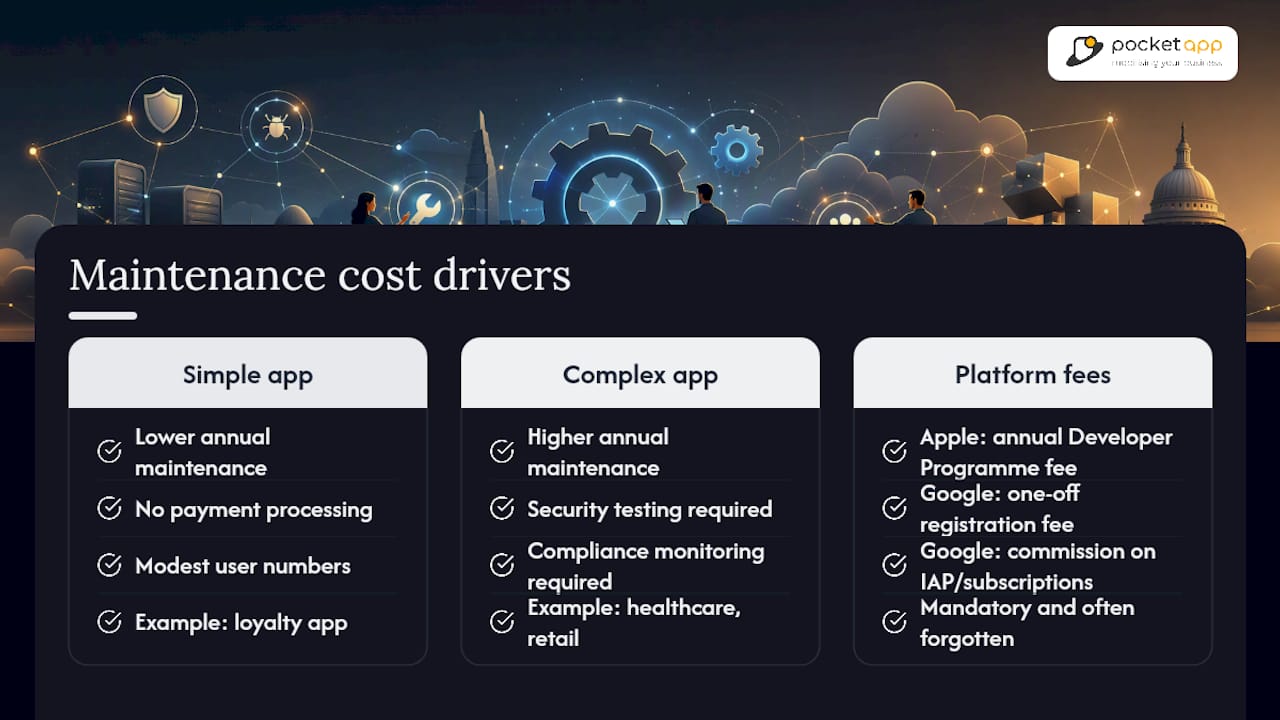
Maintenance costs generally scale with build cost and complexity levels. Simpler apps incur lower annual maintenance amounts while complex or compliance-heavy apps require significantly higher budgets.
A simple loyalty app with no payment processing and modest user numbers requires a lower maintenance budget. Healthcare apps handling patient records, or retail apps processing card payments, require higher spending due to security testing and compliance monitoring needs.
On top of the maintenance percentage, budget for platform fees separately. Apple charges an annual Apple Developer Programme fee to keep your app live and updatable on the App Store, and Google Play charges a one-off registration fee plus commission on in-app purchases and subscriptions. Neither of these is optional, and both are easy to forget when a first-year budget gets drawn up. If you're still finalising your build budget, it's worth reviewing what a mobile app costs to develop before locking in a maintenance percentage, since the two figures are directly linked.
What factors push maintenance costs higher?
Not every app costs the same to maintain, even at similar build budgets. Several variables consistently separate a lean maintenance bill from an expensive one, and most of them are visible before you sign a maintenance contract.
- Complexity and integrations: an app that talks to five external systems needs testing every time one of those systems changes, not just when your own code changes.
- User volume and hosting scale: more users means more server load, more support tickets, and more edge cases surfacing in production.
- Data sensitivity and compliance: apps handling health records, payment data, or children's information carry GDPR, PCI-DSS, or accessibility obligations that demand ongoing audit work, not a one-off compliance check.
- Third-party licence costs and update frequency: SDKs and APIs change their terms and pricing regularly, and each change can ripple into your app.
- Team location and hourly rates: UK-based developers typically charge more per hour than offshore teams, but they usually cost less overall once you factor in communication delays and rework.
Fintech and healthcare apps routinely sit at the top of the cost curve because compliance testing and security audits aren't a line item you can skip. That's a structural cost, not a vendor upsell.
Pro Tip: Ask any prospective maintenance partner exactly which of these five factors apply to your app before you accept a quote. A vendor who can't map your specific risk profile to their price is probably quoting a generic rate card.
Retainer, ad-hoc, or in-house: which maintenance model fits?
Maintenance work itself falls into four recognised categories. Corrective maintenance fixes bugs after they appear. Preventive maintenance catches problems before they cause downtime, through monitoring and proactive patching. Adaptive maintenance keeps the app working as the OS, devices, and third-party APIs change around it. Perfective maintenance improves performance or usability without fixing a fault.
How you pay for that work matters as much as what the work covers.
- Retainer: a fixed monthly fee for a set number of hours or a defined scope of ongoing work. This gives you predictable costs and a team that retains full knowledge of your app, and it's the model most UK SMEs settle on within their first year post-launch.
- Ad-hoc: pay-as-you-go, billed only when something needs fixing. Cheaper in quiet months, but response times slip and costs spike unpredictably when several issues land at once.
- In-house: hiring your own developer or small team. Sensible once your app is complex enough, or your user base large enough, to justify a full-time salary rather than a contracted rate.
For most businesses running a single commercial app, a mid-tier retainer strikes the right balance between cost control and response speed.
What hidden costs catch businesses off guard?
The maintenance percentage covers predictable work. It's the usage-scaled and compliance-driven costs sitting outside that percentage that tend to catch finance teams by surprise.
- Usage-based third-party fees: push notification services, SMS gateways, mapping APIs, and analytics platforms often charge per call or per message, and these bills grow directly with your user base.
- App-store commissions: both major platforms take a cut of in-app purchases and subscriptions, which erodes margin on any app with a transactional revenue model.
- Compliance and accessibility remediation: fixing an accessibility gap or a data-handling flaw after the fact costs considerably more than building it in from the start.
- Delayed updates: postponing an OS compatibility update to save money this quarter often means a more expensive emergency fix next quarter, once users start reporting crashes.
Under UK GDPR, a data breach traced back to an unpatched vulnerability can trigger regulatory penalties and mandatory remediation costs that dwarf the price of the patch itself. The ICO's guidance for organisations makes clear that keeping software updated is treated as a basic security obligation, not a nice-to-have.
Businesses that treat security patching as discretionary spend are the ones most likely to face this bill.
How do you build a realistic maintenance budget?
Here's how that plays out over three years for a £60,000 app, assuming steady growth in year two and faster growth in year three:
When you're reviewing a maintenance contract, three clauses deserve particular attention:
- Service level agreement (SLA): how quickly the vendor commits to responding to critical issues versus minor ones.
- Included hours: whether monitoring, patching, and minor fixes are bundled into the retainer or billed separately.
- Out-of-scope rates: the hourly or day rate charged once you exceed included hours, so a busy month doesn't produce a surprise invoice.
For a fuller view of how build cost and maintenance cost interact, our breakdown of mobile app costs is worth reading alongside this budget model.
Pocket App: UK credentials and what maintenance looks like with us
Pocket App has delivered over 300 projects for UK and international clients, including brands such as WWF, Dechra, and Crocus, across retail, healthcare, charity, and consumer engagement sectors. That range gives our maintenance teams direct experience with the compliance demands, integration complexity, and user-volume swings covered throughout this guide.
A typical Pocket App retainer includes:
- Continuous server and performance monitoring
- Scheduled security patching aligned to platform release cycles
- OS compatibility updates as Apple and Google roll out new versions
- Bug triage and fixes within agreed response times
- Planned feature releases alongside routine upkeep
Why the standard maintenance advice undersells the risk
Most guides to app maintenance cost treat the 15 to 25% figure as the whole answer, and that's where the conventional advice falls short. The percentage is a starting point for budgeting, not a substitute for understanding what happens when maintenance gets deprioritised. An app that goes twelve months without a security patch or an OS compatibility update doesn't just look outdated, it becomes a liability the moment Apple or Google enforce a policy change.
What businesses consistently underestimate is how much cheaper prevention is than recovery. A £2,000 annual patching budget looks expensive in isolation. It looks trivial next to the cost of a data breach remediation or an emergency rebuild after delisting. If there's one priority worth acting on first, it's this: treat maintenance as a line item in your original launch budget, not a decision you make once the app is already live and something has already gone wrong.
— Paul
Get a maintenance estimate built around your app
Unlike piecing together freelance cover on an ad-hoc basis, a Pocket App retainer means the same team that understands your codebase handles monitoring, patching, and scheduled updates as one continuous service.
Before an initial review, it helps to have your build cost, current user numbers, and any compliance requirements (health data, payments, accessibility) ready to discuss. That lets us size a retainer to your actual risk profile rather than a generic rate card. If you're weighing options for pricing comparisons in the wider market, resources like apppricer's app pricing data can be a useful sense check alongside a direct conversation with our team.
Get in touch through our mobile app development page to start that conversation and get a maintenance estimate tailored to your app.
Sources
FAQ
How much does a 10,000-download app make?
This depends entirely on the monetisation model (subscriptions, ads, or in-app purchases) and isn't tied to maintenance cost; download numbers indicate hosting and support load rather than revenue.
How much does it cost to maintain a website in the UK?
Website maintenance costs generally sit lower than app maintenance, since there's no app-store compliance or OS-update cycle to manage, though hosting and security patching still apply.
What happens if I skip app maintenance?
Skipping maintenance risks crashes on new OS versions, security vulnerabilities, and potential removal from the Google Play Store or App Store for failing to meet update requirements.