
TL;DR:
- UK organizations should hire a specialized UK Android developer with a strong portfolio and experience publishing on Google Play to build bespoke apps tailored to their needs. The cost varies widely, typically ranging from £25,000 for internal tools to over £150,000 for regulated enterprise applications, with project timelines usually lasting four to six months. A thorough discovery process, clear scope, verified sector experience, and strict security and compliance checks are essential for successful app development and deployment.
For UK organisations ready to commission a bespoke Android application, the recommendation is clear: engage a specialist UK Android developer with a demonstrable portfolio, a structured discovery process, and explicit experience publishing on Google Play. Android holds around 70.8% of global mobile OS share, making it the primary platform for UK-facing apps. Google Play is the principal distribution channel, and your supplier must know it inside out. Pocketapp, with a substantial number of delivered projects across retail, charity, and healthcare, is one supplier worth including in your shortlist.
Before you contact anyone, do three things:
- Define your scope: what the app must do, which systems it must connect to, and who will use it
- Set a realistic budget band (see the cost section below)
- Fix your deadline and identify your internal sign-off process
Then request a discovery call. Everything else follows from that conversation.
Table of Contents
- Why does a bespoke Android app make sense for your organisation?
- What does a bespoke Android app cost in the UK?
- What does the development process look like, and how long will it take?
- How do you choose the right UK Android developer?
- What Android-specific technical issues should you check in proposals?
- What security and compliance checks must you require?
- What does credible proof of delivery look like?
- How do you write a procurement-ready supplier brief?
- Key takeaways
- What working with a UK Android developer actually means
- Pocketapp: bespoke Android development for UK organisations
- Useful sources and further reading
- FAQ
Why does a bespoke Android app make sense for your organisation?
Off-the-shelf apps solve generic problems. A bespoke Android application solves your problem, built around your operational workflows, your brand, and your data. A retail loyalty app needs to talk to your ERP. A charity engagement tool needs to reflect your mission and your supporter journey. A clinical pathway app for an NHS-adjacent provider needs to meet NHS Digital guidance and handle patient data with care. None of those requirements fit a template.
The long-term case for bespoke development rests on three pillars: data ownership (you control what is collected and where it lives), integration depth (direct connections to your CRM, ERP, or clinical records rather than workarounds), and competitive differentiation (a unique user experience that a competitor cannot simply copy by buying the same SaaS licence).
Expect any credible supplier to offer a discovery workshop before writing a line of code, an interactive prototype before the build begins, and clear SLAs covering delivery milestones and post-launch support. Those are not optional extras; they are the minimum standard.
What does a bespoke Android app cost in the UK?
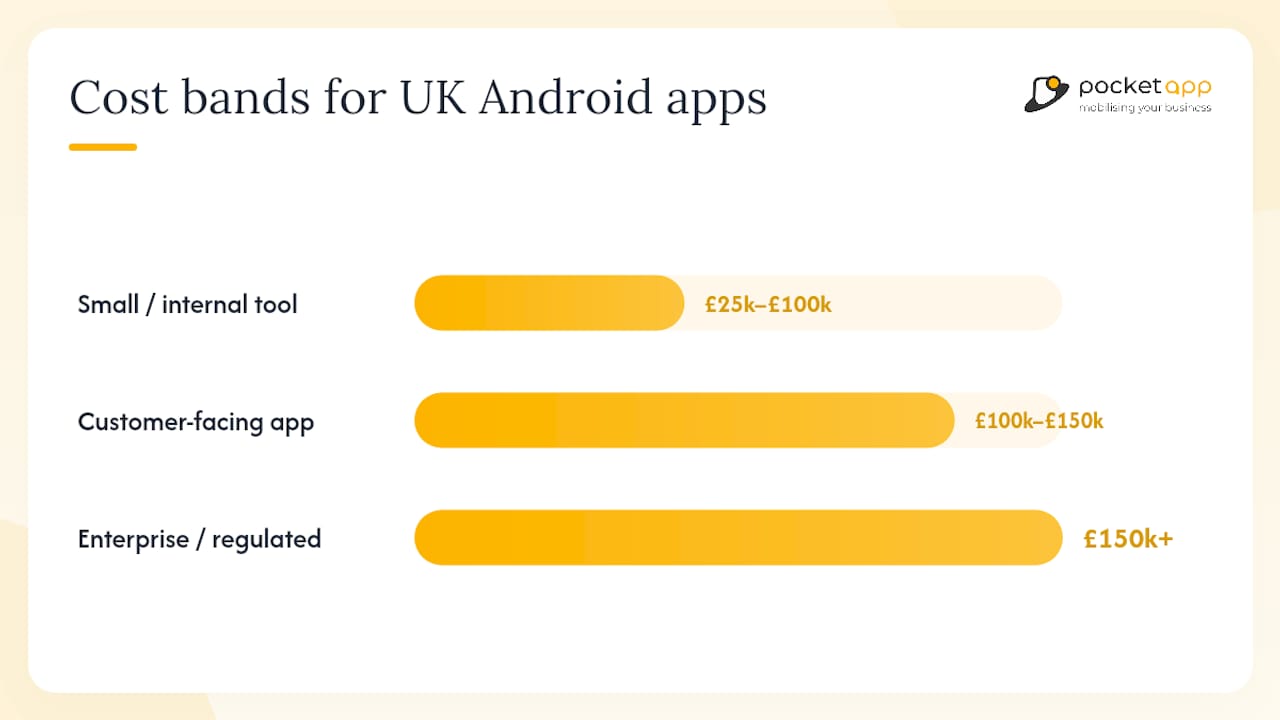
Pricing varies significantly with scope, but three broad bands cover most UK projects.
| Band | Typical starting cost | What is usually included | Common exclusions |
|---|---|---|---|
| Small / internal tool | £25,000–£100,000 | Single-function app, basic auth, limited integrations | Complex APIs, offline sync, regulated data handling |
| Customer-facing app | £100,000–£150,000 | UX/UI design, multiple user roles, API integrations, Play Store release | Enterprise-scale load testing, multi-language support |
| Enterprise / regulated | £150,000+ | Full discovery, complex integrations, security audit, SLA package | Ongoing feature roadmap (usually a separate retainer) |
Two pricing models dominate the market. Fixed-price contracts suit well-defined scopes: you know what you are getting and the supplier carries the delivery risk. Time and materials (T&M) suits projects where requirements will evolve, giving you flexibility but requiring tighter governance on your side.
The main cost drivers are:
- Discovery depth and prototype fidelity
- Number and complexity of third-party integrations (ERP, CRM, clinical systems)
- Offline functionality and data sync requirements
- Security and regulatory obligations (healthcare and charity data carry higher compliance costs)
- Number of supported device families and minimum Android version
Dedicated teams and flexible engagement models can help organisations balance quality against cost, particularly when a hybrid of UK-led oversight and specialist resource makes sense commercially.
What does the development process look like, and how long will it take?
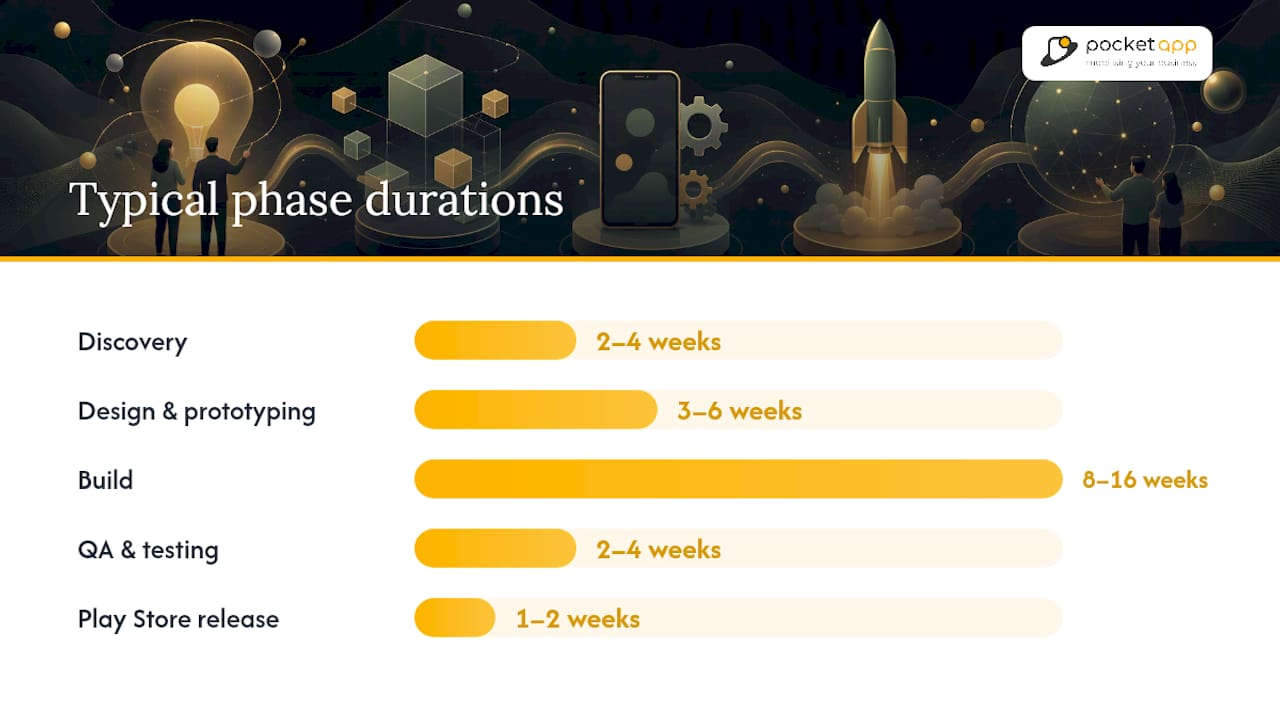
Most medium bespoke Android projects typically complete in 4–6 months from discovery to Play Store launch. Enterprise builds with complex integrations take longer; simple internal tools can move faster.
- Discovery (2–4 weeks): workshops, user research, technical scoping, and a written specification
- Design and prototyping (3–6 weeks): wireframes, UI design, interactive prototype for stakeholder sign-off
- Build (8–16 weeks): agile sprints, regular demos, integration work, and incremental testing
- QA and testing (2–4 weeks): functional, regression, device, and performance testing
- Play Store release (1–2 weeks): signing, app bundle preparation, store listing, and staged rollout
- Post-launch support (ongoing): monitoring, patching, and feature updates under an agreed SLA
| Phase | Typical duration | Key deliverable |
|---|---|---|
| Discovery | 2–4 weeks | Specification document, effort estimate |
| Design | 3–6 weeks | Interactive prototype |
| Build | 8–16 weeks | Working app, sprint demos |
| QA | 2–4 weeks | Test report, bug-fix sign-off |
| Release | 1–2 weeks | Live Play Store listing |
| Support | Ongoing | SLA-backed maintenance |
A structured discovery and prototyping stage materially improves estimate accuracy and reduces the scope changes that inflate fixed-price bids. Require it in your contract, even if it is billed separately.
How do you choose the right UK Android developer?
Selection criteria to apply:
- Portfolio relevance: has the supplier built apps in your sector?
- Technical depth: can they demonstrate native Android capability and cross-platform experience?
- Team structure: who leads delivery, who tests, and who handles Play Store operations?
- Communication: do they offer milestone reports and a collaborative dashboard?
Questions to ask at RFI/RFP stage:
- Walk us through your discovery process. What do we receive at the end of it?
- How do you handle scope changes mid-project?
- What is your testing strategy, and which devices do you cover?
- Can you show us a Play Store release you managed end to end?
- What does your post-launch SLA look like, and what is the response time for critical bugs?
Red flags to watch for:
- No verifiable portfolio or case studies
- Pricing provided without a discovery phase
- Vague or absent testing and security practices
- No references willing to speak to you directly
UK hiring guides recommend checking portfolios, sector experience, and verified reviews on platforms such as Clutch and GoodFirms before shortlisting. Trusted suppliers emphasise regular milestone updates and collaborative reporting as standard practice, not a premium add-on.
Pro Tip: Ask every shortlisted supplier to describe a project that went wrong and how they resolved it. The quality of that answer tells you more about delivery culture than any case study.
What Android-specific technical issues should you check in proposals?
Native Android vs cross-platform: Native Android (Kotlin or Java) gives the best performance and full access to device APIs. Cross-platform frameworks such as Flutter or React Native reduce development time when you need iOS parity, but introduce a layer of abstraction that can complicate access to hardware features. For cross-platform trade-offs and tooling, the decision depends on your performance requirements and whether a single codebase genuinely serves both platforms.
Device and OS fragmentation: Android runs across thousands of handset models. Ask your supplier which minimum Android version they will support, which device families they will test against, and how they handle fragmentation in their QA process.
Play Store publishing: The Google Play Store hosts over 3.3 million apps (AppBrain, January 2025), making it the main distribution channel. Your supplier must manage signing keys, release tracks (internal, closed testing, production), and Android App Bundle (AAB) format. If your app includes in-app purchases or subscriptions, Google Play Billing integration adds complexity and review time.
CI/CD and quality tooling: Ask about automated testing pipelines, crash reporting (Firebase Crashlytics is standard), and analytics integration. A supplier without a CI/CD pipeline is a risk on any project beyond a simple prototype. For a practical overview of Android frameworks and toolsets, Pocketapp's resources are a useful reference.
What security and compliance checks must you require?
For UK organisations, especially in healthcare and the charity sector, security is not a checklist item to address at the end of the project. It belongs in the specification from day one.
| Requirement | What to ask for | Relevant standard |
|---|---|---|
| Data encryption | In transit and at rest | UK GDPR, NHS DSP Toolkit |
| Authentication | MFA support, secure token storage | OWASP Mobile Top 10 |
| Penetration testing | Pre-launch pen test report from an accredited tester | NCSC guidance |
| DPIA | Completed Data Protection Impact Assessment | UK GDPR |
| Incident response | Documented plan with defined response times | ICO expectations |
| Patching SLA | Agreed timeline for critical security patches | Contract SLA |
Industry project reports recommend penetration testing, patch SLAs, and a documented incident response plan as minimum expectations for any business-grade app. For healthcare clients, NHS Digital guidance on data security applies alongside UK GDPR. For charities handling donor or beneficiary data, a DPIA is almost always required.
For a practical mobile app security checklist, Pocketapp's published guidance covers the core controls your RFP should reference.
What does credible proof of delivery look like?
A supplier's portfolio is only as useful as the evidence behind it. When reviewing case studies, look for:
- Named client and sector
- The specific problem the app solved
- Measurable outcomes: user adoption figures, process efficiency gains, or app store ratings
- The technology stack used
- A reference contact willing to take a call
Pocketapp's portfolio of Android projects spans retail, charity, and healthcare, with named clients including WWF, Dechra, and Crocus. That breadth of sector coverage is the kind of evidence worth requesting from any supplier you shortlist.
How do you write a procurement-ready supplier brief?
A clear brief reduces misunderstandings and produces more accurate proposals. Structure yours as follows:
- Project overview: what the app does and why you are building it now
- Objectives and KPIs: what success looks like (e.g., 10,000 active users within 90 days of launch)
- Target users: who will use the app and on which devices
- Integrations: which systems the app must connect to (ERP, CRM, clinical records)
- Performance constraints: expected concurrent users, offline requirements, response time targets
- Security requirements: data classification, regulatory obligations, pen test expectations
- Deliverables and acceptance criteria: what you will sign off at each phase
- Timeline and budget band: your hard deadline and the budget range you are working within
Contractual items to include:
- Milestone-linked payment schedule
- Change request process and pricing mechanism
- Termination clauses (for cause and for convenience)
- IP ownership (you should own the code)
- Post-launch maintenance SLA with defined response times
Pro Tip: Run a short paid discovery with your preferred supplier before signing the full build contract. It produces a tighter specification, a more accurate fixed-price bid, and a clear picture of how the team communicates under pressure.
Key takeaways
Commissioning a bespoke Android app requires a clear scope, a realistic budget band, and a supplier with verifiable sector experience and Play Store delivery capability.
| Point | Details |
|---|---|
| Android market reach | Android holds around 70.8% of global mobile OS share, making it the primary platform for UK-facing apps. |
| Budget planning | Typical UK projects vary widely in cost, from entry-level internal tools to higher investment needed for enterprise or regulated builds. |
| Timeline expectation | Medium bespoke Android projects typically complete in 4–6 months from discovery to Play Store launch. |
| Discovery is non-negotiable | A paid discovery phase improves estimate accuracy and reduces costly scope changes during the build. |
| Pocketapp as a supplier | Pocketapp's 300+ project portfolio and sector coverage across retail, charity, and healthcare make it a credible shortlist candidate. |
What working with a UK Android developer actually means
There is a gap between what procurement teams expect from a bespoke app project and what they actually need to do to get a good outcome. Most briefs arrive too late in the process, after internal stakeholders have already formed strong opinions about features, and too early in terms of technical clarity, before anyone has thought seriously about integrations or security.
The suppliers who consistently deliver well are the ones who push back on that. A discovery phase is not a formality; it is the mechanism by which a good supplier stress-tests your assumptions before they cost you money. If a supplier skips it or offers to waive it to win the contract, that is the clearest possible signal about how they will handle problems during the build.
For regulated sectors, the stakes are higher still. A healthcare app that fails a pen test after launch, or a charity platform that cannot produce a DPIA, creates reputational and legal exposure that dwarfs the cost of getting it right the first time. Prioritise suppliers with explicit, verifiable experience in your sector, not just general mobile development credentials.
Pocketapp: bespoke Android development for UK organisations
Pocketapp builds bespoke Android applications for UK brands, retailers, charities, and healthcare providers, from initial discovery through to Play Store launch and ongoing support. With over 300 delivered projects, the team brings sector-specific experience that shortens the distance between your brief and a working product.
Every project starts with a structured discovery workshop that produces a written specification, a realistic effort estimate, and an interactive prototype before a single sprint begins. Post-launch, clients receive server monitoring, security patching, and feature updates under a clear SLA. Whether you need a native Android build or a cross-platform solution that covers iOS as well, Pocketapp can scope both and advise on the right approach for your budget and timeline.
To request a project estimate or book a discovery call, visit Pocketapp's mobile app development service page.
Useful sources and further reading
- Android developer documentation — Google's official guidance on Play Store publishing, signing, app bundles, and in-app billing
- UK GDPR guidance — ICO resources on Data Protection Impact Assessments and data security obligations
- NHS Digital Data Security and Protection Toolkit — mandatory framework for organisations handling NHS patient data
- Pocketapp mobile app security guide — practical security checklist for UK business apps
- Android programming resources for 2026 — curated technical references for evaluating developer competency
FAQ
How much does a bespoke Android app cost in the UK?
Typical UK projects start at around £25,000 for a simple internal tool and rise to £150,000 or more for enterprise or regulated builds. The main cost drivers are integration complexity, security requirements, and the depth of the discovery phase.
How long does it take to build a bespoke Android app?
Most medium-complexity projects complete in 4–6 months from discovery to Play Store launch. Enterprise builds with complex integrations take longer; straightforward internal tools can move faster.
What should I look for in an Android app developer's portfolio?
Look for named clients in your sector, a description of the problem solved, measurable outcomes, and a reference contact. Pocketapp's portfolio covers retail, charity, and healthcare with named clients available for reference.
Do I need a separate iOS app, or can one codebase cover both platforms?
Cross-platform frameworks such as Flutter can serve both Android and iOS from a single codebase, reducing cost when you need both. Native Android development is preferable when performance or access to specific device APIs is critical. Pocketapp advises on the right approach during discovery.
What security checks should I require before launch?
At minimum, require a penetration test from an accredited tester, confirmation of TLS encryption in transit, a completed DPIA if personal data is processed, and a documented incident response plan. Healthcare apps must also meet NHS Digital's Data Security and Protection Toolkit requirements.