
TL;DR:
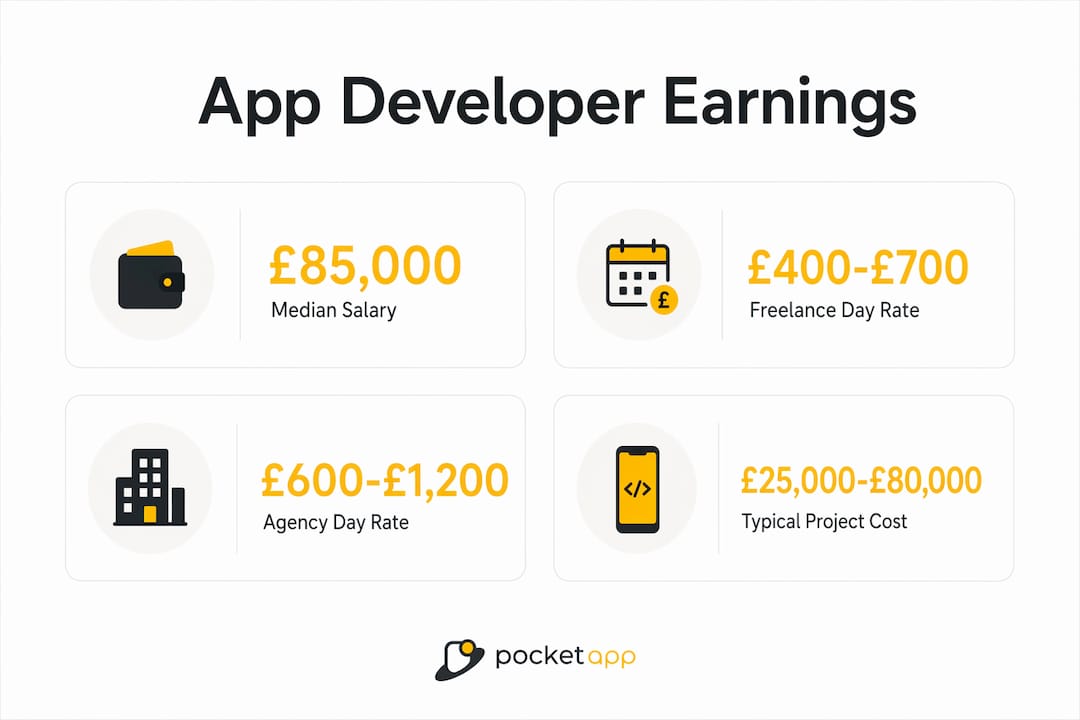
- UK mobile app developers earn a median salary around £85,000 to £105,000, reflecting seniority and location. Building a standard app costs between £25,000 and £80,000, with complexity increasing the price beyond £75,000. Reputable UK agencies charge day rates of £600 to £1,200, including project management and quality assurance.
UK mobile app developers earn a median salary of £85,000 according to IT Jobs Watch, while PayMetric Labs places the 2026 UK median at a higher level reflecting differences in dataset sampling and role seniority, reflecting differences in dataset sampling and role seniority. For business buyers, those figures matter less than what you will actually pay to get an app built. Contractor day rates in the UK typically run £400–£700 per day for mid-to-senior developers. Agency day rates sit higher, reflecting bundled project management, QA, and design services. Per-project, expect to budget:
- MVP or single-workflow app: £8,000–£25,000, delivered in roughly 8–12 weeks
- Standard production app: £25,000–£80,000, typically 12–24 weeks
- Complex or regulated app: £75,000–£250,000+, often 6–12 months or more
Quotes that fall well below these ranges almost always omit discovery, QA, or post-launch support — costs that surface later and inflate the total.
Table of Contents
- How much do app developers earn in the UK?
- How do agencies and developers charge for their work?
- What does a typical project actually cost?
- What drives cost? Your RFQ checklist
- How should you evaluate quotes and spot red flags?
- What a reputable UK agency actually delivers: the Pocketapp approach
- Key takeaways
- Why low quotes fail and what good pricing actually buys
- Pocketapp: your next step towards a bespoke UK app
- Useful sources
- FAQ
How much do app developers earn in the UK?
Salary bands vary sharply by seniority, and understanding them helps you judge whether an agency's day rate is credible or whether an in-house hire is genuinely cheaper.
| Role | Typical annual salary | Freelance day rate | Agency day rate | What's usually included |
|---|---|---|---|---|
| Junior developer | salary varies depending on experience and region | typical lower day rates for less experienced developers | Supervised delivery, limited autonomy | |
| Mid-level developer | salary varies depending on experience and region | moderate day rates reflecting growing expertise | Feature ownership, some architecture input | |
| Senior developer | salary varies depending on experience and region | higher day rates due to advanced skills and responsibilities | Architecture, code review, mentoring | |
| Lead / principal | salary for highly experienced developers varies widely | top-tier day rates reflecting technical leadership | Technical strategy, team leadership |
The IT Jobs Watch median of £85,000 sits at the senior end of the mid-level band, consistent with a market where experienced mobile developers remain scarce. PayMetric Labs' higher figure of £105,000 likely reflects a sample weighted towards London and senior roles.

Freelance day rates convert to apparent annual equivalents spanning a wide range depending on contract gaps and costs once you account for gaps between contracts, self-employment costs, and no employer National Insurance. An agency day rate covers a seniority mix, project management, QA, and design resources which adds value beyond pure development that a single contractor cannot provide.
Pro Tip: When comparing a contractor quote to an agency quote, add employer NI (13.8%), recruitment fees, equipment, and management overhead to the contractor's day rate before drawing conclusions. The gap narrows considerably.
How do agencies and developers charge for their work?
Understanding the commercial structure behind a quote is as important as the headline number.
In-house employment carries the full salary cost plus employer NI, pension contributions, equipment, and management overhead. For a senior developer at £90,000 salary, total employment cost typically reaches £110,000–£115,000 per year before any tooling or training.
Contractor or freelance engagements use hourly or day rates billed through a limited company or umbrella arrangement. They offer flexibility but require active management and carry IR35 risk if the engagement resembles employment.
Agency models come in three main forms:
- Fixed price: The agency quotes a total for a defined scope. Reputable agencies build in a 15–25% contingency buffer for scope certainty. You get budget predictability; the agency carries scope risk.
- Time and materials (T&M): You pay for actual hours at agreed rates. Flexible for evolving requirements, but budget control requires active governance.
- Hybrid: A paid discovery phase (fixed price) followed by a T&M build with an agreed cap. This is often the most pragmatic structure for complex projects where scope cannot be fully defined upfront.
Pro Tip: For a first engagement with a new agency, a hybrid contract reduces your exposure. You pay a modest fixed fee for discovery, then negotiate the build phase with full scope clarity.
What does a typical project actually cost?
Cost and timeline vary with complexity. The table below maps the three main tiers.
| Complexity | Typical cost range | Typical timeline | What's included |
|---|---|---|---|
| MVP / single workflow | £8,000–£30,000 | 8–12 weeks | Core feature set, one platform or cross-platform, basic QA |
| Standard production app | £25,000–£80,000 | 12–24 weeks | Full UX/UI, cross-platform build, integrations, QA, deployment |
| Complex / regulated | £75,000–£250,000+ | 6–12+ months | Security architecture, compliance, multiple integrations, full QA, ongoing support |
Softpact's 2026 benchmarks align closely with Zest City's figures, giving buyers two independent reference points. For standard business apps targeting both iOS and Android, cross-platform development using frameworks such as React Native typically reduces build cost by 25–40% compared with maintaining two separate native codebases.
Beyond the build, budget 20–25% of the original build cost per year for maintenance, OS updates, security patches, and new features. Cloud hosting costs vary widely depending on user volume and redundancy requirements.
What drives cost? Your RFQ checklist
These are the scope items that most frequently cause budget surprises when left unspecified in a request for quotation.
- Discovery phase: Clarifies requirements, reduces rework. Budget £2,000–£5,000 separately.
- Target platforms: iOS only, Android only, or cross-platform. Each choice has a different cost profile.
- Third-party integrations: Payment gateways, CRMs, ERPs, and APIs each add development and testing time.
- Compliance and security: Healthcare, financial services, and regulated industries require additional architecture and audit trails. See mobile app security best practices for what this involves.
- Bespoke UX/UI design: Custom design costs more than adapting a template but materially affects retention and conversion.
- User roles and scale: Multi-tenant architectures, admin portals, and high concurrent-user requirements all add complexity.
- Data storage and hosting: Specify expected user volumes and data residency requirements upfront.
- Post-launch support SLA: Define response times and who owns ongoing maintenance before signing.
Pro Tip: A paid discovery phase represents an important investment to clarify scope and reduce rework in any app project. It produces a defined scope, a realistic budget, and acceptance criteria — the three things most needed to evaluate a fixed-price bid accurately.
How should you evaluate quotes and spot red flags?
A credible Statement of Work (SOW) should include:
- Discovery outputs: user stories, technical architecture, and wireframes
- Defined acceptance criteria for each deliverable
- Clear ownership of source code and intellectual property
- Named roles: who is responsible for project management, QA, and design
- Testing scope: unit, integration, and user acceptance testing
- Post-launch support terms and SLA response times
- Handover artefacts: documentation, credentials, and deployment guides
Questions worth asking every prospective supplier:
- Can you share case studies from a similar sector or complexity level?
- Who specifically will work on our project, and what are their seniority levels?
- How do you handle scope changes mid-project?
- What does your post-launch support package include?
- Do you hold any security or compliance credentials relevant to our industry?
Quotes that omit a discovery phase, carry no QA budget, or rely on a predominantly junior team frequently result in apps that require significant rework within 12 months. The saving on day one becomes a liability by month six.
Red flags to watch for: no discovery phase in the proposal, QA described as "included" with no budget allocation, a team composition that is entirely junior, and post-launch support that is absent or vaguely worded.
What a reputable UK agency actually delivers: the Pocketapp approach
Pocketapp has delivered over 300 projects across retail, healthcare, charity, and brand engagement, working with clients including WWF, Dechra, and Crocus. That breadth of UK app development experience means the team has encountered most of the scope and compliance challenges a business buyer is likely to face.
A typical Pocketapp engagement includes:
- A structured discovery workshop to define scope, user journeys, and technical requirements
- UX/UI design with interactive prototyping before any build begins
- Agile build cycles with regular client review points
- Cross-platform deployment where appropriate, using proven frameworks
- QA testing at unit, integration, and user acceptance levels
- Deployment to the App Store and Google Play
- Post-launch monitoring, server oversight, and a defined maintenance arrangement
Pro Tip: Ask any agency you are evaluating to walk you through a project that went off-plan and how they managed it. The answer tells you more about delivery culture than any case study.
Key takeaways
UK businesses budgeting for bespoke app development should plan for agency day rates of £600–£1,200, per-project costs of standard production apps typically fall within a moderate range depending on complexity, and annual maintenance at 20–25% of the original build cost.
| Point | Details |
|---|---|
| UK developer salaries | Median salary ranges from £85,000 (IT Jobs Watch) to £105,000 (PayMetric Labs) depending on seniority and dataset. |
| Agency day rates | Reputable UK agencies charge typical agency day rates varying reflecting a range of included services, covering project management, QA, and design alongside development. |
| Per-project cost | Standard production apps typically cost £25,000–£80,000; complex or regulated builds reach £75,000–£250,000+. |
| Cross-platform savings | React Native and similar frameworks reduce build cost by 25–40% versus two separate native codebases. |
| Pocketapp | Offers structured discovery, UX/UI, agile build, QA, and post-launch support across 300+ completed projects. |
Why low quotes fail and what good pricing actually buys
The pattern repeats itself often enough to be predictable. A business receives three quotes: one from a reputable agency at £60,000, one from a mid-market supplier at £35,000, and one from a freelancer or offshore team at £12,000. The lowest quote wins the contract. Six months later, the client is back in the market, this time looking for someone to fix what was built.
What the low quote almost always omits is discovery, which means the build starts without a defined scope. QA is deferred or absent, so defects accumulate rather than being caught incrementally. Post-launch support is either not included or priced so thinly that it disappears at the first sign of complexity.
What a reputable agency rate actually buys is predictability. You get a team that has solved similar problems before, a process that catches issues before they become expensive, and a product that is maintainable by the next developer who touches it. That last point matters more than most buyers realise. An app built without documentation, without clean architecture, and without test coverage costs significantly more to extend or hand over than one built properly from the start.
Pocketapp: your next step towards a bespoke UK app
Knowing what developers earn and what projects cost is the foundation of a sound brief. Pocketapp takes that foundation and builds on it, offering bespoke mobile app development from discovery through to post-launch support, with a team that has delivered over 300 projects for UK businesses across retail, healthcare, charity, and more.
Whether you need a cross-platform business app for internal operations or a consumer-facing product for a major brand, the starting point is a discovery conversation. Get in touch with Pocketapp to discuss your project and request a scoped proposal.
Useful sources
- IT Jobs Watch: Mobile Applications Developer — UK salary data drawn from live vacancy postings; the most grounded benchmark for in-house hiring decisions.
- PayMetric Labs: Mobile Developer Salary UK 2026 — Broader compensation dataset useful for senior and London-weighted comparisons.
- Zest City: Business App Development Cost 2026 — Agency pricing ranges, discovery cost guidance, and maintenance budgeting rules of thumb.
- Softpact: Mobile App Development Cost UK 2026 — Independent cost bands and timeline estimates; useful cross-reference for project planning.
Across these sources, the consistent message is that reputable UK agencies price at levels that reflect full project delivery, not just development hours. Buyers who use salary data alone to benchmark a project quote are comparing different things.
FAQ
How much do app developers earn in the UK?
UK mobile app developers earn a median salary of £85,000 according to IT Jobs Watch, with PayMetric Labs placing the figure closer to £105,000 for senior and London-based roles.
How much does it cost to build a business app in the UK?
A standard production app typically costs £25,000–£80,000 with a reputable UK agency, while an MVP can be delivered for £8,000–£30,000 and complex or regulated builds often exceed £75,000.
How much can you make from an app as a business?
App revenue depends entirely on the monetisation model: subscription, in-app purchase, or transaction fees. The build cost is a separate question from revenue potential, which varies by market size and product-market fit.
What should I budget for app maintenance after launch?
Budget 20–25% of the original build cost per year to cover OS updates, security patches, hosting, and ongoing feature development.
How do I know if an app development quote is realistic?
A credible quote includes a discovery phase, a named QA budget, defined post-launch support, and a clear SOW. Quotes significantly below established market ranges almost always omit one or more of these elements.