
TL;DR:
- Most organizations confuse basic segmentation with true AI-powered, real-time personalisation.
- Advanced personalisation adapts content dynamically based on current user context, behaviour, and intent.
- Ethical implementation requires transparency, user control, and continuous testing to build trust and effectiveness.
Most business leaders still think personalisation means dropping a customer's first name into a push notification or sorting users into three broad segments. That assumption is now a liability. In 2026, the organisations pulling ahead in retail and healthcare are deploying adaptive, AI-powered personalisation that responds to a user's context, behaviour, and intent in real time, not just their stored profile. The gap between those doing it well and those doing it superficially is widening fast, and the consequences show up directly in retention figures, patient compliance rates, and revenue.
Table of Contents
- What does app personalisation mean in 2026?
- How app personalisation works: mechanics and strategies
- Why personalisation is pivotal for customer experience
- Pitfalls and ethical challenges in app personalisation
- Personalisation: the new competitive edge, if you do it right
- Transform your app experience with expert support
- Frequently asked questions
Key Takeaways
| Point | Details |
|---|---|
| Beyond basic tailoring | True app personalisation adapts in real time using both profile and contextual signals. |
| Measurable business value | Personalisation strategies drive relevance, loyalty, and trust in both retail and healthcare. |
| Ethics and trust are vital | Effective personalisation requires privacy-by-design, transparency, and user control. |
| Ongoing experimentation | Continuous measurement and adaptive design prevent backfiring or ethical missteps. |
What does app personalisation mean in 2026?
The word "personalisation" has been stretched so far it risks losing meaning entirely. For years, it described relatively simple mechanics: show the user their name, remember their last purchase, suggest products from a category they browsed. That is profile-based personalisation, and while it remains common, it is no longer sufficient for organisations that want genuine competitive advantage.
True personalisation in 2026 means the app adapts its content, layout, offers, and messaging dynamically, based on who the user is right now, not who they were when they created an account. Hyper-personalisation in retail uses first-party data combined with AI and machine learning to predict user intent and adjust in-app content, messaging, and offers in the moment. A retail customer browsing cycling accessories on a rainy Tuesday morning gets a fundamentally different experience from one opening the same app on a sunny Saturday before a long-distance ride.
For UK healthcare organisations, the shift is equally significant. A mental health app that serves the same content to every user regardless of their progress, current emotional state, or previous session outcomes is not genuinely personalised. It is a catalogue with the user's name on the cover.
What separates advanced from basic personalisation:
- Profile-based: Uses stored demographic or purchase data to adjust static content
- Behavioural: Responds to in-session actions such as dwell time, taps, or scroll depth
- Contextual: Adapts based on time, location, device, weather, or journey stage
- Predictive: Uses AI to anticipate what the user needs before they ask
The critical caveat here is that more personalisation is not always better. Personalisation can become ethically problematic when it undermines user autonomy, feels surveillant, or tips too far from relevant into intrusive. You can explore customisation strategies that balance both, but understanding where the line sits is essential before building anything. The most advanced AI-driven personalisation frameworks actively build in user control rather than treating it as an afterthought.
| Personalisation type | Data source | Adaptivity | Typical use case |
|---|---|---|---|
| Profile-based | Registration data | Static | Welcome screens, saved preferences |
| Behavioural | In-session signals | Semi-dynamic | Recommendations, content ranking |
| Contextual | Environment, time, location | Real-time | Localised offers, journey-stage messaging |
| Predictive / AI | All of the above plus ML | Continuous | Intent prediction, dynamic pricing |
How app personalisation works: mechanics and strategies
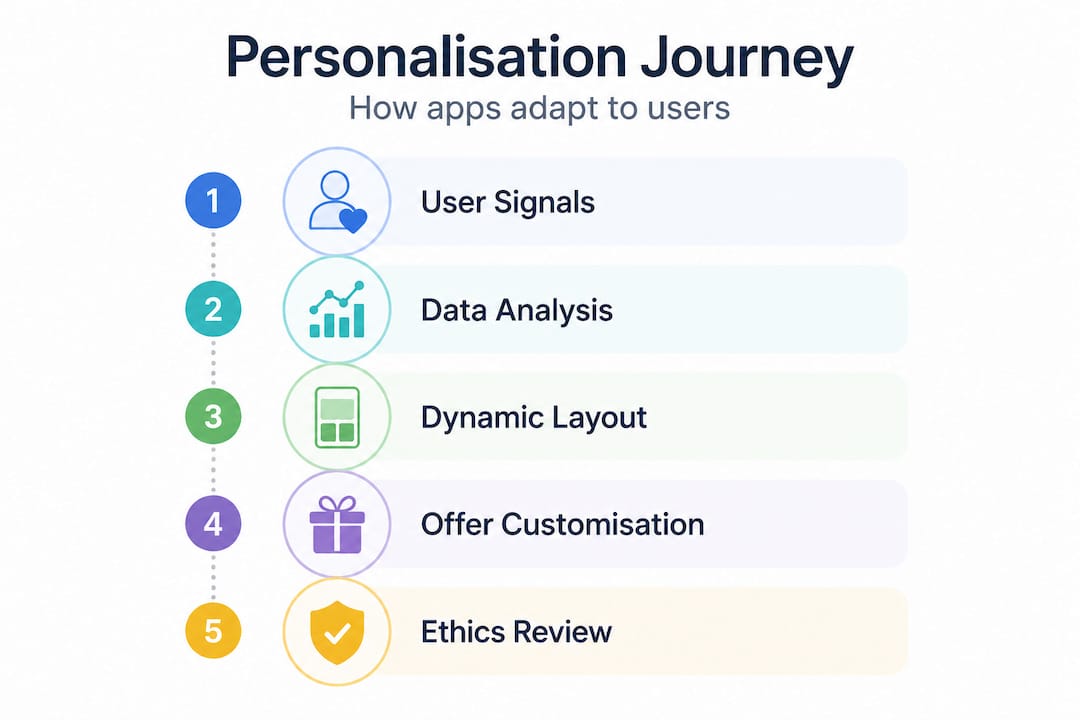
Understanding what personalisation is matters less than understanding how to build and run it effectively. The operational mechanics fall into three broad phases: data gathering, dynamic rendering, and iterative experimentation.
Data gathering starts with first-party signals: what users explicitly tell the app through their preferences or profile, combined with what their behaviour reveals implicitly. Every tap, scroll, pause, and exit is a signal. Contextual inputs layer on top: the current time, the user's location, the weather, what stage of the customer or patient journey they are in. The richest personalisation frameworks combine all three streams simultaneously.
Dynamic rendering means the app does not serve the same interface to every user. Content blocks, promotional banners, onboarding flows, and even navigation options can shift based on the incoming signal mix. Contextual triggers such as weather, journey stage, and moment-specific relevance power targeted entry experiences and ongoing experimentation, as seen in well-structured retail implementations. The key distinction is between static personalisation (the app adjusts once, then stays fixed) and dynamic personalisation (the app continues adjusting throughout the session and over time).

Contextual collaboration is replacing personalisation as the dominant model in forward-thinking organisations. Rather than building a static user profile and serving content against it, these systems prioritise the interaction itself: what is happening right now, in this context, and what does the user most likely need from this moment?
Comparison of personalisation approaches:
| Approach | Strengths | Limitations | Best suited to |
|---|---|---|---|
| Profile-based tailoring | Simple to implement | Stale data, limited adaptivity | Low-frequency transactional apps |
| Contextual personalisation | Real-time relevance | Requires strong data infrastructure | Retail, loyalty, mHealth apps |
| Collaborative filtering | Learns from cohort behaviour | Cold-start problem for new users | High-volume consumer retail |
| AI-predictive | Highest accuracy over time | Needs significant data volume | Mature apps with large user bases |
Practical personalisation strategies for retail and healthcare teams typically follow a structured sequence:
- Map the user journey in detail, identifying every key decision point where a tailored experience could improve an outcome.
- Define the signals you will collect at each stage and confirm they meet GDPR obligations before you build.
- Build targeted entry experiences that serve different onboarding flows based on user segment or context.
- Run A/B experiments continuously, not as a one-time exercise. Personalisation without ongoing testing is guesswork.
- Measure outcomes at the journey level, not just individual screens. A well-timed offer that feels relevant increases completion rates across the whole flow.
Investing in user-centred design from the outset makes each of these stages significantly more effective, because the architecture supports adaptation rather than fighting against it. The same logic applies to AI integration, which works best when the app's design already anticipates dynamic content.
Pro Tip: Never automate personalisation without a human review loop. Set clear rules for what the algorithm can and cannot change autonomously, particularly in healthcare contexts, and build regular review checkpoints so a real team is examining what the system is actually doing to users over time.
Why personalisation is pivotal for customer experience
The business case for advanced personalisation is no longer theoretical. The evidence from retail is clear, and the implications for healthcare are substantial.
In retail, contextual personalisation that accounts for moment-specific factors directly improves relevance and conversion. Contextual personalisation increases relevant engagement for 80% of users in well-implemented retail programmes. That figure is not a projection; it reflects what happens when personalisation accounts for where a customer is in their journey, what they have done before, and what their environment suggests they need right now.
"The difference between profile-based and context-aware personalisation is not marginal. It is the difference between an app that knows you and one that merely remembers you."
For healthcare, the stakes are higher because the stakes are always higher when wellbeing is involved. Many commercial apps in digital mental health do not meet the threshold for true personalisation, because adaptive interventions require longitudinal, evidence-linked data and continuous updating rather than a fixed set of pre-built content paths.
Key business-critical impacts of effective personalisation:
- Higher conversion rates in retail through contextually relevant offers that match the user's current intent rather than their historical average
- Improved patient adherence and compliance in healthcare apps where content adapts to the user's current engagement level and progress
- Lower churn and attrition because users who feel understood by an app have less reason to abandon it
- Stronger brand loyalty built on repeated experiences of relevance rather than repeated experiences of friction
- Reduced support burden when the app proactively surfaces the right information before a user needs to search for it
The risk of a superficial approach is not just missed opportunity; it is active damage to trust. An app that claims to be personalised but serves the same push notifications to every user, regardless of their journey stage, signals to the user that the organisation does not actually understand them. That signal is particularly damaging in healthcare, where the relationship between provider and patient depends on trust. Organisations working on digital healthcare transformation need personalisation frameworks that are rigorous, not cosmetic. The broader mHealth app landscape is moving in this direction, and organisations that invest now will set the standard others follow.
Pitfalls and ethical challenges in app personalisation
Understanding the potential of personalisation is only half the picture. The other half is understanding where it goes wrong, because the failure modes are specific, measurable, and increasingly visible to users.
The most common failure is what might be called the "relevance-surveillance" trade-off. An app that knows too much, or that makes its knowledge too visible, can shift the user experience from "this feels helpful" to "this feels like I am being watched." Personalisation becomes ethically problematic when it undermines user autonomy, feels surveillant, or misjudges the balance between relevance and user control. The line is thinner than most teams realise, and users cross it in both directions: sometimes they want the app to anticipate their needs, and sometimes they want to be surprised or to discover something independently.
"For UK healthcare specifically, defining personalisation rigorously matters enormously: privacy-by-design, data minimisation, transparent consent, and evidence-linked adaptivity are not optional extras but the conditions under which personalisation in digital mental health can actually improve care outcomes and user trust."
Practical safeguards every team should implement:
- Transparent consent flows that explain clearly what data is being collected and how it shapes the user's experience, without burying this in legal language
- Meaningful opt-out options that do not penalise users for choosing a less personalised experience
- Algorithmic bias audits to ensure that AI-driven personalisation is not systematically disadvantaging particular user groups based on demographic patterns in the training data
- Regular sentiment monitoring, including in-app feedback mechanisms and attrition tracking, to catch when personalisation is generating frustration rather than satisfaction
- Adaptive, not repetitive personalisation: an app that shows the same "personalised" recommendation twelve times in a row has stopped personalising and started pestering
In healthcare, the ethical obligations extend beyond GDPR compliance into clinical responsibility. An app serving adaptive mental health content must have evidence that its adaptations improve outcomes, not just engagement metrics. Ethical design guidance and data privacy best practices are not separate concerns from personalisation strategy; they are central to it.
Pro Tip: Set a quarterly "personalisation review" meeting that brings together product, clinical or commercial, and data teams. Review attrition rates at each personalised journey stage, examine any feedback flagging the experience as intrusive or irrelevant, and adjust logic accordingly. Personalisation is not a build-and-forget system.
Personalisation: the new competitive edge, if you do it right
Here is an uncomfortable truth that most articles on this subject avoid. The majority of organisations investing in app personalisation are doing so in ways that will not move the needle. They are implementing personalisation as a feature rather than as a discipline. They build a recommendation engine, add some dynamic content blocks, call it done, and wonder why retention has not improved.
Real leadership in personalisation requires treating it as an ongoing organisational practice, not a product release. The organisations generating measurable results from personalisation share three characteristics. They experiment continuously, with structured A/B frameworks that generate genuine learning rather than just confirming existing assumptions. They invest in context-awareness, ensuring their systems respond to what is happening now for the user, not just what happened last month. And they build user trust actively, through transparency, control, and demonstrated respect for the user's autonomy.
Most teams underestimate the first of these. Continuous experimentation is genuinely difficult to sustain. It requires resourcing, discipline, and a willingness to be wrong often. But personalisation without experimentation is not personalisation; it is assumption at scale.
The organisations that will define the next five years of customer experience in UK retail and healthcare will not be those with the most sophisticated algorithms. They will be those who combine adaptive technology with ethical clarity and a genuine commitment to understanding their users rather than manipulating them. Building user trust through design is not a soft consideration; it is the foundation that makes everything else sustainable.
Siloed approaches, where data science sits apart from UX and product, consistently underperform. Personalisation works best when the whole team shares the same understanding of user intent, the same ethical framework, and the same feedback loop. That integration is where the real competitive edge lives.
Transform your app experience with expert support
Building personalisation that is genuinely adaptive, ethically sound, and commercially effective is a different challenge from building a standard mobile app. It requires architectural decisions made early, data strategies aligned with GDPR and clinical governance where relevant, and a design approach that anticipates dynamic content from the very first wireframe.
At Pocket App, we have delivered over 300 mobile projects across retail, healthcare, charity, and consumer sectors, and we understand what separates personalisation that performs from personalisation that simply adds complexity. Our mobile app development process integrates personalisation strategy from discovery through to deployment, rather than bolting it on at the end. Our app design services ensure that adaptive experiences feel seamless rather than jarring, and our cross-platform solutions mean your personalisation logic works consistently across iOS and Android. If you are ready to move beyond profile-based basics, we would welcome the conversation.
Frequently asked questions
What is the difference between profile-based and contextual app personalisation?
Profile-based personalisation uses stored user data to adjust static content, while contextual personalisation adapts in real time using live signals such as location, behaviour, weather, and journey stage. Hyper-personalisation combines AI and first-party data to predict intent dynamically, whereas contextual systems prioritise the current interaction over historical records.
Why does personalisation matter more in healthcare apps?
Personalisation in healthcare must be adaptive, evidence-based, and privacy-centred to genuinely improve outcomes rather than simply increasing engagement. Commercial mental health apps frequently fail this standard because they use fixed content paths rather than longitudinal, continuously updating interventions.
What is a practical example of app personalisation in UK retail?
Halfords personalises its digital experience using customers' past behaviour, MOT renewal dates, and real-time contextual factors such as weather to serve relevant content. Contextual triggers at key journey stages helped deliver relevant experiences to 80% of users through targeted entry experiences and structured experimentation.
How can organisations avoid the ethical pitfalls of personalisation?
Organisations should prioritise privacy-by-design, offer clear user controls including meaningful opt-outs, and audit algorithms regularly for bias or overreach. Personalisation that undermines user autonomy or feels surveillant damages trust quickly, and in UK healthcare specifically, rigorous consent and evidence-linked adaptivity are prerequisites rather than best practice.