
TL;DR:
- Proper app localisation extends beyond translation to include cultural adaptation, design adjustments, and regulatory compliance. It significantly boosts user engagement, retention, reviews, and revenue in targeted international markets. Implementing localisation from the start and continuously measuring its impact ensures long-term global success.
Most businesses assume that translating their app into another language is enough to win users overseas. It is not. A translated app is just words in a different tongue. A properly localised app feels as though it was built specifically for that market, speaking to users in their cultural context, meeting their expectations around design and interaction, and complying with local regulations. The difference between the two approaches can determine whether your global launch flourishes or quietly fails. This article explains what genuine app localisation involves, why it drives measurable business growth, and how to execute it strategically.
Table of Contents
- Understanding app localisation: Beyond translation
- Why app localisation matters for business growth
- The process of app localisation: Key steps and challenges
- Measuring the impact of app localisation
- Rethinking app localisation: Lessons from real launches
- Transform your global reach with Pocket App
- Frequently asked questions
Key Takeaways
| Point | Details |
|---|---|
| Localisation goes beyond translation | Adapting an app for culture and region is fundamental to success. |
| Business growth through localisation | Expanding with a localised app increases user engagement and revenue. |
| Start localisation early | Integrating localisation at the design stage saves time and resources. |
| Continuous measurement is key | Regularly evaluating metrics ensures your localisation strategy remains effective. |
Understanding app localisation: Beyond translation
Translation converts words. Localisation transforms experiences. That distinction matters enormously when you are investing in an international product launch.
The importance of app localisation is often underestimated precisely because translation is visible and localisation is felt. Users rarely notice when localisation is done well. They simply feel comfortable. They notice immediately when it is done badly.
"App localisation means adapting your mobile app for cultural, linguistic, and regulatory differences to maximise usability and appeal."
So what does genuine localisation actually cover? It goes well beyond swapping English text for French or Japanese text. It includes adapting visual design to match cultural colour associations, restructuring interface layouts to accommodate languages that read right to left, reformatting dates, currencies, and measurements to regional standards, and ensuring that the app complies with local data privacy laws and payment regulations.
Consider a retail app expanding from the UK into Japan. The currency must switch from sterling to yen. Date formats shift from DD/MM/YYYY to YYYY/MM/DD. Colour palettes may need rethinking, as white, which signals cleanliness in Western markets, is associated with mourning in parts of East Asia. Push notification etiquette differs. Even the density of information on a screen is a cultural preference, with Japanese users often expecting richer, more information-dense interfaces than their European counterparts.
Here is the clear breakdown of how translation and localisation differ across key elements:
- Text content: Translation swaps words; localisation adapts tone, idioms, and formality for the target culture
- Images and icons: Localisation replaces imagery that may carry unintended cultural connotations
- UX and navigation: Interface layouts adapt for reading direction, screen density preferences, and interaction norms
- Regulatory compliance: Local data laws, age restrictions, and payment standards are addressed in localisation
- Currencies and formats: Numbers, currencies, date and time formats are all region-specific adjustments
Pro Tip: Research local holidays, customs, and seasonal imagery before your launch. A campaign image featuring a symbol that feels celebratory in one country can cause genuine offence in another.
The depth required here explains why businesses that skip localisation or treat it as a quick translation task typically see flat download numbers, poor retention, and negative reviews from international users. Getting it right from the start is far more efficient than retrofitting it later.
Why app localisation matters for business growth
Localisation is not a cosmetic exercise. It is a commercial strategy with measurable returns. Let's look at what the data tells us.
Apps that are properly localised see up to 50% higher user engagement in their targeted markets compared to apps that rely on translation alone. That figure reflects the direct impact of users feeling understood rather than accommodated.

The business case becomes even clearer when you consider that mobile apps drive business success across virtually every sector, and that success depends entirely on adoption rates. An app nobody downloads generates no value, regardless of how sophisticated its technology is.
Consider market access. Over 75% of the world's internet users do not speak English as their first language. By launching only in English, you are, by definition, excluding the vast majority of potential users before they even open your app. Localisation is the mechanism that unlocks those audiences.
The commercial impact plays out across multiple dimensions:
| Metric | Before localisation | After localisation |
|---|---|---|
| Monthly downloads (target region) | 1,200 | 4,800 |
| User retention at 30 days | 18% | 41% |
| In-app purchase conversion rate | 2.1% | 5.8% |
| Average user review score | 3.2 / 5 | 4.5 / 5 |
| Regional revenue contribution | 8% of total | 29% of total |
These figures illustrate a consistent pattern: localisation meaningfully improves every metric that matters to a business. Downloads increase because the app appears in local app store searches. Retention improves because the experience feels natural. Conversion rates rise because users trust a product that speaks their language properly, not just literally.
There is also a competitive angle worth considering. In many markets, local competitors already offer deeply familiar experiences. An international app launching with surface-level translation will consistently lose to a local player whose product resonates culturally, even if the international product is technically superior. Localisation is how you compete on equal terms.
Trust is also a driving factor. Users are far more likely to share payment details, allow data permissions, and engage with in-app purchases when the app communicates in their native language and follows familiar conventions. Every awkward phrase or misaligned cultural reference creates friction that erodes that trust incrementally.
The process of app localisation: Key steps and challenges
Knowing why localisation matters is one thing. Executing it well is another. Here is a structured approach that covers the essential steps without the pitfalls that trip up most first-time international launches.
When developing a mobile app for international markets, localisation should be built into the product roadmap from day one, not bolted on after launch. The following steps outline a practical, tested process:
- Market research: Identify target regions based on opportunity, competition, and cultural fit. Understand local user behaviours and device preferences before writing a single line of code.
- Language selection: Prioritise languages based on market size and strategic importance. Account for regional dialects where relevant, such as Castilian versus Latin American Spanish.
- UI and UX adaptation: Design flexible interface components that accommodate text expansion and contraction. German text, for example, typically runs 30% longer than its English equivalent.
- Translation and cultural review: Use professional translators with native expertise and subject matter knowledge, then have a separate cultural reviewer check for unintended meanings or associations.
- Quality assurance testing: Test on real devices from each target market, checking layout integrity, functionality, and cultural appropriateness throughout the app.
- Compliance review: Verify that the app meets local data protection laws, age verification requirements, and financial regulations before launch.
- Post-launch support: Monitor user feedback by region, address issues rapidly, and plan iterative updates to improve the localised experience over time.
How does professional localisation compare to attempting it in-house or on the cheap? The table below is instructive:
| Factor | DIY localisation | Professional localisation |
|---|---|---|
| Upfront cost | Lower | Higher |
| Time to market | Slower (learning curve) | Faster (specialist expertise) |
| Translation quality | Variable | Consistently high |
| Cultural accuracy | High risk of errors | Thoroughly reviewed |
| Hidden risks | Regulatory non-compliance, user backlash | Managed proactively |
| Long-term ROI | Lower | Significantly higher |
The hidden risks column deserves particular attention. Regulatory non-compliance in markets such as Germany or China can result in an app being removed from local stores entirely, costing far more than the professional localisation would have done in the first place.
There are also consistent challenges that businesses face regardless of how prepared they feel. Managing multiple simultaneous language sets creates version control complexity. Keeping marketing copy, in-app content, and help documentation consistent across languages requires robust processes. Addressing regional regulations that change over time demands ongoing attention, not a one-off effort.
Following proven app development tips around internationalisation from the earliest design stage makes all of these challenges significantly more manageable.
Pro Tip: Build your app with localisation in mind from the start. Use string files for all user-facing text, avoid embedding text within images, and design layouts with flexible spacing. These choices cost almost nothing early in development and save enormous rework later.
Measuring the impact of app localisation
Localisation without measurement is just hope. To justify ongoing investment and continuously improve your app's performance across regions, you need clear metrics and a structured feedback loop.
The key indicators worth tracking are:
- Regional download rates: Are downloads increasing in your target markets following localisation?
- User engagement rates: Are users from localised markets spending more time in the app and completing more actions?
- Churn rates by region: Are localised markets retaining users better than non-localised markets?
- Regional revenue contribution: Is the proportion of revenue from target markets growing?
- App store ratings by region: Are your ratings improving in local stores following localisation updates?
- Support ticket volume by language: High volumes in a specific language often signal localisation gaps
Tracking these metrics before and after localisation gives you the evidence base to optimise further. Here is an example of what that tracking might reveal over a six-month period:
| Metric | Month 1 (post-launch) | Month 3 | Month 6 |
|---|---|---|---|
| Regional downloads (monthly) | 2,100 | 3,800 | 6,200 |
| 30-day retention rate | 27% | 35% | 43% |
| Average session duration | 4.2 mins | 5.9 mins | 7.1 mins |
| Regional app store rating | 3.8 / 5 | 4.2 / 5 | 4.6 / 5 |
| Support tickets (language-specific) | 340 | 190 | 85 |
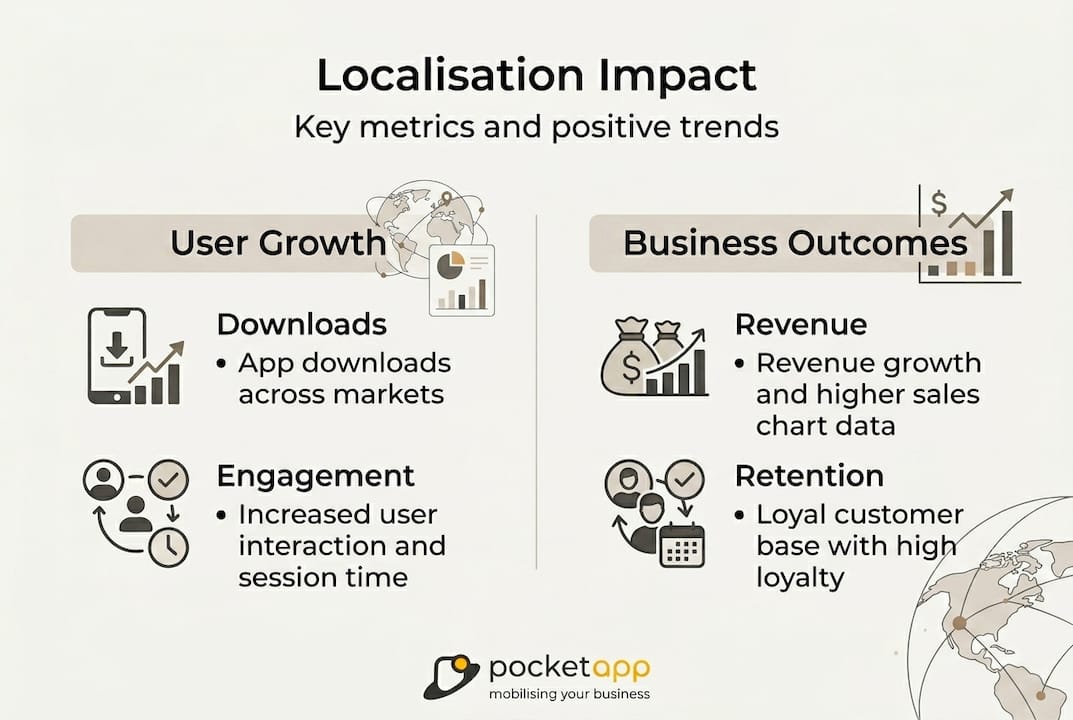
This kind of data tells a clear story: localisation is working, and the investment is compounding over time. Importantly, it also shows where to focus next. A drop in support tickets in a particular language typically means your localisation quality in that region has improved. A flat retention rate might signal that a cultural UX issue remains unresolved.
For advice on making your app a sustained success, exploring approaches to developing successful apps gives valuable context around the longer-term product strategy needed to keep localised apps competitive.
Pro Tip: Read app store reviews from each target market every fortnight. Users in localised markets will tell you plainly in their own language where the experience feels off. This is your fastest, cheapest feedback mechanism.
Crucially, localisation is never finished. Markets evolve, language evolves, regulations change, and user expectations shift. Businesses that treat localisation as a one-off project typically see their gains erode within 12 to 18 months. Treating it as a continuous improvement programme is what sustains the commercial advantage.
Rethinking app localisation: Lessons from real launches
Here is something that often surprises businesses approaching their first international launch: the apps that struggle the most in new markets are rarely the ones with poor technology. They are the ones with excellent technology wrapped in a culturally tone-deaf experience.
We have seen this pattern repeatedly. A business invests heavily in features, performance, and visual polish, then allocates a fraction of the budget to localisation. They translate the strings, ship the product, and wonder why adoption is flat. The product works perfectly. It just does not belong.
The apps that genuinely resonate in new markets are the ones where localisation was treated as a design discipline rather than an afterthought. They considered not just what words to use, but how users in that region expect to be spoken to, what they trust, what frustrates them, and what delights them.
"In our experience, apps designed for cultural resonance consistently see better retention rates than apps that have only been translated."
The distinction is user-centric thinking applied at a regional level. Working with experienced app developers who understand how culture influences product decisions makes a measurable difference to launch outcomes.
Pro Tip: Before your localised app goes live, test it with a small group of native users from that market. Their instinctive reactions will surface issues that no internal review process could catch.
Transform your global reach with Pocket App
If this article has clarified one thing, it should be that effective localisation requires expertise, not just effort. Getting it right the first time saves significant cost and protects your reputation in new markets.
At Pocket App, we bring over 300 projects of experience to every international build, from mobile app development and strategy through to professional app design that works across cultural boundaries. Whether you are planning your first localised launch or refining an existing international product, our team of business app developers can help you build something that genuinely connects with your target audiences. Get in touch to discuss how we can support your global growth ambitions with a tailored approach.
Frequently asked questions
How is app localisation different from translation?
App localisation adapts the entire app experience for language, cultural context, and regional standards, whereas translation only converts text from one language to another without addressing design, UX, or compliance.
What types of apps benefit the most from localisation?
Apps targeting multiple international markets or diverse user bases see the greatest benefit, particularly those in retail, healthcare, financial services, and consumer engagement where trust and cultural familiarity drive conversion.
How long does the app localisation process usually take?
Timelines vary depending on app complexity and the number of target markets, but integrating localisation from the earliest design stage significantly accelerates delivery and reduces rework.
Can localisation improve app store ratings?
Yes. Localised apps consistently receive higher ratings and more positive reviews from regional users because the experience feels native rather than translated, which directly reduces frustration and increases satisfaction.
Do I need a separate app for each language or region?
No. A well-architected app can support multiple languages and regions within a single build by using resource files and conditional logic, making updates and ongoing maintenance far more efficient.
Recommended
- Pocket App | Marketing Your Mobile App: A Comprehensive Guide
- Pocket App | Effective Mobile App Marketing: Strategies for Increasing Downloads and Engagement
- Pocket App | App Store Listing Optimisation: a simple way to get more app downloads
- Pocket App | Revamping Your App Store Strategy: Tips to Boost Discoverability in 2025