
TL;DR:
- Successful app monetisation requires understanding various models and aligning them with user behavior.
- Establishing proper technical, legal, and UX foundations is essential for sustainable revenue.
- Continuous testing, analytics, and user feedback are key to maximising long-term monetisation success.
Many UK businesses invest heavily in building a polished mobile app, only to find that downloads do not automatically translate into revenue. It is a frustrating gap that reveals a fundamental truth: monetisation is a separate discipline from development. Getting users through the door is one challenge. Persuading them to spend, subscribe, or engage in ways that generate sustainable income is quite another. This guide walks you through the core monetisation models, the technical and legal foundations you need, and a practical step-by-step process for selecting, implementing, and refining strategies that actually work for your app and your audience.
Table of Contents
- Understanding mobile app monetisation models
- Essential requirements for effective monetisation
- Step-by-step: selecting and implementing monetisation strategies
- Optimising and maximising monetisation over time
- What most businesses overlook in app monetisation
- Take your app monetisation further with expert help
- Frequently asked questions
Key Takeaways
| Point | Details |
|---|---|
| Know your models | Familiarise yourself with all major monetization approaches before deciding which suits your app. |
| Foundations matter | Successful monetization starts with technical readiness, legal compliance, and a smooth user experience. |
| Iterate and improve | Continually test, analyse, and refine your monetization tactics to maximise results over time. |
| User focus wins | Keeping your users’ needs central to your model consistently drives both revenue and loyalty. |
Understanding mobile app monetisation models
Before committing to any approach, it helps to understand what options are genuinely available. A variety of proven monetisation models exist beyond simply charging for downloads, and each suits different app types, audiences, and business objectives.
Here is a breakdown of the most widely used models:
| Model | Typical use case | Pros | Cons | Revenue potential |
|---|---|---|---|---|
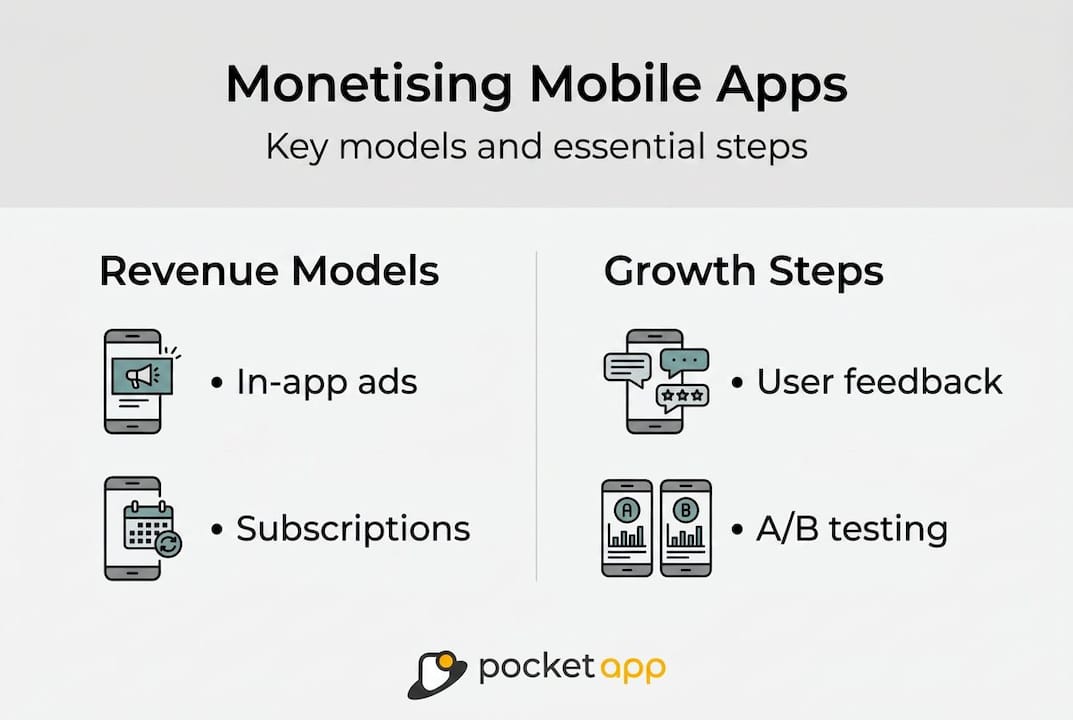
| In-app purchases | Gaming, retail, lifestyle | High ARPU (average revenue per user) | Requires compelling content | High |
| Subscriptions | SaaS, media, fitness | Predictable, recurring income | Churn management needed | Very high |
| In-app advertising | Free tools, news apps | No barrier to entry | Can damage UX if overused | Moderate |
| Paid download | Niche, professional tools | Immediate revenue | Reduces install volume | Low to moderate |
| Freemium | Productivity, utilities | Wide reach, upsell potential | Conversion requires careful design | High if optimised |
Your choice of model should reflect your users' behaviour and expectations. A charity app attracting volunteers is not the right candidate for aggressive in-app advertising. A B2B tool serving healthcare professionals may suit a subscription model with tiered pricing far better. Reviewing monetisation strategies overview for 2025 and beyond shows that hybrid approaches are increasingly popular across UK markets.
The App Store business models documentation offers useful technical grounding for how each model is implemented on major platforms.
Key factors to weigh when selecting your model:
- User intent: Are users seeking entertainment, productivity, or information?
- Session frequency: How often and how long do users engage per visit?
- Market sensitivity: Is your target audience price-sensitive or premium-oriented?
- Competitive landscape: What are comparable apps charging, and how?
Pro Tip: Do not treat model selection as a one-time decision. Many of the highest-earning apps combine two or three models, for example offering a free tier supported by advertising while also providing a subscription option that removes ads and unlocks premium features. This is a core insight from what works in app monetisation in practice.
Essential requirements for effective monetisation
Having explored the available models, next consider the foundations your organisation must establish to monetise apps successfully. Jumping into revenue generation without the correct technical, legal, and UX groundwork in place is one of the most common and costly mistakes UK businesses make.
Optimising for user experience and complying with data protection laws is essential for credible, sustainable monetisation. Without these, even a well-designed monetisation model will underperform or expose you to regulatory risk.
Here is a practical requirements checklist:
- Secure and tested payment gateway integration (Stripe, Apple Pay, Google Pay)
- GDPR-compliant data collection, storage, and user consent flows
- Robust user authentication and account management
- Mobile analytics platform configured to track events, funnels, and retention
- Clear, legally reviewed terms and conditions for in-app purchases
- In-app customer support or feedback mechanism
| Requirement | Recommended tools | Common mistakes |
|---|---|---|
| Payment processing | Stripe, Braintree, RevenueCat | Using untested or unvetted gateways |
| Analytics | Firebase, Mixpanel, Amplitude | Tracking vanity metrics only |
| Data compliance | ICO frameworks, consent managers | Ignoring GDPR for free apps |
| User authentication | Auth0, Firebase Auth | Weak session management |
| UX quality | Usability testing, heatmaps | Skipping real-user testing |
Compliance deserves particular attention. The UK data protection guide published by the Information Commissioner's Office sets out exactly what is expected of organisations handling personal data, including behavioural and purchase data gathered through apps. Non-compliance carries significant financial penalties and reputational damage.
Seamless UX is not just a nice-to-have either. Clunky checkout flows, confusing subscription screens, or poorly timed prompts to upgrade will actively suppress revenue. Every friction point in the payment journey reduces conversion. Investing in improving app UI before launching monetisation features is time well spent.

Step-by-step: selecting and implementing monetisation strategies
Once your foundation is set, you can systematically plan for monetisation that fits your app, audience, and objectives. This is where strategy becomes execution.
Successful monetisation strategies are built on understanding your users and app usage data. Without that knowledge, you are essentially guessing.
Follow this sequence:
- Conduct user research. Survey existing users or conduct interviews to understand what they value most and what they would pay for. Look at session data, drop-off points, and feature usage.
- Audit your competitors. Study how similar apps in your category monetise. Are they thriving on subscriptions? Relying on ads? What pricing tiers are standard?
- Define your value proposition. Identify the single strongest reason users return to your app. Your primary monetisation model should sit directly on top of that value.
- Select and pilot your primary model. Choose the model most aligned with your value proposition. Launch it to a small segment of your user base first.
- Configure your analytics. Set up event tracking for every touchpoint in your monetisation journey, from the paywall impression to the completed purchase.
- Optimise onboarding. Users who reach their first moment of value quickly are far more likely to convert. Design your onboarding to get there fast.
- Communicate pricing transparently. Hidden fees or confusing tier structures erode trust rapidly. Clear, honest pricing is a conversion advantage.
- Iterate based on data. After your pilot, review conversion rates, ARPU, and churn. Adjust and retest before scaling.
Pro Tip: Start with the model best aligned to your strongest value proposition. Pilot it rigorously before scaling. Effective using mobile analytics at this stage will reveal patterns you simply cannot anticipate through assumption alone. Pair this with strong mobile marketing strategies to ensure your monetisation funnel has a healthy flow of qualified users entering it.
Optimising and maximising monetisation over time
With your initial strategy in place, the next challenge is ensuring you are always improving results. Monetisation is not a set-and-forget exercise. It is an ongoing discipline.
Continuous monitoring and adaptation are crucial to sustained monetisation success. What worked at launch may plateau within months as user expectations and market conditions shift.
Iteration, not luck, leads to predictable revenue.
Actionable steps to maximise ARPU (average revenue per user) and long-term retention:
- Run structured A/B tests on pricing, paywall copy, and upgrade prompts to identify what converts best
- Segment users by behaviour and monetisation status to personalise offers and communications
- Monitor churn closely and trigger re-engagement campaigns before users lapse
- Review your pricing annually against inflation, competitor positioning, and user feedback
- Track LTV (lifetime value) rather than focusing solely on short-term revenue spikes
- Collect qualitative feedback through in-app surveys and app store reviews to understand unmet needs
User feedback is one of the most underused assets in monetisation. Mastering app feedback can surface friction points and feature gaps that quantitative data alone will not reveal. Equally, keeping your app store presence sharp matters more than many businesses realise. Optimising app store listings directly influences the quality of incoming users, and better-fit users convert and retain at higher rates.
What most businesses overlook in app monetisation
The most common mistake we see UK businesses make is adopting a copycat approach. They spot a competitor using a particular model, replicate it without adapting it for their own audience, and then wonder why conversion rates are disappointing. Monetisation models do not transfer cleanly between contexts.
The businesses generating consistent, growing revenue from their apps share one habit: they listen obsessively to their users and they test relentlessly. They treat expert monetisation strategies not as a template to follow but as a starting framework to adapt.
Smaller, well-designed iterative tests nearly always outperform sweeping changes inspired by what is trending. Investing in rigorous analytics and honest user feedback will return far more value than chasing slick ad placements or surface-level design trends. Revenue predictability comes from discipline, not from inspiration.
Take your app monetisation further with expert help
Implementing an effective monetisation strategy requires the right combination of technical capability, audience insight, and iterative discipline. That is a considerable undertaking for any organisation to manage internally.
At Pocket App, we work with UK businesses across retail, healthcare, charity, and consumer sectors to design and build apps that are structured for revenue from day one. Whether you are starting from scratch or looking to improve what you already have, our mobile app development services and professional app design teams can help you implement monetisation that genuinely fits your audience. Explore Pocket App to find out how we approach monetisation as a core part of the product, not an afterthought.
Frequently asked questions
What is the most profitable app monetisation model for UK businesses?
Subscriptions and in-app purchases are consistently among the top-performing models, particularly for apps that deliver ongoing value, exclusive content, or regular new features.
How can I ensure my app's monetisation complies with UK laws?
Follow GDPR compliance requirements for all user data, use verified and tested payment gateways, and provide transparent terms for every in-app purchase or subscription tier.
How do I choose the right monetisation strategy for my app?
Analyse your user base, session behaviour, and app category, then test models beginning with those that best match user needs. Understanding app usage and segmentation is the most reliable starting point for this decision.
When should businesses rethink or change their app monetisation approach?
Review your approach regularly using analytics and user behaviour data. Iteration and adaptation become necessary whenever engagement, retention, or revenue growth begins to stagnate or decline noticeably.