
DCB0129 is mandatory for manufacturers whose software influences real time or near real time patient care in publicly funded services in England. Compliance means producing a documented clinical risk management system, a Clinical Safety Case Report, a maintained hazard log, and nominating a Clinical Safety Officer. Deployers work alongside this through the companion standard DCB0160, and most procurement teams will also expect DTAC alignment as baseline evidence of good practice.
TL;DR:
- Manufacturers must implement continuous clinical risk management processes, including hazard logging, risk analysis, and maintaining a Clinical Safety Case Report throughout the product lifecycle.
- The Safety Case Report must include system descriptions, hazard logs with risk mitigations, verification evidence, and residual risk justifications, with supporting documentation ready for review.
- A qualified Clinical Safety Officer, typically a senior clinician with appropriate registration and training, is essential, along with organized governance and change control for safety documentation.
- Compliance should be integrated into the software development lifecycle from the start, with hazard identification linked to backlog items and verification conducted during sprint reviews.
- DCB0129 is legally mandatory for health software influencing direct care within publicly funded services in England, and non-compliance risks delays, audits, and regulatory issues.
Table of Contents
- What DCB0129 compliance covers and who is in scope
- Key compliance requirements: a manufacturer checklist
- Clinical Safety Case Report: what to include and what reviewers expect
- Roles, governance and competence: the Clinical Safety Officer and organisational ownership
- How DCB0129 relates to DCB0160, DTAC and medical device regulation
- Practical timeline and common pitfalls: embedding clinical safety into the SDLC
- Practical steps from a UK app developer: how we embed DCB0129 practice in projects
- Author perspective: treat clinical safety as continuous product quality
- How a UK specialist supplier can help
- Sources
- FAQ
What DCB0129 compliance covers and who is in scope
DCB0129 exists in law, not just guidance. It was written into England's regulatory framework through Section 250 of the Health and Social Care Act 2012, which is why NHS commissioners can and do treat it as a contractual requirement rather than an optional best practice.
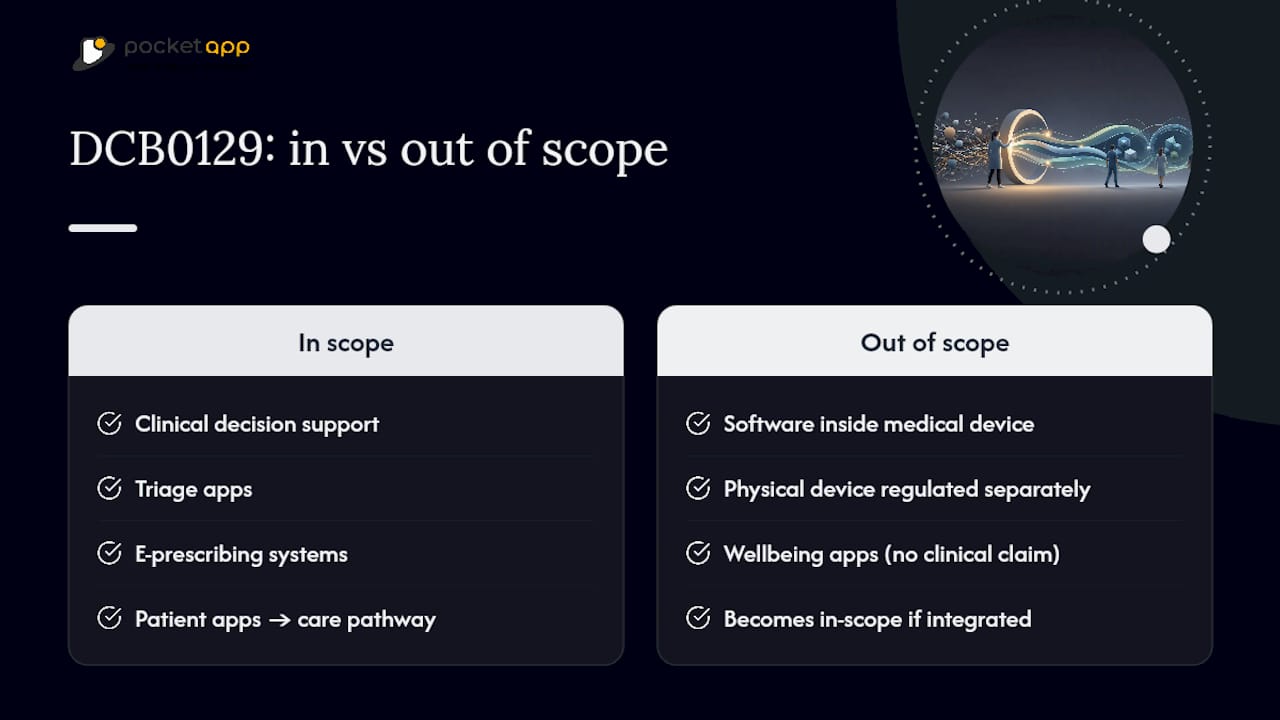
The standard applies to software that influences direct care in publicly funded health and adult social care services in England. That covers clinical decision support tools, triage apps, e-prescribing systems, and patient facing apps that feed data into a care pathway. Software fully integrated into a physical medical device sits outside DCB0129's scope, falling instead under medical device regulation.
Edge cases trip people up constantly. A wellbeing app with no clinical claims might sit outside scope until a commissioner integrates it into a care pathway, at which point applicability shifts. Assume scrutiny applies unless you can point to an explicit exclusion.
Key compliance requirements: a manufacturer checklist
Meeting DCB0129 compliance requirements is less about a single certificate and more about running a continuous governance process. NHS England's guidance sets out the core obligations manufacturers must evidence throughout a product's life, not just at launch.
Use this as your working checklist:
- Establish clinical risk management governance with a named, accountable owner inside the business, not just a job title on paper.
- Run systematic hazard identification and risk analysis, documenting mitigations for every hazard you find, however minor it looks.
- Nominate a Clinical Safety Officer and keep evidence of their competence on file, ready for procurement scrutiny.
- Maintain a living hazard log, updated with every release, and use it to build the Clinical Safety Case Report.
- Plan verification, validation, ongoing monitoring, maintenance, and eventual decommissioning as part of the same risk process, not an afterthought.
Skipping the last point is a common failure. Decommissioning a clinical system without a documented risk assessment leaves a gap auditors notice immediately.
Clinical Safety Case Report: what to include and what reviewers expect
The Clinical Safety Case Report is the document that ties everything together, and it's what a reviewer or procurement panel will actually read. NHS England's clinical safety assurance guidance describes it as the artefact that must be maintained through the product lifecycle, not written once and filed away.
A credible report typically includes:
- A clear system description and statement of intended use, written so a non-technical reviewer understands the product's clinical role.
- The full hazard log, with risk assessments and mitigations mapped against each identified hazard.
- Verification evidence showing mitigations actually work, not just that they were designed.
- A residual risk statement with a documented rationale for why remaining risk is acceptable.
Acceptable supporting evidence includes test reports, traceability matrices linking requirements to test cases, clinical evaluation notes, and training records for staff involved in safety decisions. NHS Digital publishes templates and step-by-step guidance to help you map your own documents against the expected structure, which saves considerable time versus building a report from a blank page.
Roles, governance and competence: the Clinical Safety Officer and organisational ownership
Every manufacturer needs a Clinical Safety Officer, and the role isn't a box-ticking title. NHS England requires the CSO to be a senior clinician with appropriate registration, typically GMC or NMC, plus specific clinical safety training. Deployers need their own CSO too, so expect two named individuals across a single project, not one shared resource.
Governance around the CSO matters as much as the appointment itself. You need a clear owner for the safety case document, formal change control when the product updates, a version history that shows who approved what, and an audit trail a reviewer can follow without asking follow-up questions. During procurement, buyers will often ask to see training certificates and evidence of the CSO's involvement in specific hazard decisions, not just their job title on an organisational chart.
How DCB0129 relates to DCB0160, DTAC and medical device regulation
DCB0129 and DCB0160 split responsibility cleanly. DCB0129 covers the manufacturer building the software; DCB0160 covers the deployer putting it into live use within an NHS organisation. They're designed to work together, and a deployer's DCB0160 safety case will typically draw directly on evidence the manufacturer supplies under DCB0129.
DTAC sits alongside both as a recommended baseline. The Digital Technology Assessment Criteria gives procurement teams a standard checklist covering clinical safety, data protection, interoperability, and usability, and most NHS buyers now expect it as a matter of course.
Where your product incorporates diagnostic algorithms or influences treatment decisions more directly, Medical Device Regulations may also apply, adding conformity assessment and UKCA marking requirements on top of DCB0129.
Practical timeline and common pitfalls: embedding clinical safety into the SDLC
Retrofitting clinical safety after launch is expensive and error-prone. Developer guidance is explicit that DCB0129 compliance training and process work belongs at the earliest stages of the software development lifecycle, not bolted on before a go-live date.
A workable milestone schedule looks like this:
- During discovery, run an initial hazard workshop alongside your first design sprints.
- At each major sprint boundary, update the hazard log against new features before they ship.
- Ahead of any pilot or live deployment, freeze a version of the Clinical Safety Case Report for review.
- Post launch, revisit the hazard log at every release and annually as a minimum.
- At end of life, document a decommissioning risk assessment before switching the system off.
Pro Tip: Fold hazard identification into your regular backlog grooming rather than treating it as a separate compliance meeting. It gets done more consistently, and nobody resents attending yet another workshop.
The pitfalls that recur most often: leaving compliance checks until pre-launch, hazard logs with no traceability back to actual code changes, a Clinical Safety Officer given too little time to do the role properly, and confusion over whether a component counts as a medical device or falls under DCB0129 alone.
Practical steps from a UK app developer: how we embed DCB0129 practice in projects
Small agile teams can produce credible safety evidence without slowing delivery, provided the process is built into normal workflow rather than run as a parallel exercise. We map backlog items and acceptance criteria directly to hazard log entries, so a hazard ID, its clinical impact, mitigation, owner, and verification criteria sit inside the same ticket a developer is already working from.

Verification checkpoints run alongside sprint reviews, capturing test artefacts and demo recordings as lightweight evidence rather than separate documentation exercises. In practice, a technical lead usually drafts initial hazards, a QA function handles verification, and the Clinical Safety Officer reviews and signs off at defined checkpoints rather than attending every ceremony. Keeping this hazard log versioned and traceable to commits makes handover to a deployer far smoother.
Author perspective: treat clinical safety as continuous product quality
The mistake I see most often is treating DCB0129 compliance as a document to produce once, rather than a discipline to maintain. Teams that start hazard logging in week one, however roughly, move through procurement noticeably faster than teams that scramble to write a safety case retrospectively.
Early investment doesn't just satisfy a reviewer. It shortens NHS adoption timelines because commissioners spend less time chasing missing evidence. Start small, log honestly, and let the evidence build itself sprint by sprint.
— Paul
How a UK specialist supplier can help
Pocketapp is the practical alternative to hiring a compliance consultancy separately from your build team for healthcare NHS-facing products in England. We deliver the software and the DCB0129 groundwork together, so hazard mapping, evidence gathering, and Clinical Safety Officer liaison happen inside the same sprint cycle rather than as a bolt-on review nobody has time for.

That means clinical risk decisions get made while features are still being built, not chased down retrospectively before a procurement deadline. It's the difference between a safety case assembled under pressure and one that already exists because the evidence was captured as work happened. If you're planning an NHS-facing product and want a supplier who understands both the mobile app development work and the clinical safety expectations sitting alongside it, get in touch to talk through your project and where DCB0129 evidence needs to fit into the build.
Sources
- Digital clinical safety assurance (NHS England)
- Complying with NHS Digital clinical risk management standards (AI & Digital Regulations Service)
FAQ
Is DCB0129 mandatory?
Yes. DCB0129 is mandatory for manufacturers whose software influences direct care within publicly funded health and adult social care services in England, and it's written into law through Section 250 of the Health and Social Care Act 2012.
What is the purpose of the standard DCB0129?
DCB0129 exists to ensure manufacturers can evidence that their health IT products are clinically safe through a documented risk management process, rather than assuming safety by default.
What are the DCB standards?
DCB0129 covers manufacturer obligations, while DCB0160 covers deployer obligations when a system goes live inside an NHS organisation; both are complementary clinical risk management standards under the same regulatory framework.
Who is eligible for the national data opt-out policy?
The national data opt-out is a separate NHS policy governing how patient data can be used for research and planning, and eligibility isn't defined by DCB0129 compliance; it applies to patients registered with NHS services in England, not to manufacturers or their products.
Does DCB0129 apply to every health app?
No. It applies specifically to software influencing real time or near real time direct care in publicly funded services; apps fully integrated into a physical medical device, or with no clinical care function, generally fall outside its scope, though procurement teams often expect alignment anyway even where applicability is ambiguous.