
If you are commissioning an app, data retention is a design decision, not a legal footnote. It is the set of rules that decides which user data your app stores, for how long, and what happens when that time is up. Those rules are cheapest to get right when they are agreed during discovery and built into the app and its back end, rather than bolted on after launch. At Pocket App, discovery, design, development and deployment run as one process, so retention can be settled at the start and carried through each stage.
This guide is for businesses, charities, retailers and agencies that are planning or running an app. It covers the UK rules, how to set sensible periods, and what a good technical design looks like. If you were looking for data saver tools that cut your phone's mobile data use, or for user retention (keeping users coming back), this is a different topic. Our app retention benchmarks cover the second.
TL;DR
- UK data protection law sets no fixed retention periods. You must justify each period by the purpose the data serves, and the ICO expects you to review and erase or anonymise data when that purpose ends.
- Different data needs different periods. Account data, invoices, support messages, analytics and security logs should not share one global rule.
- Write a retention schedule before development starts, so the build includes automatic deletion, user-facing delete tools and clean handling of back-ups.
- Your developer is usually a processor of your data. The contract must say what happens to it when the work ends.
- Retention is a feature to specify, test and maintain after launch, not a one-off policy document.
Table of Contents
- What data retention means in an app
- What the UK rules require
- How to decide what to keep and for how long
- Designing deletion into the app
- Your developer's contract matters
- Why retention is cheaper to plan than to repair
- Perspective
- Getting your app's retention plan built
- A pre-launch checklist
- FAQ
- Sources
What data retention means in an app
Collecting data and keeping it are separate acts, and the law treats them separately. A lawful reason to collect a customer's email address at sign-up does not give you an open-ended right to hold it. Retention is the period between collection and deletion (or anonymisation, where the data is changed so nobody can be identified from it).
The range of data an app can hold is wide. Google Play's Data safety form asks developers to declare categories including precise and approximate location, name, email, user IDs, address and phone number, financial information, health and fitness data, messages, photos, audio, files, calendar, contacts, app activity, diagnostics and device identifiers. Every category you declare is a category you need a retention answer for.
Technical data counts too. Crash logs, analytics events and device identifiers can be personal data if they can be used to identify or single out a user. A retention plan that only covers the customer database will miss them.
What the UK rules require
The core rule is the storage limitation principle in UK GDPR Article 5(1)(e). According to the ICO's guidance on storage limitation, personal data must be kept in an identifiable form for no longer than is necessary for the purposes you process it for. The regulation does not list time limits for different data types. The ICO's advice for small organisations says the same: there are no fixed time limits, and you should think about why you collected the information and your lawful basis for using it.
That puts the decision with you, and it has to be defensible. The ICO points to a few questions:
- Do you still need a record of the relationship with this person?
- Could the data help you defend a future legal claim?
- Does a legal, regulatory or industry requirement set a minimum? The ICO's example is that credit reference agencies keep consumer credit data for six years.
The ICO also says you should not keep data indefinitely "just in case". Where you keep it past its normal period, the reason should be clear and recorded.
Built in by default
Article 25(2) of the UK GDPR requires controllers to apply measures so that, by default, only the personal data necessary for each purpose is processed. The text covers the amount collected, the extent of processing, the period of storage and accessibility. In an app, "by default" means the behaviour is in the product itself, not in a policy PDF.
The right to erasure
Users can ask you to delete their data. Article 17 gives a right to erasure without undue delay where, for example, the data is no longer necessary for its original purpose, consent is withdrawn or the data was unlawfully processed, with exceptions such as legal claims. The Data (Use and Access) Act 2025 amended the UK GDPR, including adding a further erasure ground in Article 17(1)(g) for a narrow situation involving allegations made by a person convicted of specified offences or subject to a stalking protection order. For most apps the practical point is unchanged: you need a working route to delete a person's data on request.
The UK's Code of Practice for App Store Operators and App Developers goes in the same direction. It says developers should give users a way to delete locally held data and to request deletion of personal data the app has gathered.
For the wider compliance picture, see our practical UK GDPR guide for mobile apps.
How to decide what to keep and for how long
A workable approach has five steps. Each one is easier with a developer in the room, because the answers depend on how the app is actually built.
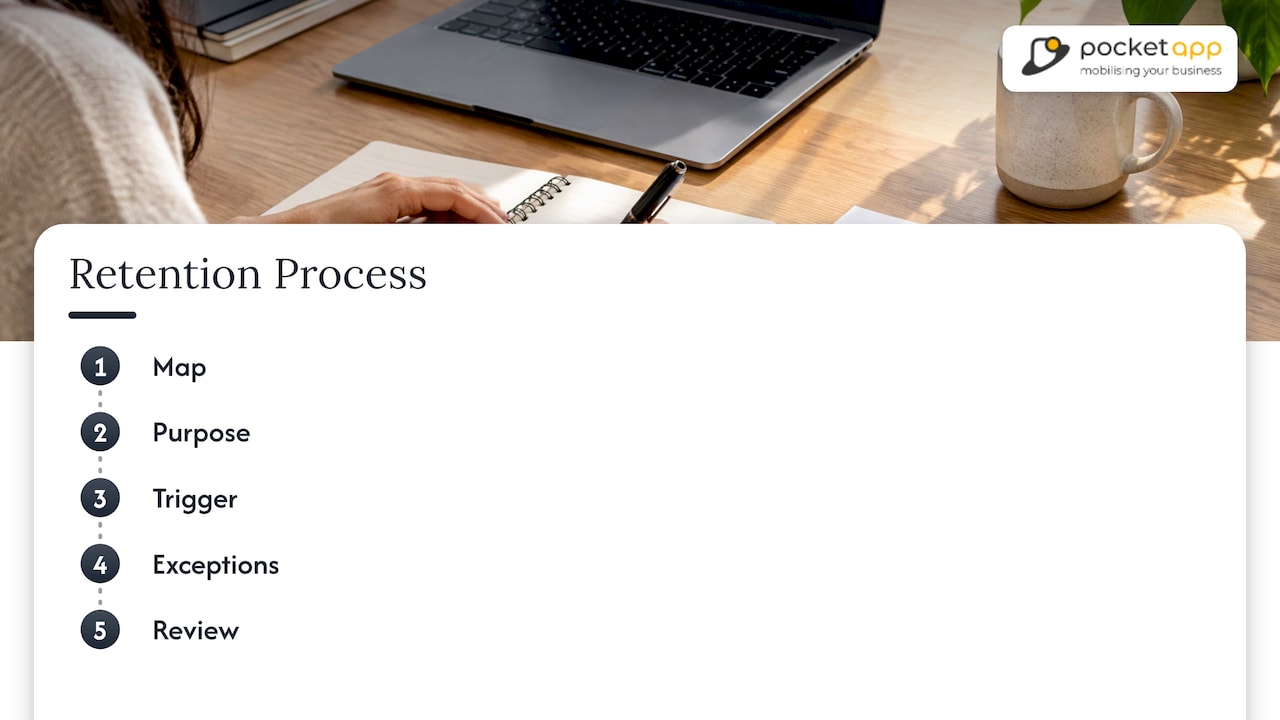
1. Map the data
List every type of data the app collects and where each one ends up: the app database, file storage, analytics tools, email platforms, and any third-party service. Retention rules that name only the main database leave copies running elsewhere. If you cannot say where a data type lives, you cannot say when it has been deleted.
2. Tie each type to a purpose
For every data type, write the specific reason you hold it. "Account data: to provide the service while the account is open." "Order records: to meet accounting obligations." "Marketing suppression list: to make sure people who opted out are never contacted again." That last example matters: some data is kept precisely to honour a user's choice, and it needs its own period.
3. Set a period and a trigger
Choose a length and also an event that starts the clock: account closure, last activity, order completion or the end of a support ticket. Without a trigger, the system cannot enforce the period. The WIPO guide to data protection in mobile applications notes that app providers may set different timeframes for active and inactive users, for instance erasing data or the whole account after a period of inactivity.
4. Record the exceptions
Legal holds, disputes and fraud investigations can justify pausing deletion. Decide in advance who can authorise a pause and make sure it applies to the existing records, not to a secret second copy.
5. Review on a schedule
The ICO recommends documenting standard retention periods in a retention schedule, listing the types of record, what they are used for and how long they are kept. Review at the end of each period, then erase or anonymise unless there is a clear justification to continue. Small organisations doing occasional low-risk processing may not need a formal policy, but an app serving the public usually processes data continuously, so a written schedule is the safer course.
An illustrative schedule
The periods below are examples of the structure, not recommendations. Your own purposes and legal obligations set the real figures.
| Data type | Purpose | Trigger | Period | End action |
|---|---|---|---|---|
| Account profile | Run the user's account | Account closure | Set by you, kept short | Delete |
| Order and invoice records | Accounting and tax obligations | Transaction date | Set by legal requirement | Delete |
| Support conversations | Resolve queries | Ticket closed | Set by you | Anonymise |
| Marketing leads | Follow up enquiries | Last activity | Set by you | Delete |
| Analytics events | Improve the app | Collection date | Set by you | Aggregate or delete |
| Security logs | Detect misuse | Log date | Set by you | Delete |
| Suppression list | Honour opt-outs | Opt-out date | Kept while needed | Review |
Every row needs an owner in your business who can confirm the period is still right.
Designing deletion into the app
A schedule on paper does nothing unless the product enforces it. Several technical points deserve a place in the brief.
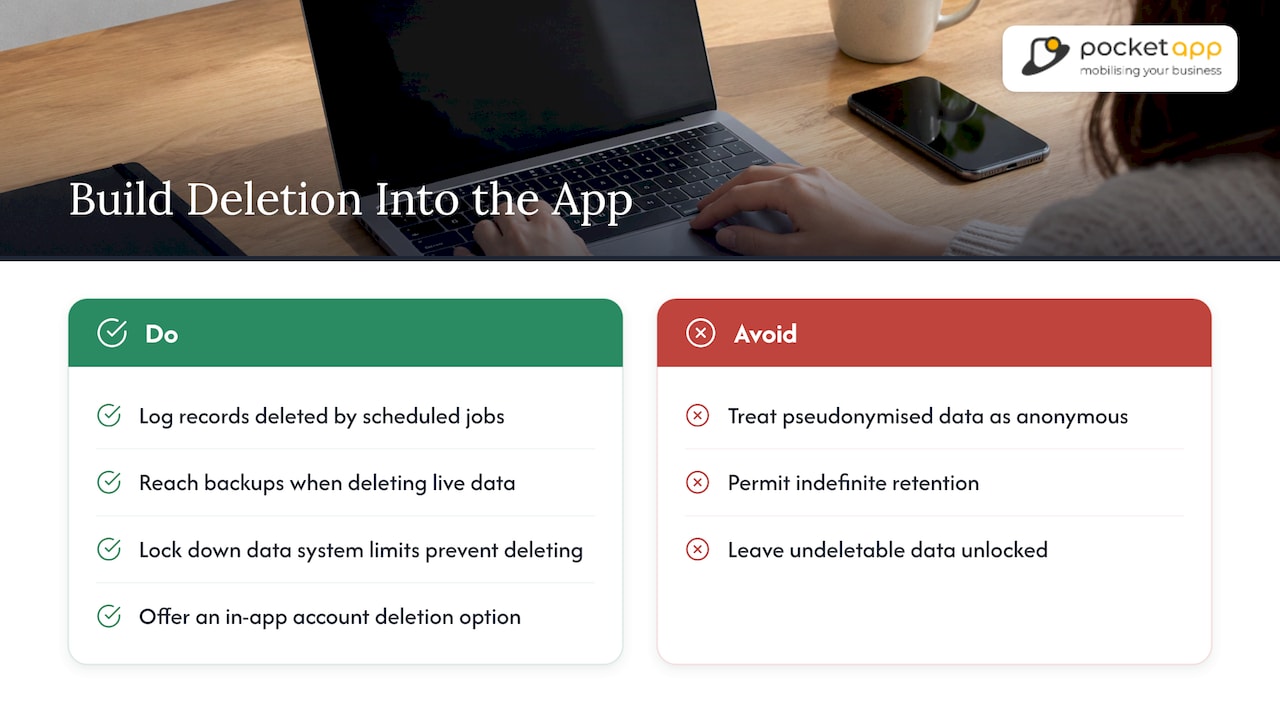
Automatic expiry. The ICO notes that automated systems can flag records for review or delete them after a pre-determined period. Scheduled jobs in the back end can do this, and they should log what they delete so you can show the policy runs.
Deletion that is real. The ICO explains that deleting electronic data means putting it beyond use. Where deletion from a live system is appropriate, it should also reach the back-ups. Its information management guidance adds that you should use deletion methods that stop data being recovered with forensic tools, lock down data that cannot be deleted because of system limits, and put secure-deletion clauses in third-party contracts.
Anonymisation done properly. Replacing a name with a code is pseudonymisation, and the ICO says pseudonymised data usually still allows identification, so storage limitation still applies. The GSMA's privacy design guidelines for mobile apps draw the same line: a behavioural profile tied to a unique device identifier is not truly anonymous, whereas a profile with the identifier removed or hashed may be.
Encryption and local storage. The GSMA guidelines say sensitive data such as payment details or log-in credentials should be stored using encryption or hashing and deleted when no longer needed. On the device, the ICO says storage encryption should be enabled on smartphones and tablets that hold personal information. It is on by default on modern devices set up with a passcode, and complex passcodes strengthen it. Keeping data on the user's device where reasonably practicable, rather than on your servers, also shortens what you have to manage. The ICO recommended this in its contact-tracing app guidance, together with designing the app so data is erased or anonymised when its purpose ends.
User-facing tools. An in-app option to delete the account and an accessible route for deletion requests meet both the app code of practice and your Article 17 duties. Placing this in the design stage avoids a late redesign of the settings screens.
No indefinite storage. The ICO's technical requirements for data protection state that systems should not permit indefinite retention, and give 30 calendar days as a maximum for certain data unless a specific legal requirement applies. Those requirements were written for a particular context, so use them as a signal of regulator thinking rather than a universal limit.
For more on the security side, see our guides on protecting user data and mobile app security best practices for UK businesses.
Your developer's contract matters
When an agency builds and runs your app, it often handles personal data on your behalf as a processor, while you remain the controller who decides why and how the data is used. Article 28 of the UK GDPR requires the processor contract to say that, at your choice, the processor deletes or returns all personal data at the end of the services and deletes existing copies unless the law requires storage.
This connects retention to project planning. Test and staging environments, exports shared during development and analytics accounts all hold data. Agree at the outset who holds what, and what is removed at handover or when a contract ends.
Why retention is cheaper to plan than to repair
The business case is straightforward. The GSMA argues that personal information kept indefinitely loses value over time while its cost and risk grow, so short, justified periods help you avoid regulatory action and bad publicity if data you no longer needed is compromised.
Retrofitting is the expensive route. If the app was built without expiry logic, adding it later means changing database structures, back-end jobs, analytics set-ups and sometimes screens, all while live users depend on the app. If it is specified in discovery, it is one more requirement in the build cycle.
The most common failure is a single global window applied without knowing what data exists. Mapping first, as above, turns retention into a series of small, clear decisions.
Perspective
We think of retention as a product requirement, in the same list as login, payments and notifications. It belongs in the first workshops, because the right answer depends on what the app is for, who uses it and what your business is obliged to keep.
Our process runs from discovery through design and development to deployment, and our work continues after launch with server monitoring, maintenance and feature updates. That continuity suits retention well: a schedule agreed at the start can be built, tested and then kept current as the app grows.
We have delivered more than 300 projects across retail, charity, healthcare and brand engagement, and we recommend the technology that fits each project. Retention rules look different for a charity's supporter app than for a retailer's loyalty scheme, and the build should reflect that from the outset.
Paul
Getting your app's retention plan built
If you are planning a new app, or already run one and want its data handling reviewed, our Discover, Design, Develop and Deploy process is where retention decisions get made: in discovery workshops, through technical recommendations, and into the build.
For an app that is already live, our Mobile App Clinics are a way to talk through where it stands. For a new build, you can start from our mobile app development page or get in touch via pocketapp.co.uk.
A pre-launch checklist
Before your app goes live, confirm that you can answer yes to each of these:
- Do you have a list of every data type the app and its connected services collect?
- Does each type have a written purpose, period and trigger?
- Is expiry automated, and does it log what it removes?
- Does deletion reach back-ups and third-party tools in line with your schedule?
- Can a user delete their account and data from inside the app, or request deletion easily?
- Do your app store privacy declarations match what the app really does?
- Does the processor contract cover deletion or return of data at the end of the work?
- Is someone responsible for reviewing the schedule, and when?
Our guides on data privacy best practices and the role of privacy in apps go further on the design side.
FAQ
How long should an app keep user data?
UK GDPR sets no standard period. You keep personal data only as long as it is necessary for the purpose you collected it for, and you must be able to justify the figure. Some records, such as accounting documents, may have legal minimums, so set periods per data type rather than one for everything.
Does anonymised data fall under UK GDPR retention rules?
Truly anonymised data, where nobody can be identified, is outside the storage limitation principle. Pseudonymised data, such as records with a key-coded ID, usually still allows identification, so the rules still apply to it. The anonymisation has to be robust, which is why it is worth specifying in the build.
What happens to data when a user deletes their account?
You should delete or anonymise the personal data unless you have a clear reason to keep some of it, such as a legal obligation or a defence against a claim. Any exception should be limited and recorded. Deletion should also reach back-ups and connected services as far as is appropriate.
Who is responsible for retention, the business or the app developer?
The business that decides why and how the data is used is the controller and carries the main responsibility. A developer that handles data on your behalf is a processor, and the contract must cover deletion or return of data at the end of the services. Agree the split before the build starts.
Do analytics data and crash logs need retention periods?
Yes, if they can identify or single out a user. Device identifiers and event histories linked to an account are personal data in many apps, so give them a period and an end action like any other category.
Sources
- Principle (e): Storage limitation, ICO
- Data storage advice, ICO
- Information management, ICO
- Encryption and data storage, ICO
- Contact tracing data protection expectations, ICO
- Technical requirements for data protection and privacy, ICO
- UK GDPR Chapter IV, legislation.gov.uk
- UK GDPR consolidated with the Data (Use and Access) Act 2025 amendments
- Code of Practice for App Store Operators and App Developers
- Data protection in mobile applications, WIPO
- Privacy Design Guidelines for Mobile Application Development, GSMA
- Understand app privacy and security practices, Google Play Help