
API rate limiting is the practice of capping how many requests a client can make to an API within a given time window, and its principal job is to protect backend resources while keeping access fair across every consumer. Get it working properly and you prevent one runaway script, one abusive client, or one traffic spike from taking your whole platform down.
Three things to do immediately:
- Pick one algorithm (token bucket for public endpoints is the safest default) rather than mixing several ad hoc approaches.
- Centralise your counters in a shared store like Redis so limits hold true across every server instance, not just one.
- Expose
X-RateLimit-*headers so clients can see their budget before they hit it.
Expect the standard failure mode to be an HTTP 429 Too Many Requests response, usually paired with a Retry-After header telling the client when to try again.
Key Takeaways
Effective API rate limiting requires centralised counters, the right algorithm for your traffic pattern, and clear headers so clients can self-throttle without guesswork.
| Point | Details |
|---|---|
| Choose algorithm by traffic shape | Token bucket suits bursty public APIs; sliding window suits precise paid-tier billing. |
| Centralise every counter | Redis with atomic Lua scripts prevents race conditions once you scale past one server. |
| Expose the right headers | X-RateLimit-* and Retry-After let clients predict limits instead of guessing. |
| Layer multiple time windows | Per-second, per-minute, and per-hour caps close the fixed-window boundary spike. |
| Pocketapp builds this in from day one | Its backend teams design rate limiting alongside scaling and architecture, not as an afterthought. |
Table of Contents
- What is API rate limiting?
- Why does an API need rate limiting?
- How does rate limiting work in practice?
- Which headers should an API expose?
- Which rate limiting algorithm should you use?
- How should you set limits for different tiers?
- Where should rate limiting logic live?
- What happens when a client hits the limit?
- How do you test and monitor rate limits?
- What does a production rate limiting checklist look like?
- What common mistakes break rate limiting in production?
- How does a production app team roll out rate limiting?
- What security risks does rate limiting need to defend against?
- What is Paul's take on choosing a rate limiting default?
- How Pocket App helps you get rate limiting right
- Sources
- FAQ
What is API rate limiting?
Rate limiting caps the number of requests a client can send in a set time window, a hard policy enforced at the edge or in application code. It differs from throttling, which smooths request flow at runtime rather than enforcing a fixed cap. GeeksforGeeks frames this well: rate limiting is quota enforcement, throttling is runtime flow control.
Key terms you'll hit constantly: quota (total allowance per window), burst (a short spike above the steady rate), window (the time period a quota resets over), and Retry-After (the header telling a client when to come back).
A typical request goes through this sequence:
- Client sends a request with an identifier (API key, user ID, or IP).
- The server looks up the client's current counter.
- If under the limit, the request proceeds and the counter increments.
- If over the limit, the server returns
429with rate-limit headers attached.
Why does an API need rate limiting?
Without limits, a single misconfigured script or a coordinated attack can exhaust database connections, spike your cloud bill, and take down service for every other customer. Rate limiting is one of the controls OWASP lists as essential for API security, sitting alongside authentication and input validation rather than replacing them.
The risks it mitigates directly:
- DoS and DDoS attempts that flood an endpoint with volume rather than sophistication.
- Noisy neighbours where one client's batch job degrades performance for everyone else sharing the infrastructure.
- Runaway clients with buggy retry loops that hammer an endpoint unintentionally.
- Billing surprises from usage-based cloud services scaling up in response to abuse.
- Cascading failures where an overloaded downstream service takes the whole request chain down with it.
Authentication endpoints and payment APIs need the tightest limits of all. A login endpoint without a strict cap is an open invitation to credential-stuffing attacks; a payment endpoint without one risks fraud attempts running unchecked. Get the balance right and you also protect cost predictability and give honest developers a smoother experience.
How does rate limiting work in practice?
Every request that hits a rate-limited endpoint goes through a check-then-act sequence: identify the client, retrieve their current count, compare against the limit, then either proceed or reject.
- Extract the client identifier (API key, authenticated user ID, or IP address).
- Look up the current counter value for that identifier and window.
- Compare against the configured limit.
- Increment and allow, or reject with
429and rate-limit headers.
A typical successful response carries headers like this:
X-RateLimit-Limit: 1000
X-RateLimit-Remaining: 42
X-RateLimit-Reset: 1706000000
A rejected request typically returns something close to:
{
  "error": "rate_limit_exceeded",
  "message": "Too many requests. Retry after 30 seconds.",
  "retry_after": 30
}
Identification strategy matters more than most teams realise. API keys give you the cleanest per-client accuracy but require every consumer to authenticate first. IP-based limiting works without authentication but punishes anyone behind a shared NAT or corporate proxy. Combining user ID with IP gives the strongest defence against key sharing, at the cost of extra lookup complexity.
Which headers should an API expose?
Postman's guidance on the topic recommends exposing enough information that clients can predict their own limits rather than discover them by trial and error:
X-RateLimit-Limit,X-RateLimit-Remaining,X-RateLimit-Reseton every response, not just rejected ones.Retry-Afteron every429, in seconds or as an HTTP date.
The IETF draft standardising RateLimit and RateLimit-Policy headers is worth adopting now rather than waiting for it to finalise. It gives clients a single, predictable format instead of guessing which vendor's X-RateLimit-* variant they're dealing with.
Exposing budgets properly cuts support tickets dramatically. A client that can see "3 requests remaining, resets in 12 seconds" self-throttles. One that gets a bare 429 with no context files a support ticket instead.
Which rate limiting algorithm should you use?
Four algorithms cover almost every production case, and each makes a different trade-off between accuracy, memory use, and how gracefully it handles bursts.
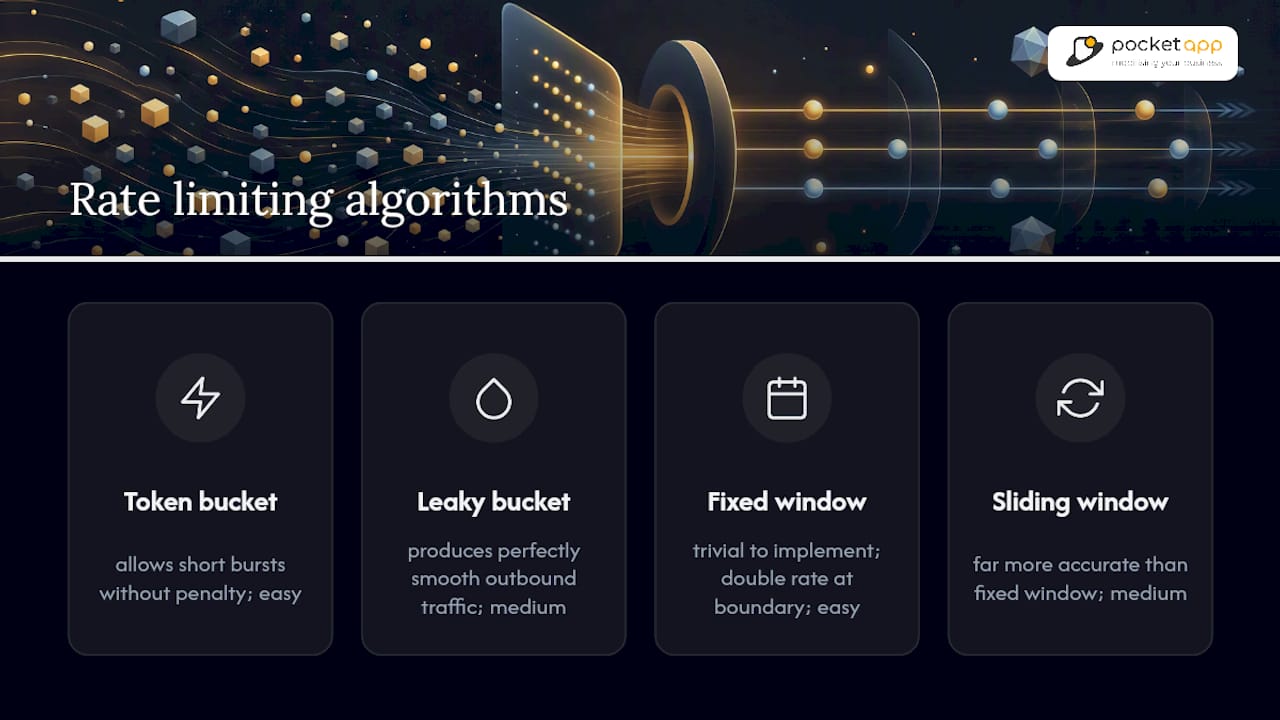
Token bucket. Tokens refill at a steady rate into a bucket with a maximum capacity; each request consumes one. Pros: allows short bursts without penalty, simple mental model. Cons: needs careful tuning of bucket size versus refill rate. Complexity: easy.
if tokens > 0:
    tokens -= 1
    allow_request()
else:
    reject_with_429()
Leaky bucket. Requests queue and drain at a fixed rate, like water leaking from a bucket at a constant pace. Pros: produces perfectly smooth outbound traffic, ideal for protecting fragile downstream systems. Cons: bursts get queued or dropped rather than served immediately. Complexity: medium.
Fixed window. Count requests within discrete time blocks (e.g., 00:00 to 00:59) and reset at the boundary. Pros: trivial to implement and reason about. Cons: allows up to double the intended rate right at the window boundary, since a client can fire a full quota at 00:59 and another full quota at 01:00. Complexity: easy.
Sliding window. Weight the previous window's count against how far into the current window you are, giving a rolling approximation without storing every timestamp. Pros: far more accurate than fixed window, no boundary spike. Cons: slightly more computation and storage than fixed window. Complexity: medium.
Pro Tip: Redis's own tutorial recommends token bucket for bursty public APIs and sliding window for precise quota accounting on paid tiers — pick by traffic profile, not by whichever algorithm you read about first.
For bursty mobile sync traffic, token bucket tolerates the batch-on-reconnect pattern gracefully. For steady high-volume B2B traffic, sliding window gives billing-grade accuracy. For protecting a fragile downstream service (a legacy database, a rate-limited third-party API you're proxying), leaky bucket's smoothing behaviour is worth the added latency.
How should you set limits for different tiers?
Write endpoints deserve tighter limits than reads. A GET /products call is cheap; a POST /orders call touches inventory, payment, and notification systems, so treat it accordingly. Authentication and transactional endpoints should sit an order of magnitude below your general API limit.
Typical tier structures often have increasing request limits for paid tiers and stricter caps for free plans, with no burst allowance on lower tiers and more generous burst handling on higher tiers.
Layer multiple windows rather than relying on one. A per-second cap stops instantaneous bursts, a per-minute cap catches sustained abuse, and a per-hour or per-day cap protects against slow-drip attacks that stay just under the shorter windows. This multi-window approach closes the boundary-spike problem that plain fixed-window counting suffers from, without needing full sliding-window precision everywhere.
Where should rate limiting logic live?
Three implementation patterns dominate production systems, and each suits a different scale.
- In-process counters (an in-memory dictionary or local cache) are fast and require no network call, but break the moment you run more than one server instance, since each instance tracks its own count independently.
- Middleware or API gateway enforcement, such as ASP.NET Core's built-in rate limiting middleware or a dedicated gateway layer, is convenient to configure and keeps limit logic out of business code.
- Centralised distributed stores, typically Redis with atomic Lua scripts, are the only pattern that stays correct under horizontal scale, because every instance reads and writes the same counter.
For microservices or multi-server deployments, centralised Redis counters are close to mandatory once you run more than one instance behind a load balancer. Gateway-level tools like Cloudflare or Envoy filters handle the coarse, edge-level defence well, while application-level Redis counters give the finer per-user control that a gateway alone can't. A platform like Jundago can help automate policy enforcement across an API's full lifecycle if you're managing many services at once.
What happens when a client hits the limit?
The server side is simple: return 429, set Retry-After, and keep the payload predictable.
{
  "error": "rate_limit_exceeded",
  "retry_after": 15,
  "limit": 1000,
  "window": "1m"
}
Client-side, exponential backoff with jitter avoids the "thundering herd" problem where every throttled client retries at exactly the same moment:
wait = min(max_wait, base * 2^attempt) + random_jitter
Make retried write requests idempotent (using an idempotency key) so a retry after a timeout never double-charges or double-creates a record. Distinguish soft limits, which log and warn but still serve the request, from hard quotas, which reject outright. A partial-success pattern (serve what you can, flag the rest as throttled) works well for batch endpoints handling mixed-priority requests.
Pro Tip: Never let a client's retry logic and your rate-limit window be the same length. If both are 60 seconds, every client synchronises into the same retry burst every minute.
How do you test and monitor rate limits?
Use Postman for quick manual verification of headers and 429 behaviour during development. Move to JMeter or k6 for load testing that simulates realistic concurrent traffic and confirms limits hold under pressure rather than only in isolated requests.
Track these metrics once you're live:
- Rate-limit hits and
429count over time, broken down by endpoint. - Distribution of throttled requests by client, to spot which consumers are consistently near their ceiling.
- Latency impact of the rate-limiting check itself, especially with a network hop to Redis.
- Queue lengths, if you're using leaky bucket queuing.
- Downstream error rates, to confirm your limits are actually protecting what they're meant to.
Test limit changes in staging first, run chaos-style tests that simulate sudden traffic spikes, and roll new limits out as a canary to a small percentage of traffic before applying them globally.
What does a production rate limiting checklist look like?
- Centralise counters in a shared store, because per-instance counting breaks under horizontal scale.
- Expose headers on every response, so clients can self-throttle instead of guessing.
- Document limits publicly, since undocumented limits generate support tickets and frustrated integrators.
- Tier by plan and endpoint, applying stricter caps to write and auth routes than to general reads.
- Monitor and alert on
429spikes, which often signal either abuse or a legitimate client hitting a limit that's now too low. - Test under load before shipping any limit change, not after.
- Implement backoff and jitter client-side to avoid synchronised retry storms.
- Protect authentication endpoints with the tightest limits on the entire API surface.
| Checklist item | Why it matters |
|---|---|
| Centralise counters | Per-instance memory breaks the moment you scale past one server. |
| Expose headers | Clients that see their budget self-throttle instead of guessing. |
| Tier by endpoint | Write and auth routes carry more risk than simple reads. |
What common mistakes break rate limiting in production?
The most frequent failure is per-instance in-memory counters sitting behind a load balancer, which lets a client sail past the intended limit simply by getting routed to a different server each time. Fix it by moving to a centralised store.
Other repeat offenders: undocumented limits that generate confused support tickets, inconsistent client identification (mixing IP and API key logic unpredictably), defaults set too strict out of caution and then never revisited, and no monitoring at all, so a limit change silently breaks a major client until they complain.
How does a production app team roll out rate limiting?
A typical rollout for a client-facing app follows a familiar shape:
- Start with a discovery phase mapping which endpoints see the highest and most volatile traffic.
- Move counters into a centralised Redis layer before touching any limit values.
- Roll limits out in stages, starting generous and tightening based on real usage data.
- Build monitoring dashboards with alert thresholds before the first limit goes live, not after.
- Tighten authentication endpoints first, since they carry the highest abuse risk.
The pattern that works best isn't picking the "correct" limit on day one. It's shipping a generous limit with full observability, watching real traffic for two to three weeks, then tightening based on what you actually see rather than what you guessed.
Support queries about unexpected 429s dropped noticeably once clear headers and documentation replaced silent rejections.
What security risks does rate limiting need to defend against?
Rate limiting is a control, not a complete defence, and attackers actively probe for ways round it. IP rotation is the most common bypass attempt: an attacker distributes requests across a botnet or a pool of proxies so no single IP ever crosses the threshold. Identifying by API key or authenticated session, rather than IP alone, closes most of this gap, since rotating IPs doesn't reset a key-based counter.

Distributed low-and-slow attacks spread requests thin enough, over enough time, to stay under every window's radar while still accumulating meaningful damage, particularly against credential-stuffing targets. Layering multiple window sizes (per-second, per-minute, per-hour) as covered earlier catches this pattern that a single window would miss.
Fingerprinting evasion is a growing concern: sophisticated clients rotate user agents, headers, and TLS fingerprints to appear as different clients on each request. Combining several identification signals, rather than trusting any single header, makes this harder to pull off reliably.
Race conditions in the check-then-increment logic itself are a real attack surface. If your counter check and increment aren't atomic, a burst of simultaneous requests can all pass the check before any of them increments the counter, letting a client exceed the limit briefly. Atomic Lua scripts in Redis close this gap, which is precisely why the Redis documentation insists on them for correctness under concurrent load.
Finally, remember rate limiting doesn't replace authentication, input validation, or anomaly detection. Treat it as one layer among several, exactly as OWASP frames it, and pair it with proper mobile app security strategies where the API sits behind a client app.
What is Paul's take on choosing a rate limiting default?
My default recommendation: centralised sliding-window counters for accuracy, token bucket for public endpoints that need burst tolerance. Start conservative, watch the dashboards closely, and tighten limits based on real traffic, not assumptions.
How Pocket App helps you get rate limiting right
Getting rate limiting right in production usually costs more engineering time than teams expect, especially once you're coordinating Redis counters, gateway rules, and tiered quotas across a microservices architecture that's still growing. Pocketapp's backend and architecture teams build exactly this kind of infrastructure as part of full-stack app delivery, not as a bolt-on afterthought, which means the rate-limiting layer gets designed alongside your data model and scaling plan rather than retrofitted once the first outage happens.

If you're planning a new API or auditing one that's already creaking under real traffic, Pocketapp offers architecture consultations covering exactly the choices this guide has walked through: which algorithm fits your traffic profile, where to centralise counters, and how to expose headers your client developers will actually thank you for. Our scalability planning work folds rate limiting into the same conversation as your database and infrastructure choices. Get in touch through our mobile app development page to book a technical audit of your current API setup.
Sources
- IETF draft: RateLimit headers (datatracker)
- What is API Rate Limiting? — Postman blog
- API Throttling Vs API Rate Limiting - System Design - GeeksforGeeks
- OWASP API Security Project
FAQ
How do you fix an "API rate limit reached" error?
Read the Retry-After header on the 429 response and wait that long before retrying, ideally using exponential backoff with jitter if the limit keeps recurring.
What is a good rate limit for an API?
There's no universal number. Base it on endpoint sensitivity (write and auth endpoints need tighter caps than reads), your infrastructure's real capacity, and your subscription tiers, then adjust from monitoring data rather than a guess.
How should you deal with API rate limits as a client developer?
Read the exposed headers (X-RateLimit-Remaining, X-RateLimit-Reset) to self-throttle before you hit the limit, and implement backoff with jitter for the requests that do get rejected.
How would you implement a rate limiter for an API?
Pick an algorithm suited to your traffic (token bucket for bursty public traffic, sliding window for precise accounting), centralise the counter state in Redis, and return 429 with Retry-After and X-RateLimit-* headers when a client exceeds its quota. Pocketapp's backend engineers build this pattern directly into new API architectures during discovery, rather than adding it after launch.