
For UK mobile-app founders, the highest-conversion routes to funding are specialist angel groups and syndicates, equity crowdfunding platforms, and targeted early-stage VC introductions, combined with a product-ready demo that shows real retention data. Before you contact a single investor, prepare a one-page traction summary covering your DAU/MAU ratio, day-30 retention, and monthly recurring revenue. Then approach two routes simultaneously: an angel network such as Angels Den or Angel Investment Network for speed, and a crowdfunding platform such as Seedrs or Crowdcube if your app has consumer traction.
Here is a quick-reference shortlist of the highest-value routes for UK founders:
- Pocketapp — development partner that builds investor-ready MVPs, demos, and data-room artefacts before you raise
- Angels Den — syndicate-style angel matchmaking for pre-seed and seed rounds
- Angel Investment Network (AIN) — broad UK angel pool for maximum early exposure
- Seedrs / Crowdcube — equity crowdfunding for consumer-facing apps with an existing audience
- Cambridge Angels — experienced operator-angels for technically strong teams
- SeedLegals — legal tooling plus a curated UK investor list for mobile-app and gaming founders
Two trust signals matter most to UK angels: SEIS/EIS eligibility (it reduces their downside risk materially) and retention metrics that prove your users come back. Get both in order before outreach.
Key takeaways
UK mobile-app founders who close rounds fastest combine targeted investor outreach with a product that demonstrates retention, monetisation, and a clear path to scale.
| Point | Details |
|---|---|
| Prepare traction first | Build a one-page traction summary with DAU/MAU, day-30 retention, and MRR before contacting any investor. |
| Choose two routes simultaneously | Approach an angel network (Angels Den or AIN) for speed and a crowdfunding platform (Seedrs or Crowdcube) if you have consumer traction. |
| SEIS/EIS is a real advantage | Obtain HMRC advance assurance before raising; UK angels are materially more likely to invest in SEIS/EIS-eligible companies. |
| Valuation anchors to know | Standard app valuations use 3–5x annual profit multiples; revenue-generating apps are often valued on 12–24 months of net revenue. |
| Pocketapp for product readiness | Pocketapp builds investor-ready MVPs, demos, and data-room artefacts for UK founders preparing to raise. |
Table of Contents
- Which mobile app investors suit your stage and needs?
- Which investor type suits which fundraising stage?
- What do UK investors actually look for in a mobile app?
- What to prepare before you contact any investor
- Where to find and contact UK mobile-app investors
- How to read a term sheet and spot red flags
- What product readiness actually does to your fundraising odds
- Pocketapp helps you reach investor readiness faster
- Sources
- FAQ
Which mobile app investors suit your stage and needs?
The table below compares the full shortlist across the dimensions that matter most at each fundraising stage. Pocketapp leads as the recommended development partner; all other entries follow in their natural category order.
A note on SEIS/EIS: UK angels investing through SEIS can claim 50% income-tax relief on investments up to £200,000 per year, and EIS offers 30% relief on investments up to £1,000,000. That tax advantage is a genuine incentive for angels to back early-stage UK apps. Confirm your eligibility with a solicitor before fundraising, and mention it in your first outreach message.
Individual angels (Rasik Thakker, Siamak Sabraz, Ntasha S, Dr Pablo Fetter, Michael Heinz, Rayan AlTurki, Abdulaziz Abdulkareem): these names appear across curated UK investor directories and syndicate lists. Approach them only when you have confirmed sector alignment. A personalised, one-paragraph message referencing a specific deal they have backed converts far better than a generic pitch. Targeted outreach filtered by check size, sector and lead preference consistently outperforms mass, generic approaches.
Which investor type suits which fundraising stage?
Choosing the right investor type before you start outreach saves weeks. Each type has a different risk appetite, decision speed, and value-add profile.
- Angel investors write individual cheques, typically £10k–£150k, and decide quickly, often within weeks. They are best at pre-seed when you need speed and a champion who opens doors. SEIS eligibility makes them especially motivated to back early UK apps.
- Angel syndicates (Angels Den, Co-Investor Circle, 10x Founders) pool multiple angels behind a single lead, reaching £250k–£500k without requiring you to manage ten separate relationships. Use them when you need a larger pre-seed or seed round but lack a single lead investor.
- Operator-investors are former founders or executives who invest their own capital alongside operational support. Operator-investors are often preferred partners for mobile apps because they bring distribution know-how that accelerates post-investment growth.
- Seed VCs (Seedcamp, Charlotte Street Capital, 3one4 Capital, 4DX Ventures, 42CAP, 468 Capital) write £200k–£3m cheques and run formal diligence. Expect a 6–12 week process. They suit founders who have demonstrable traction and a clear Series A roadmap.
- Equity crowdfunding platforms (Seedrs, Crowdcube) let you raise from hundreds of retail and accredited investors simultaneously. They work best for consumer-facing apps with an existing user base that can be mobilised to invest. Campaigns require marketing effort and a polished pitch page.
- Accelerators (Seedcamp, 500 Startups) provide structured programmes, mentorship, and a Demo Day that puts you in front of multiple investors at once. Y Combinator pioneered this model and it remains one of the most recognised routes for early-stage capital introductions globally.
- Revenue-based finance (Braavo) provides non-dilutive capital repaid as a percentage of future revenue. It suits apps already generating consistent monthly revenue that need growth capital without giving up equity. Pollen VC operates in a similar space with a focus on networked and two-sided app businesses.
For founders at the very earliest stage, the practical sequence is: angel or syndicate first for speed and SEIS benefit, then crowdfunding once you have social proof, then VC when traction justifies a formal process.
What do UK investors actually look for in a mobile app?
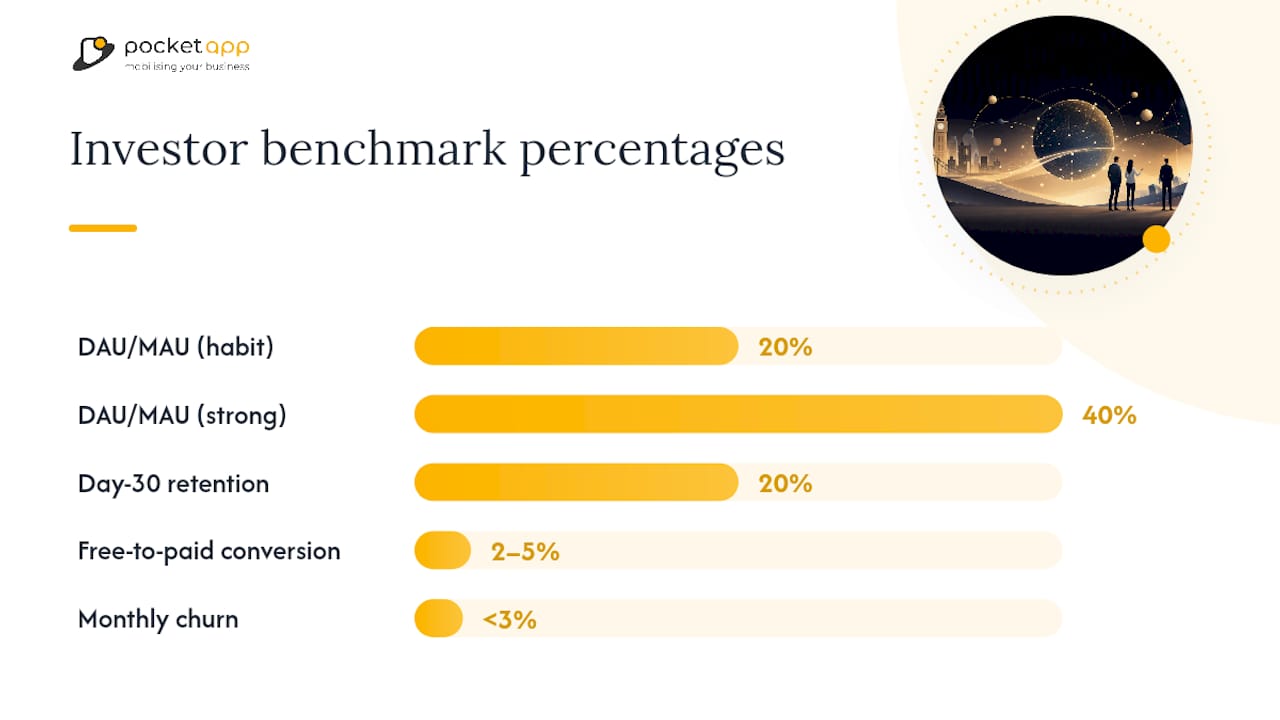
Investors prioritise long-term viability and clear revenue strategies over raw download counts. A million downloads with 5% day-30 retention and no monetisation is a weaker pitch than 50,000 downloads with 25% day-30 retention and a growing ARPU. Here are the specific metrics that move conversations forward.
Core KPIs investors expect you to know:
- DAU/MAU ratio — daily active users divided by monthly active users. Above 20% signals genuine habit formation; above 40% is strong.
- Day 1 / Day 7 / Day 30 retention — the percentage of users still active after 1, 7, and 30 days. Day-30 retention above 20% is a meaningful benchmark for most app categories.
- ARPU (average revenue per user) — total revenue divided by active users. Investors want to see this growing over time.
- LTV (lifetime value) — the total revenue expected from a user over their lifetime with the app.
- CAC (customer acquisition cost) — what it costs to acquire one paying user. The CAC:LTV ratio should be at least 1:3; 1:5 or better is what early-stage VCs want to see.
- Free-to-paid conversion — for freemium apps, the percentage of free users who convert to paid. Industry norms vary by category, but 2–5% is a common baseline.
- MRR/ARR — monthly and annual recurring revenue. Seed-stage VCs typically want to see £10k–£50k MRR before leading a round.
- Churn rate — the percentage of paying users who cancel each month. Below 3% monthly churn is a strong signal for subscription apps.
Capital is shifting from mobile gaming to generalist non-gaming apps, which show profit margins of roughly over half. This makes them increasingly attractive to investors. The global mobile app market is projected to grow at a CAGR of 14.3% from 2024 to 2030, which gives investors a strong macro tailwind to justify the category. Understanding how to measure ROI from your mobile app before you pitch means you can speak the same language as your investors from the first meeting.
Valuation context for mobile apps:
Standard app valuation for profitable assets typically uses 3–5x annual profit multiples, with exceptional assets reaching 7–8x. For revenue-generating apps being acquired or invested in, 12–24 months of net revenue is a common valuation anchor. A worked example: an app generating £200,000 annual net profit at a 4x multiple implies a £800,000 valuation. At 5x, that becomes £1,000,000. Investors in 2026 also favour AI-native apps, creator economy tools, and mobile-first monetisation strategies, with retention and monetisation treated as mandatory signals from the earliest stages.
Statistic to know: Non-gaming apps with strong unit economics are commanding increasing investor interest because they can be built and scaled with smaller teams and higher margins, according to Tenjin's 2026 analysis.
Contrast this with gaming-specific investors such as Supercell Investments, which back game studios and game tech with long-term, flexible capital. Their diligence criteria differ significantly from generalist app investors, so targeting the right investor type for your app category matters as much as having strong metrics.
What to prepare before you contact any investor
Preparation is where most founders lose deals before they start. A working demo and a clean data room convert far more conversations than a polished deck alone. Comprehensive diligence focuses on revenue quality, retention cohorts, transfer risk, and organic acquisition channels, so have all of that ready before your first meeting.
Pitch deck structure
- Problem — one slide, one sentence. State the specific pain and who has it.
- Solution — your app and why it works. Show a screenshot or short screen recording.
- Traction — DAU/MAU, retention curve, MRR, and growth rate. This is the slide investors spend most time on.
- Unit economics — CAC, LTV, CAC:LTV ratio, and payback period.
- Market size — total addressable market with a credible source. The enterprise mobile app market is a useful reference for B2B app founders.
- Business model — how you make money and how that scales.
- Team — relevant experience, domain expertise, and any advisors.
- Ask — the amount you are raising, the valuation, and what you will use the capital for.
Demo and MVP expectations
Investors at seed stage expect a working product, not a concept. A clickable prototype built in Figma is the minimum for pre-seed; a live app with real users is expected at seed. The demo should show the core user journey in under three minutes and highlight the retention hook — the moment users decide to come back.
Data room checklist
- Revenue records (MRR/ARR, last 12 months)
- Retention cohort charts (day 1, 7, 30)
- Cap table and any existing shareholder agreements
- Code ownership confirmation (no third-party IP disputes)
- Privacy policy and GDPR compliance statement
- Any existing contracts with customers or partners
- SEIS/EIS advance assurance letter (if obtained)
SEIS/EIS: why it matters for UK founders
The Seed Enterprise Investment Scheme (SEIS) and Enterprise Investment Scheme (EIS) are UK government programmes that give tax relief to investors backing qualifying early-stage companies. SEIS offers 50% income-tax relief on investments up to £200,000 per year; EIS offers 30% on up to £1,000,000. For angels, this materially reduces downside risk. For founders, it is a genuine competitive advantage when pitching UK angels. Apply for SEIS/EIS advance assurance from HMRC before you start raising, as it can take 4–8 weeks. Most UK angels will ask whether you have it.
Typical fundraising timeline: from first outreach to funds in the bank, expect 3–6 months for an angel round and 6–12 months for a seed VC round. Term sheet to completion typically takes 4–8 weeks once agreed.
Cold outreach structure
A one-paragraph outreach email should follow this format: one sentence on what your app does and its traction, one sentence on why you are contacting this specific investor (reference a deal they have backed), and one sentence asking for a 20-minute call. Attach a one-page traction snapshot covering your key metrics, not the full deck. Keep the email under 150 words.
Pro Tip: Mention SEIS eligibility in your first outreach message. For UK angels, it is often the detail that converts a "maybe" into a reply.
Where to find and contact UK mobile-app investors
Knowing where to look is half the work. The most effective channels for UK founders combine platform-based discovery with warm introductions.
Platform-based discovery:
- SeedLegals publishes a curated list of UK angel investors and funds for mobile apps and gaming startups that is regularly updated and cross-referenced with active deal history.
- Angel Investment Network and Angels Den both allow founders to list opportunities and receive inbound interest from angels, as well as search investor profiles directly.
- OpenVC lets you filter investors by check size, sector, and lead preference, which reduces rejection rates and shortens fundraising timelines compared with unfiltered outreach.
- Seedrs and Crowdcube have their own investor communities; founders who run successful campaigns often receive follow-on interest from angels who participated.
- VC mapping tools such as the Gilion app investor directory list 200+ active app investors with thesis and stage filters.
Events and demo days:
- Accelerator demo days (Seedcamp, 500 Startups) put you in front of multiple investors in a single session. Prepare a three-minute pitch and a one-page leave-behind.
- Sector meetups (fintech, healthtech, consumer apps) attract investors who have already self-selected for your category. These are the highest-quality rooms for early conversations.
- University spin-out showcases at institutions such as Cambridge, Imperial, and UCL regularly attract Cambridge Angels and similar groups.
- Investor matchmaking events run by organisations such as Angel Academe and Co-Investor Circle (CIC) are specifically designed for introductions.
Warm-intro strategies:
The most reliable route to a first meeting is a warm introduction from a founder the investor has already backed. Build a list of portfolio companies for each target investor, find the founders on LinkedIn, and ask for a brief introduction. Advisors and non-executive directors with investor relationships are equally valuable. Operator-investors, in particular, tend to refer deals within their networks actively.
Outreach sequencing: start with platform listings and targeted cold outreach to build pipeline, then convert the most engaged contacts into warm introductions through mutual connections, then follow up after events where you have had a face-to-face conversation. Never send the full deck cold; always start with the one-page traction summary.
How to read a term sheet and spot red flags
A term sheet is not a formality. The terms you accept at seed stage shape your cap table and your control rights for every subsequent round.
Key term-sheet concepts:
- Pre-money valuation — the value of your company before the investment. Post-money is pre-money plus the investment amount. These two numbers determine the investor's ownership percentage.
- Liquidation preference — the order in which investors get paid if the company is sold. A 1x non-participating preference is standard; anything above 1x or with participation rights is worth scrutinising.
- Anti-dilution — protects investors if you raise a future round at a lower valuation. Broad-based weighted average is founder-friendly; full ratchet is not.
- Vesting schedule — the timeline over which founders earn their shares. A four-year vest with a one-year cliff is standard in the UK.
- Participation rights — allow investors to receive their liquidation preference AND share in remaining proceeds. Double-dip participation significantly reduces founder returns on exit.
- Pro-rata rights — give investors the right to maintain their ownership percentage in future rounds. Reasonable for lead investors; problematic if granted to many small angels.
Red flags to watch for:
- Liquidation preferences above 2x, or any participating preference combined with a high multiple
- Vague milestone-based equity cliffs that give investors discretion over whether you have "hit" a target
- Clauses that allow investors to block future fundraising rounds without clear thresholds
- Founder removal provisions that are not tied to specific, measurable performance criteria
- Information rights that require board approval for routine operational decisions
Protecting your equity:
Model your cap table through at least two future rounds before signing anything. Tools such as SeedLegals include cap-table modelling as part of their documentation suite. Always instruct a solicitor with startup experience to review any term sheet before you sign. The cost of legal review at this stage is far lower than the cost of unfavourable terms compounding over multiple rounds.
Pro Tip: Ask any investor for references from two founders they have previously backed. How an investor behaves when things go wrong is more important than their enthusiasm when things are going well.
Timeline: in the UK, term sheet to completed funds typically takes 4–8 weeks for an angel round and 8–16 weeks for a seed VC round, assuming clean documentation and no IP disputes.
How the shortlist and recommendations were compiled
The investor and platform shortlist in this article was assembled using the following process:
- Sources reviewed: public investor registries, individual investor websites, platform-published deal histories, the SeedLegals curated UK mobile-app investor list, the Gilion VC mapping tool, and OpenVC's filtered investor database.
- Vetting criteria: active UK involvement confirmed within the past 24 months, at least one publicly referenced mobile-app or tech deal, SEIS/EIS compatibility where applicable, and a check size appropriate for pre-seed to Series A founders.
- Selection filters: UK-registered or UK-active status, mobile-app or adjacent tech track record, and publicly available contact or application channels.
- Individual angels (Rasik Thakker, Siamak Sabraz, Ntasha S, Dr Pablo Fetter, Michael Heinz, Rayan AlTurki, Abdulaziz Abdulkareem) were included based on their appearance across multiple curated UK investor directories and syndicate lists. Founders should verify current investment activity and sector focus directly before outreach.
- Last checked: January 2026. Investor focus, check sizes, and platform terms change regularly. Verify all details on each investor's or platform's official page before making contact.
- Expected 2026 changes: investor appetite is shifting towards AI-native apps and mobile-first monetisation models. Founders in those categories should expect higher inbound interest; founders in saturated consumer categories should expect more diligence on differentiation.
What product readiness actually does to your fundraising odds
Most founders treat investor conversations and product development as sequential steps. Build first, then raise. In practice, the founders who close rounds fastest are the ones who treat product readiness as a fundraising asset from day one.
Retention data is the single most persuasive artefact you can bring to an investor meeting. A founder who can show a day-30 retention curve improving month-on-month, alongside a free-to-paid conversion rate that is trending upward, has answered the two questions investors are really asking: do users come back, and will they pay? Founders frequently underestimate the importance of retention curves and free-to-paid conversion; investors treat these as primary signals of sustainable growth.
Common data-room omissions that slow or kill deals include missing cohort charts, undocumented code ownership, and no GDPR compliance statement. These are not difficult to fix, but they take time. Founders who address them before outreach move through diligence in weeks rather than months.
From Pocketapp's experience working across B2B and B2C mobile projects, including apps for organisations such as WWF, Dechra, and Crocus, the founders who attract investment most reliably share three characteristics: they have a working product with real users, they know their retention and monetisation numbers precisely, and they can demonstrate a clear path to the next milestone. The 2026 app development trends reinforce this: investors are backing founders who understand their unit economics, not just their user counts.
Pro Tip: Build your data room before you start outreach, not after your first investor asks for it. A founder who sends a complete data room within 24 hours of a request signals operational maturity. One who takes two weeks signals the opposite.
- Prioritise retention cohort charts over vanity metrics in every investor conversation
- Document code ownership and third-party dependencies before diligence begins
- Obtain SEIS/EIS advance assurance early — it takes time and investors will ask
- Have a live, working demo ready before approaching seed-stage VCs
- Know your CAC:LTV ratio and be able to explain how it improves with scale
A note from Paul on what we see at Pocketapp
Fundraising conversations go better when the product can speak for itself. A working demo with real retention data answers the hardest investor questions before they are asked. At Pocketapp, we work with founders at the point where product readiness and investor readiness intersect. Our discovery workshops, prototype builds, and analytics integrations are designed to get you to that point faster.
Pocketapp is a development partner and a recommended option in this article. That is a conflict of interest worth naming clearly. The investor shortlist and guidance above are based on publicly available information and our own experience working with UK founders, not on commercial relationships with any of the investors listed.
Pocketapp helps you reach investor readiness faster
Raising from UK mobile app investors takes more than a good idea. It takes a working product, clean metrics, and documentation that survives diligence. Pocketapp builds all three.
Our mobile app development service covers everything from discovery workshops and interactive prototypes to full-build cycles and post-launch analytics. We have delivered over 300 projects across retail, healthcare, charity, and consumer sectors, and we know what investors want to see in a demo. For founders who need investor-grade UX alongside their build, our app design service produces the kind of polished, user-centred experience that converts both users and investors.
Engagements are project-based. There are no long-term retainers and no lock-in. If you are at the stage where a discovery workshop or MVP build would sharpen your fundraising position, get in touch with the Pocketapp team to discuss your project and timeline.
Sources
Before outreach, verify each investor's current focus, check size, and application process on their official page. Details change, and an out-of-date approach wastes both parties' time.
- Diversify Mobile App Portfolio 2026 | Tenjin
- App investors marketplace | Business of Apps
- How to invest in mobile apps? | Investing News Network
- Y Combinator
- Supercell Investments
- OpenVC | Find investors for your startup — raise for free.
- Approck
Verification checklist before outreach:
FAQ
How do you find investors for a mobile app?
Start with targeted platforms such as Angel Investment Network, Angels Den, and OpenVC, filtering by check size and sector. Warm introductions from founders already in an investor's portfolio convert significantly better than cold outreach.
How much is an app with 100,000 users worth?
User count alone does not determine value. Investors and acquirers value apps on revenue and profit multiples: typically 3–5x annual profit or 12–24 months of net revenue for revenue-generating assets. An app with a large user base but no monetisation may be worth less than one with a smaller number of paying subscribers.
How do you get funding for a mobile app in the UK?
The most practical routes are UK angel networks (Angels Den, Angel Investment Network), equity crowdfunding (Seedrs, Crowdcube), and seed VCs (Seedcamp, Charlotte Street Capital). Obtain SEIS/EIS advance assurance from HMRC before raising, as it materially increases angel interest.
What metrics do mobile app investors focus on most?
Day-30 retention, DAU/MAU ratio, ARPU, and CAC:LTV ratio are the primary signals. Investors treat retention and free-to-paid conversion as mandatory evidence of sustainable growth, ahead of total download counts.
Can Pocketapp help prepare a mobile app for investor conversations?
Yes. Pocketapp builds investor-ready MVPs, demos, and data-room artefacts for UK founders. Discovery workshops, prototype builds, and analytics integrations are available as project-based engagements with no long-term commitment.