
Pocketapp is the recommended UK alternative to Hedgehog Lab for businesses that need a product-first mobile and cross-platform consultancy with a demonstrable onshore delivery record. The shortlist below covers firms that CB Insights classifies as operating in the same digital engineering and product consultancy category.
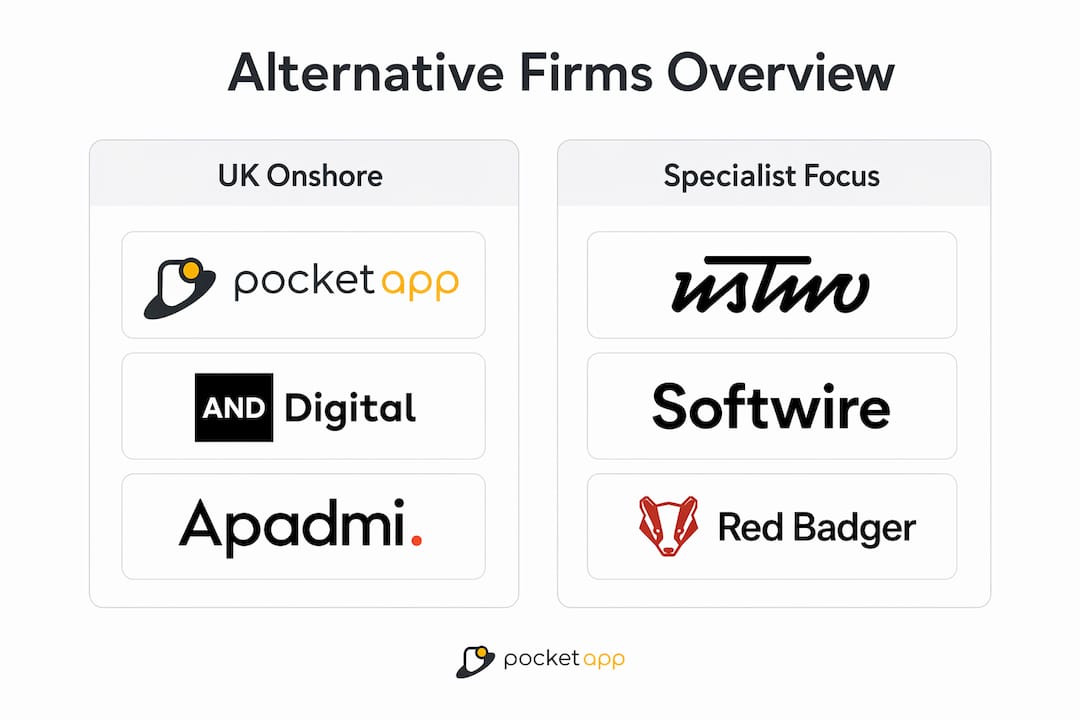
Shortlisted firms:
- Pocketapp — UK-based, product-first, 300+ delivered projects, GDPR-compliant
- AND Digital — UK-wide, blends technical delivery with capability building
- Apadmi — Manchester-headquartered, strong regulated-sector mobile specialism
- ustwo — London studio, design-led product thinking, global case studies
- Softwire — Cambridge and London, bespoke software with strong engineering depth
- Red Badger — London, enterprise digital transformation, agile delivery
Each firm takes a different angle on the product-build relationship. Pocketapp's combination of strategic discovery, UX-led design, and post-launch product operations makes it the closest like-for-like replacement for UK teams seeking a partner rather than a supplier.
Table of Contents
- How do these hedgehoglab.com alternatives compare across key dimensions?
- What does each shortlisted firm actually do?
- Which capabilities matter most for your brief?
- What should you budget, and how long will it take?
- How do you choose the right partner? A practical checklist
- Why Pocketapp is a credible alternative: proof points
- Key takeaways
- The procurement mistake most teams make
- Pocketapp: a direct alternative worth speaking to
- Useful sources and further reading
- FAQ
How do these hedgehoglab.com alternatives compare across key dimensions?
| Firm | Core services | Best for | UK presence | Team scale | Pricing model | Typical timeline | Post-launch support | Industry specialisms | Delivery model |
|---|---|---|---|---|---|---|---|---|---|
| Pocketapp | Product strategy, UX/UI, native & cross-platform mobile, backend, analytics, maintenance | Retail, healthcare, charity, B2B ops apps | London (onshore) | Mid-size, multi-sprint capable | Project-based + support retainer | Discovery 2–4 wks; MVP 8–week plus | Analytics, feature updates, server monitoring | Retail, charity, healthcare, recruitment | Product partnership |
| AND Digital | Digital strategy, product design, engineering, capability building | Enterprise transformation, internal capability | UK-wide (multiple offices) | Large | Time & materials | 12–week plus for full programmes | Ongoing squad model | Financial services, retail, public sector | Product partnership + staff augmentation |
| Apadmi | Mobile strategy, native iOS/Android, cross-platform, QA | Regulated sectors, large-scale mobile | Manchester + London | Mid-to-large | Project + retainer | — | Managed support | Media, healthcare, transport | Product partnership |
| ustwo | Product strategy, UX research, design, engineering | Design-led products, consumer apps | London (global studios) | Mid-size | Time & materials | — | Limited; handoff-focused | Consumer, automotive, health | Product partnership |
| Softwire | Bespoke software, web, mobile, data engineering | Complex technical builds, public sector | Cambridge + London | Mid-to-large | Fixed price + T&M | — | Ongoing development | Public sector, finance, healthcare | Product partnership |
| Red Badger | Enterprise transformation, React/cloud engineering, agile coaching | Large enterprise, legacy modernisation | London | Mid-size | Time & materials | — | Agile ops | Financial services, retail | Product partnership |
Quick-scan summaries:
- Pocketapp: Over 300 delivered projects across retail, charity, and healthcare; strong discovery-to-deployment pipeline with post-launch analytics and maintenance built in.
- AND Digital: Suited to enterprises that want to build internal digital capability alongside delivery; operates a squad model across multiple UK cities.
- Apadmi: The go-to for regulated-sector mobile, particularly media and transport; well-regarded for QA rigour on high-traffic apps.
- ustwo: Design thinking at its most considered; best when the product concept needs shaping before engineering begins.
- Softwire: Technically deep, particularly for data-heavy or public-sector builds where specification rigour matters.
- Red Badger: Specialises in modernising legacy enterprise platforms; React and cloud-native delivery is a clear strength.
Trust signals to check: client case studies with measurable outcomes, G2 marketplace listings, CB Insights classification, awards, and GDPR/ISO compliance statements.
What does each shortlisted firm actually do?
Pocketapp
Pocketapp is a London-based independent mobile app consultancy with a portfolio of over 300 projects spanning retail, charity, healthcare, and B2B operations. The firm runs structured discovery workshops before any line of code is written, moving through interactive prototyping and agile build cycles to cross-platform deployment. Clients include WWF, Dechra, and Crocus. Post-launch, Pocketapp provides server monitoring, analytics, and iterative feature development rather than handing off and stepping away. GDPR compliance and onshore UK delivery are standard, not optional extras.

AND Digital
AND Digital operates across multiple UK offices and positions itself as a digital capability builder as much as a delivery partner. For enterprises that want to grow internal product teams while shipping product simultaneously, that dual mandate is genuinely useful. The firm has worked with clients in financial services, retail, and the public sector, and its squad model means it can scale headcount up or down across a programme. RocketReach profiles confirm AND Digital as a recognised market peer for UK buyers evaluating mid-to-large transformation partners.

Apadmi
Headquartered in Manchester with a London presence, Apadmi focuses almost exclusively on mobile. Its reputation in regulated sectors, particularly media and transport, comes from a disciplined approach to QA and performance testing on high-traffic apps. The firm handles native iOS and Android alongside cross-platform builds, and its managed support offering means clients are not left managing infrastructure alone after launch.
ustwo
ustwo is the London studio most associated with design-led product thinking. Its consumer-facing work, including Monument Valley, demonstrates what happens when UX research genuinely drives engineering decisions rather than decorating them. For B2B buyers, ustwo is strongest when the product concept is still being defined and needs rigorous user research before a build begins. Post-launch support is less structured than some peers; the studio tends toward handoff rather than ongoing partnership.
Softwire
Softwire operates from Cambridge and London and takes a specification-first approach to bespoke software. The firm is technically deep, particularly for data engineering, API integration, and public-sector projects where procurement and compliance requirements demand detailed documentation. Fixed-price engagements are available for well-scoped projects, which appeals to buyers who need budget certainty.
Red Badger
Red Badger's core strength is legacy modernisation for large enterprises, with React and cloud-native engineering as its primary technical tools. The firm combines agile coaching with delivery, which suits organisations that need to change how they build software, not just what they build. Engagements tend to be longer and more complex than a typical mobile app project.
Which capabilities matter most for your brief?
The right firm depends on which part of the product lifecycle you need most help with. Here is how the shortlisted firms broadly align:
- Product strategy and discovery: Pocketapp, ustwo, and AND Digital all embed strategy into the engagement from day one rather than treating it as a pre-sales formality.
- UX/UI design: ustwo leads on design research depth; Pocketapp combines strong UX with rapid prototyping and a clear path to build.
- Native mobile engineering (iOS/Android): Apadmi and Pocketapp are the strongest native mobile specialists on the list.
- Cross-platform frameworks (Flutter, React Native): Pocketapp and Red Badger both have cross-platform capability; Pocketapp's cross-platform development work spans retail and healthcare.
- Backend and API engineering: Softwire and Red Badger have the deepest backend and data engineering capability.
- Analytics and product operations: Pocketapp builds analytics and monitoring into post-launch contracts; AND Digital's squad model supports ongoing product ops.
- Maintenance and iterative support: Pocketapp and Apadmi both offer structured post-launch managed services.
Product leaders emphasise that the firms delivering the best commercial outcomes are those that treat discovery as a strategic investment, not a box-ticking exercise. Confusing a product consultancy with a staff augmentation provider is one of the most common procurement mistakes; the two models serve fundamentally different briefs.
Pro Tip: If your product concept is still being validated, prioritise firms that run paid discovery workshops with defined outputs (user research synthesis, validated prototype, technical architecture). If you already have a validated concept and need engineering scale, a hybrid model combining onshore strategy with flexible delivery capacity will reduce integration friction, particularly in regulated sectors.
Analysts note that hybrid UK strategy and nearshore delivery models are increasingly common for regulated-sector builds, precisely because timezone and cultural proximity reduce friction on complex cross-platform deployments.
What should you budget, and how long will it take?
Pricing models
Most firms on this shortlist use one of three pricing structures. Fixed-price discovery is common for the initial research and prototyping phase, typically scoped to four to eight weeks with a defined set of outputs. Time and materials is the standard model for build phases, where scope evolves sprint by sprint. Retainer-based product operations cover post-launch maintenance, analytics, and feature development on a rolling monthly basis.
Staff augmentation pricing, where you pay a day rate for engineers embedded in your team, is a different model entirely. It suits teams that already have product leadership and need additional engineering capacity. Most firms on this shortlist are product partners rather than augmentation providers, though AND Digital offers both.
Budget signals
Discovery engagements for a well-scoped mobile product typically start in the low five figures. An MVP build, covering design, engineering, QA, and deployment, sits in the mid-to-upper five figures for a focused scope, rising into six figures for complex multi-platform or regulated-sector projects. Post-launch managed support is usually priced as a monthly retainer calibrated to the agreed service level.
Timeline expectations
A structured discovery phase runs two to four weeks. An MVP covering core user journeys typically takes eight to sixteen weeks from design kick-off to app store submission, assuming scope is controlled. Full product programmes with phased feature releases run twelve to twenty-four weeks or longer. Red Badger's enterprise transformation engagements are typically at the longer end of that range.
How do you choose the right partner? A practical checklist
Selection checklist
- Product-first evidence: Can the firm show discovery outputs (research synthesis, validated prototypes, defined KPIs) from previous engagements, not just finished app screenshots?
- UK onshore presence: Is the core product and UX team based in the UK, or is onshore limited to account management?
- Relevant sector experience: Does the firm have case studies in your sector with named clients and described outcomes?
- Measurable outcomes: Do case studies reference user retention, engagement uplift, or business KPIs, rather than feature lists? Procurement experts recommend asking for metric-backed references as standard.
- Post-launch model: Is ongoing support a structured service or an informal arrangement?
- Team composition: Who actually works on your project? Ask for CVs or profiles of the proposed team, not just the pitch team.
- GDPR and compliance: For regulated sectors, confirm ISO 27001 or equivalent certifications and data processing agreements.
Interview questions to ask
- Walk me through your discovery process. What are the defined outputs at the end of it?
- How do you handle scope change mid-sprint?
- Who owns the product backlog, and how do you manage prioritisation with the client?
- Can you share a case study where the product did not perform as expected, and how you responded?
- What does your post-launch support model look like in practice?
Red flags
- Case studies that show only visual design with no outcome metrics
- No named UK delivery team (account management only is onshore)
- Inability to describe their discovery methodology in concrete terms
- Vague references to "agile" with no sprint cadence or governance detail
- No GDPR or data processing documentation available on request
PitchBook lists over 70 competitors to Hedgehog Lab, which underlines how important it is to filter by delivery model and sector fit rather than treating all digital consultancies as interchangeable.
Why Pocketapp is a credible alternative: proof points
Pocketapp has delivered over 300 mobile projects for clients including WWF, Dechra, and Crocus, covering retail, charity, healthcare, and B2B operational tools. The firm's process follows a consistent arc: structured discovery workshop, technical recommendations, interactive prototype, agile build cycles, and post-launch product operations including server monitoring and analytics.
For WWF, Pocketapp built a consumer engagement app that required both strong UX and reliable backend infrastructure to handle campaign-driven traffic spikes. For Dechra, the brief was a B2B operational tool for a specialist audience, requiring careful information architecture and a disciplined discovery phase to surface the right feature set. Crocus, a retail client, needed an app that balanced brand experience with transactional performance.
The firm's methodology, from discovery through to post-launch analytics, mirrors what product leaders describe as the gold standard for digital product partnerships: strategy and user research embedded from the start, not bolted on as an afterthought. As one of the best UK app developers, Pocketapp's onshore London team handles product strategy, UX, engineering, and post-launch support within a single engagement model.
Key takeaways
Pocketapp is the strongest like-for-like UK alternative to Hedgehog Lab for product teams that need onshore delivery, structured discovery, and post-launch support within a single partner relationship.
| Point | Details |
|---|---|
| Recommended UK alternative | Pocketapp offers product-first delivery, 300+ projects, and onshore London presence across retail, healthcare, and charity. |
| Delivery model matters | Distinguish product partners (strategy + build) from staff augmentation before writing your RFP or briefing document. |
| Discovery is non-negotiable | Firms that embed discovery and user research from day one consistently deliver better commercial outcomes than execution-only providers. |
| Outcome metrics over feature lists | Ask every shortlisted firm for case studies that reference user retention, engagement, or business KPIs, not screenshots. |
| Three trust checks before contracting | Confirm UK onshore delivery team, GDPR/compliance documentation, and at least two metric-backed client references. |
The procurement mistake most teams make
The most common error I see when teams go to market for a Hedgehog Lab alternative is conflating delivery model with capability. A firm can have impressive case studies and still be the wrong fit if their model is staff augmentation rather than product partnership. Those are genuinely different engagements: one gives you engineers to direct; the other gives you a team that co-owns the product outcome with you.
The second mistake is treating discovery as a cost to minimise. Firms that run thorough discovery, with real user research, validated prototypes, and a defined technical architecture, almost always produce products that perform better commercially. The upfront investment is not overhead; it is the mechanism that prevents expensive rework at sprint twelve.
For UK product teams specifically, onshore delivery matters more than it might seem. Timezone alignment, cultural proximity, and the ability to run in-person workshops during critical phases all reduce friction on complex builds. A hybrid model, with UK strategy and UX teams and flexible engineering capacity, can work well, but only when the onshore team genuinely leads the product decisions rather than just managing the relationship.
My practical advice: before you shortlist, write down whether you need a product partner or additional engineering capacity. Then ask every firm you speak to how they handled a project that went off-track. The answer tells you more about their delivery culture than any case study.
Pocketapp: a direct alternative worth speaking to
Pocketapp is a product-first, London-based mobile app consultancy with over 300 delivered projects and a track record across retail, healthcare, charity, and B2B operations. Where other firms on this shortlist specialise in enterprise transformation or design research, Pocketapp's strength is the full arc: discovery, UX, engineering, deployment, and post-launch product operations, all delivered by an onshore UK team.
For UK businesses that need a vetted alternative to Hedgehog Lab with comparable capabilities and a clear, structured engagement model, Pocketapp is ready to talk. Get in touch to book a mobile app development discovery session and see how the process works in practice.
Useful sources and further reading
Use these sources to validate claims and conduct your own due diligence on shortlisted firms:
- CB Insights: Hedgehog Lab alternatives and competitors — market classification of digital engineering and product consultancy peers; useful for sizing the competitive field.
- PitchBook: Hedgehog Lab company profile — financing, employee signals, and a list of 70+ named competitors for context on market position and scale.
- RocketReach: Hedgehog Lab profile — quick signals on employee count and UK market peers; useful for initial sizing of comparable firms.
- G2: Hedgehog Lab alternatives — independent marketplace ratings and user reviews for firms in the same category.
- Spark Concept idea checker — a practical tool for validating product concepts before briefing a consultancy; useful during the pre-discovery phase.
- Toby Rogers on Hachyderm — practitioner commentary on product-first procurement and the distinction between product partners and staff augmentation providers.
Due diligence reminders:
- Request case studies that include measurable outcomes (retention, engagement, conversion), not just visual deliverables.
- Confirm that the proposed delivery team is UK-based, not just the account management layer.
- Ask for GDPR data processing agreements and any relevant ISO or security certifications before contracting.
- Check independent ratings on G2 or similar platforms alongside vendor-supplied references.
FAQ
What services does Hedgehog Lab offer?
Hedgehog Lab is a global software consultancy specialising in multi-platform software, connected device development, and digital product strategy. Its services span UX design, native and cross-platform mobile engineering, and emerging technology consulting.
Where is Hedgehog Lab located?
Hedgehog Lab is headquartered in the UK with offices in Newcastle and London, and operates internationally. UK-based buyers evaluating alternatives should confirm which office would lead their engagement and whether delivery is genuinely onshore.
What makes Pocketapp a strong Hedgehog Lab alternative?
Pocketapp delivers the same core combination of product strategy, UX design, mobile engineering, and post-launch support from an onshore London base, with over 300 completed projects across retail, healthcare, and charity sectors.
How do I tell a product consultancy from a staff augmentation firm?
A product consultancy co-owns the product outcome with you, running discovery, design, and engineering as an integrated team. A staff augmentation firm supplies additional engineers who work under your direction. Clarifying which model you need before issuing an RFP prevents the most common cause of digital project misalignment.
What should I ask for when shortlisting hedgehoglab.com alternatives?
Ask each firm for case studies that reference measurable outcomes (user retention, engagement uplift, or business KPIs), confirm UK onshore delivery capability, and request GDPR data processing documentation before contracting.